This is the first account of Britain's plans for industrial development in its Caribbean colonies - something that historians have usually said Britain never contemplated.
Moving between Britain and Jamaica this book reconstructs the world of commerce, consumption and cultivation sustained through an extended engagement with the business of slavery.
Moving between Britain and Jamaica this book reconstructs the world of commerce, consumption and cultivation sustained through an extended engagement with the business of slavery.
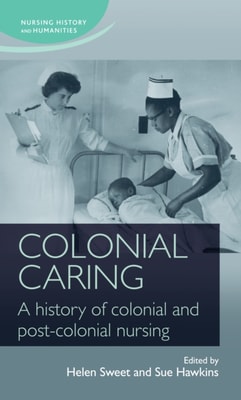
From the height of colonialism in the mid-nineteenth century, through to the aftermath of the Second World War, nurses have been at the heart of colonial projects.
Mobility was central to imperialism, from the human movements entailed in exploration, travel and migration to the information, communications and commodity flows vital to trade, science, governance and military power.
Mobility was central to imperialism, from the human movements entailed in exploration, travel and migration to the information, communications and commodity flows vital to trade, science, governance and military power.
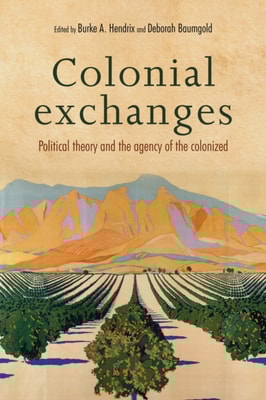
Recent scholarship in political thought has closely examined the relationship between European political ideas and colonialism, particularly the ways in which canonical thinkers supported or opposed colonial practices.
Photographic subjects examines photography at royal celebrations during the reign of Queens Wilhelmina (1898-1948) and Juliana (1948-80), a period spanning the zenith and fall of Dutch rule in Indonesia.
Photographic subjects examines photography at royal celebrations during the reign of Queens Wilhelmina (1898-1948) and Juliana (1948-80), a period spanning the zenith and fall of Dutch rule in Indonesia.
The debate about the Empire dealt in idealism and morality, and both sides employed the language of feeling, and frequently argued their case in dramatic terms.
In einer Zeit der großen Umbrüche und Herausforderungen erhob sich Haile Selassie, der letzte Löwe von Juda, als eine der bedeutendsten Persönlichkeiten des 20.
From the Victorian period to the present, images of the policeman have played a prominent role in the literature of empire, shaping popular perceptions of colonial policing.
As imperial political authority was increasingly challenged, sometimes with violence, locally recruited police forces became the front-line guardians of alien law and order.
In recent years it has become apparent that the interaction of imperialism with disease, medical research, and the administration of health policies is considerably more complex.
This book is about the processes and practices through which two differently positioned elites, among the colonisers and the colonised, were constituted respectively as the 'manly Englishman' and the 'effeminate Bengali'.
Many European countries, their imperial territories, and rapidly Europeanising imitators like Japan, established a powerful zone of intellectual, ideological and moral convergence in the projection of state power and collective objectives to children.
The notion that the British Empire was in any way an 'Irish Empire' is not one that will cut very much ice on the contemporary island of Ireland, north or south.
Air policing was used in many colonial possessions, but its most effective incidence occurred in the crescent of territory from north-eastern Africa, through South-West Arabia, to North West Frontier of India.
Professor Drummond's two pioneering studies, British Economic Policy and the Empire 1919-1939, 1972, and Imperial Economic Policy 1917-1939, 1974, helped to revive interest in Empire migration and other aspects of inter-war imperial economic history.
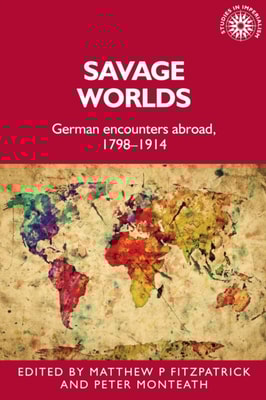
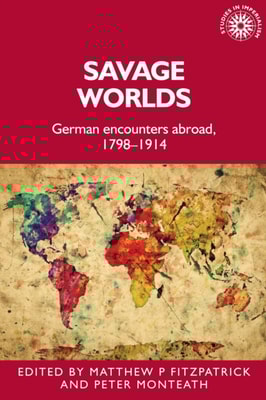
With an eye to recovering the experiences of those in frontier zones of contact, Savage Worlds maps a wide range of different encounters between Germans and non-European indigenous peoples in the age of high imperialism.
With an eye to recovering the experiences of those in frontier zones of contact, Savage Worlds maps a wide range of different encounters between Germans and non-European indigenous peoples in the age of high imperialism.
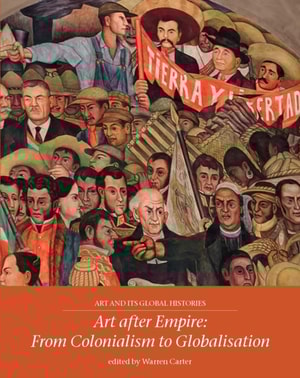
This book explores the relationship between art and visual culture in Europe and the 'wider world' from the early twentieth century to the contemporary era of globalisation.
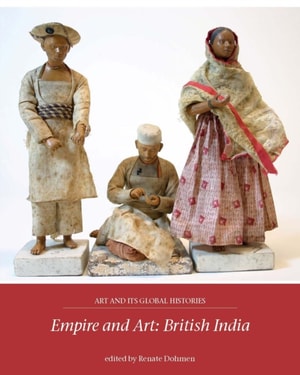
The book examines the aesthetic interactions between Britain and India during the Raj in relation to issues of empire and considers the visual culture of urban elites and princely states alongside popular arts.
Art, Commerce and Colonialism 1600-1800 examines European art, architecture and design of the seventeenth and eighteenth centuries in the light of the continent's growing engagement with the rest of the world.
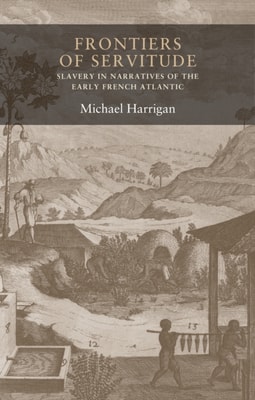
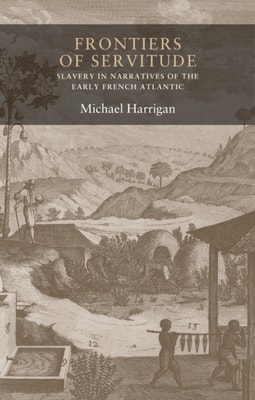
Frontiers of servitude explores the fundamental ideas behind early French thinking about Atlantic slavery in little-examined printed and archival sources, focusing on what 'made' a slave, what was unique about Caribbean labour, and what strategic approaches meant in interacting with slaves.
Frontiers of servitude explores the fundamental ideas behind early French thinking about Atlantic slavery in little-examined printed and archival sources, focusing on what 'made' a slave, what was unique about Caribbean labour, and what strategic approaches meant in interacting with slaves.
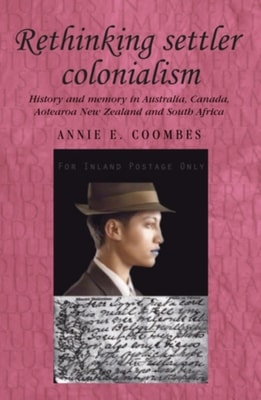
Rethinking settler colonialism focuses on the long history of contact between indigenous peoples and the white colonial communities who settled in Australia, Aotearoa New Zealand, Canada and South Africa.
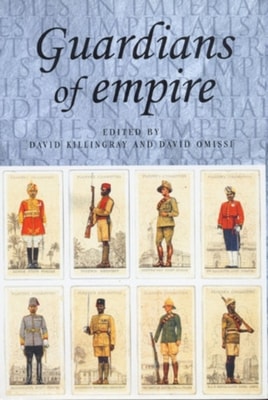
For imperialists, the concept of guardian is specifically to the armed forces that kept watch on the frontiers and in the heartlands of imperial territories.
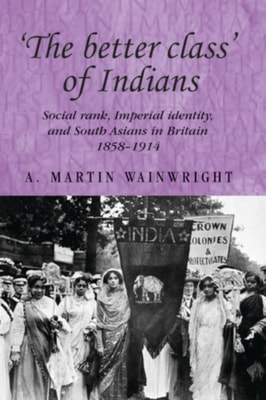
This is the first book-length study to focus primarily on the role of class in the encounter between South Asians and British institutions in the United Kingdom at the height of British imperialism.
Building on earlier work, this text combines theoretical perspectives with empirical work, to provide a comparative analysis of the electoral systems, party systems and governmental systems in the ethnic republics and regions of Russia.
The rule of law, an ideology of equality and universality that justified Britain's eighteenth-century imperial claims, was the product not of abstract principles but imperial contact.
The rule of law, an ideology of equality and universality that justified Britain's eighteenth-century imperial claims, was the product not of abstract principles but imperial contact.
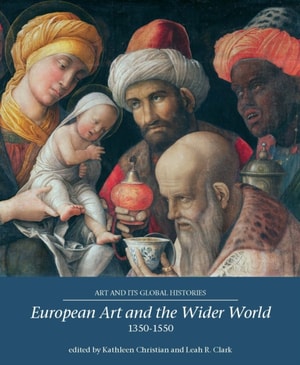
The reader Art and its global histories represents an invaluable teaching tool, offering content ranging from academic essays and excerpts, new translations, interviews with curators and artists, to art criticism.
This collection, dealing with case studies drawn from South Africa, Zimbabwe, Mozambique and Mauritius, examines the relationship between scientific claims and practices, and the exercise of colonial power.