This book builds on the idea that pragmatics and philosophy are strictly interconnected and that advances in one area will generate consequential advantages in the other area.
This book applies phenomenological methodology to examine the transformations of messages as they pass from the mind to the linear world of human speech, and then back again.
This engaging book examines the origins and first effects of the concept 'legal semiotics', focusing on the inventor of the term, Roberta Kevelson (1931-1998).
Truth is a pervasive feature of ordinary language, deserving of systematic study, and few theorists of truth have endeavoured to chronicle the tousled conceptual terrain forming the non-philosopher's ordinary view.
This book systematically investigates what follows about meaning in language if current views on the limited, or even redundant, role of linguistic semantics are taken to their radical conclusion.
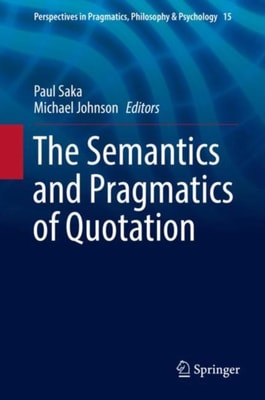
The chapters in this volume address a variety of issues surrounding quotation, such as whether it is a pragmatic or semantic phenomenon, what varieties of quotation exist, and what speech acts are involved in quoting.
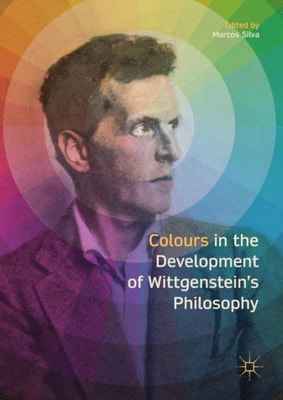
This volume sheds a new light on Philosophical Investigations, Ludwig Wittgenstein's master opus, by taking a new approach to its first stretch (sections 1-88), with special emphasis on its atypical opening.
This book argues against the mainstream view that we should treat propositional attitudes as internal states, suggesting that to treat beliefs as things of certain sort (i.
This volume brings together a wide array of papers which explore, among other things, to what extent languages and cultures are variable with respect to the interactions around the event of death.
This book develops a novel generalization of possible world semantics, called 'world line semantics', which recognizes worlds and links between world-bound objects (world lines) as mutually independent aspects of modal semantics.
This book proposes a radically evolutionary approach to biolinguistics that consists in considering human language as a form of species-specific intelligence entirely embodied in the corporeal structures of Homo sapiens.
This volume features essays about and by Paul Benacerraf, whose ideas have circulated in the philosophical community since the early nineteen sixties, shaping key areas in the philosophy of mathematics, the philosophy of language, the philosophy of logic, and epistemology.
This volume is the second part of a project which hosts an interdisciplinary discussion about the relationship among law and language, legal practice and ordinary conversation, legal philosophy and the linguistics sciences.
This work presents the structure, distribution and semantic interpretation of quantificational expressions in languages from diverse language families and typological profiles.
This volume offers recent developments in pragmatics and adjacent territories of investigation, including important new concepts such as the pragmatic act and the pragmeme, and combines developments in neighboring disciplines in an integrative holistic pragmatic approach.
This book explores the intersections between dreaming and the literary imagination, in light of the findings of recent neurocognitive and empirical research, with the aim to lay a groundwork for an empirically informed aesthetics of dreaming.
"e;According to the words of Phaedrus in the Symposium of Plato, Love, sometimes named Eros, has no parents, no age, no history, and its origin remains unknown to anyone.
This book examines linguistic expressions of emotion in intensional contexts and offers a formally elegant account of the relationship between language and emotion.
This book explores the construction of agreement in the argumentative process, aiming to investigate how the activation of shared knowledge, values and beliefs leads to the creation of a common ground between the speaker and the audience in the pursuit of persuasion.
This volume provides the reader with exclusive insights into Ernest Sosa's latest ideas as well as main aspects of his philosophical work of the last 50 years.
This book explores new territory at the interface between semantics and pragmatics, reassessing a number of linguistic phenomena in the light of recent advances in pragmatic theory.
This book introduces Meaningful Purposive Interaction Analysis (MPIA) theory, which combines social network analysis (SNA) with latent semantic analysis (LSA) to help create and analyse a meaningful learning landscape from the digital traces left by a learning community in the co-construction of knowledge.