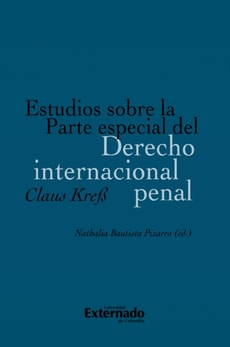
Esta obra compila seis aportes a la Parte especial del Derecho internacional penal escritos por el profesor Claus Kreß (Universidad de Colonia, Alemania) entre los años 2001 y 2018.
Este libro es un resultado de investigación sobre dos conceptos de enorme importancia para la educación jurídica en Iberoamérica: la educación legal clínica como modelo pedagógico en construcción y el litigio estratégico como herramienta de incidencia social y política.
Una obra jurídica novedosa por la actualidad del tema, la creciente influencia de la CPI y la escasa atención académica en idioma español sobre un proceso de criminalización que data de 1919 y que alcanzó su punto culminante en el 2010, durante la primera conferencia de revisión del Estatuto de Roma.
Este libro presenta las notas que han reunido y organizado los profesores Julio González Zapata y Julián Andrés Muñoz Tejada pensando en los estudiantes de la Facultad de Derecho y Ciencias Políticas de la Universidad de Antioquia.
This book brings together leading and emerging scholars and practitioners to present an overview of how regional, international and transnational courts and tribunals are engaging with the environment.
This volume of the Yearbook of International Humanitarian Law takes a close look at the role of so-called "e;expert manuals"e; in the interpretation and development of the international law of armed conflict and connected branches of international law relating to military operations.
This timely book comprehensively examines whether the worst human rights violations directed specifically at sexual and gender minorities are punishable under international criminal law, as codified in the Rome Statute of the International Criminal Court.
This book presents a selection of revised and updated papers presented in September 2018 at the International Conference 'Rethinking the Crime of Aggression: International and Interdisciplinary Perspectives', which was held in Marburg, Germany, and hosted by the International Research and Documentation Centre for War Crimes Trials (ICWC).
This book puts forward proposals for solutions to the current gaps between the Mexican legal order and the norms and principles of international criminal law.
This book deals with the phenomenon of conflict-related reproductive violence and explores the international legal framework's capacity to respond to it.
This book situates Ghana's truth-telling process, which took place from 2002 to 2004, within the discourse on the effectiveness of the different mechanisms used by post-conflict and post-dictatorship societies to address gross human rights violations.
This book challenges the traditional approach to international law by concentrating on international hThis book challenges the traditional approach to international law by concentrating on international humanitarian law and placing the focus beyond States: it reflects on current legal, policy and practical issues that concern non-State actors in and around situations of armed conflict.
This book deals with the prosecution of core crimes and constitutes the first comprehensive analysis of the horizontal and vertical systems of enforcement of international criminal law and of their inter-relationship.
This book argues for a more moderate approach to history-writing in international criminal adjudication by articulating the elements of a "e;responsible history"e; normative framework.
This book is a tribute to the work of Professor Terry Gill, offered to him by friends and colleagues who are also academics and/or practitioners in the field of International Law of Military Operations (ILMO).
In this book, it is explained that despite a current drop in the number of deaths, terrorism should still be considered a serious and widespread problem.
This book aims to investigate whether, and if so, how, an institution designed to bring to justice perpetrators of the most heinous crimes can be regarded a tool of oppression in a (neo-)colonial sense.
This book is a guide to the law and practice of victims' roles before the International Criminal Court, the Extraordinary Chambers in the Courts of Cambodia and the Special Tribunal for Lebanon.
This book seeks to understand how and why we should hold leaders responsible for the collective mass atrocities that are committed in times of conflict.
This book offers the first comprehensive and in-depth analysis of the provisions of the 'Malabo Protocol'-the amendment protocol to the Statute of the African Court of Justice and Human and Peoples' Rights-adopted by the African Union at its 2014 Summit in Malabo, Equatorial Guinea.
In the aftermath of recent multiple leaks such as the Panama Papers, the Swiss leaks, the Lux leaks, and the Bahama leaks, this book offers an interesting view on the underlying conflicting interests that impede the adoption of more effective legislation to stop money laundering by way of the financial system.
This book brings into focus the legal status of armed forced on foreign territory within, inter alia, the context of multi-national exercises and a variety of so-called crisis management operations.
The doctrine of universal jurisdiction has evolved throughout modern times in the context of global criminal justice as a paramount agent of combating impunity emanating from international criminality.
This book seeks to bridge the gap between academic, political and military thinking concerning the success and failure of peacekeeping operations and their termination.
The Convention on the Prohibition of the Development, Production, Stockpiling and Use of Chemical Weapons and on Their Destruction (CWC), which entered into force on 29 April 1997, bans an entire category of weapons of mass destruction.