The Convention on the Prohibition of the Development, Production, Stockpiling and Use of Chemical Weapons and on Their Destruction (CWC), which entered into force on 29 April 1997, bans an entire category of weapons of mass destruction.
Since the historic Nuremberg Trial of 1945 an international customary law principle has developed that commission of a core crime under international law - war crimes, genocide, crimes against humanity and aggression - should not go unpunished.
This volume contains several articles on the topic 'Detention in non-international armed conflict', including the Copenhagen Process, and moreover features contributions on autonomous weapons systems, Apartheid and the second Turkel Report.
The general theme of this volume of the Yearbook of International Humanitarian Lawis armed groups and the challenges arising from the participation of such groups incontemporary armed conflicts.
This book provides an in-depth examination of the judicial response at the internationalcriminal tribunals (ICTs) to the violation of procedural standards in thepre-trial phase of proceedings.
This book is an attempt to approach the issue of defining international terrorism, proposing that the most workable way to do so is to achieve due balance between the two principal driving forces of international law developments: State sovereignty interests and cosmopolitan ideals.
Written by a team of international lawyers from Europe, Asia, Africa, and the Caribbean,this book analyses some of the most significant aspects of the ongoing armed conflictbetween the Russian Federation and Ukraine.
This book examines the position of 'contextual elements' as a constitutive element of the legal definition of the crime of genocide, and determines the extent to which an individual genocidaire is required to act within a particular genocidal context.
This book examines the criminalisation of denials of genocide and of other mass atrocities in Europe and discusses the implications of protecting institutional historical memory through criminal law.
Combining both legal and empirical research, this book explores the statutory aspects and practice of Gacaca Courts (inkiko gacaca), the centrepiece of Rwanda's post-genocide transitional justice system, assessing their contribution to truth, justice and reconciliation.
This book investigates the road map or the transitional justice mechanisms that theEthiopian government chose to confront the gross human rights violations perpetratedunder the 17 years' rule of the Derg, the dictatorial regime that controlled state powerfrom 1974 to 1991.
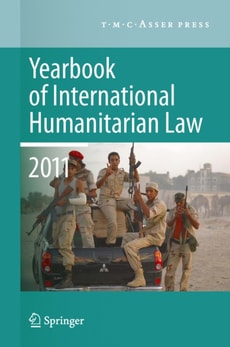
The main theme of this volume of the Yearbook of International Humanitarian Lawis the development and interpretation of international humanitarian law (IHL).
The chapters in this book are reworkings of presentations given during a conference held in 2018 at the German Embassy to the Netherlands in The Hague on the occasion of the 20th anniversary of the adoption of the Rome Statute.
This book examines the way international criminal courts and tribunals have interpreted the crimes against humanity proscription of other inhumane acts.
This book makes a significant contribution to the comprehension of the law and practice of provisional measures issued by international courts and tribunals, including international commercial arbitration.
This book brings a new focus to the ongoing debate on holding perpetrators of massive humanitarian and human rights violations accountable in countries in transition.
This book centres on Webcam Child Sex Tourism and the Sweetie Project initiated by the children's rights organization Terre des Hommes in 2013 in response to the exponential increase of online child abuse.
This book deals with the possible investigation and prosecution by the International Criminal Court (ICC) of crimes allegedly committed in the Israeli-Palestinian conflict.
This book deals with the problem of human trafficking in Tanzania in the light of international law and considers human trafficking as both a criminal offence in Tanzania and a human rights violation within international law in general.
This book deals with the problem of human trafficking in Tanzania in the light of international law and considers human trafficking as both a criminal offence in Tanzania and a human rights violation within international law in general.
This book examines the criminalisation of denials of genocide and of other mass atrocities in Europe and discusses the implications of protecting institutional historical memory through criminal law.
The main theme of this volume of the Yearbook of International Humanitarian Lawis the development and interpretation of international humanitarian law (IHL).
This book puts forward proposals for solutions to the current gaps between the Mexican legal order and the norms and principles of international criminal law.
This book examines the position of 'contextual elements' as a constitutive element of the legal definition of the crime of genocide, and determines the extent to which an individual genocidaire is required to act within a particular genocidal context.
This book argues for a more moderate approach to history-writing in international criminal adjudication by articulating the elements of a "e;responsible history"e; normative framework.
The chapters in this book are reworkings of presentations given during a conference held in 2018 at the German Embassy to the Netherlands in The Hague on the occasion of the 20th anniversary of the adoption of the Rome Statute.
Written by a team of international lawyers from Europe, Asia, Africa, and the Caribbean,this book analyses some of the most significant aspects of the ongoing armed conflictbetween the Russian Federation and Ukraine.
This book situates Ghana's truth-telling process, which took place from 2002 to 2004, within the discourse on the effectiveness of the different mechanisms used by post-conflict and post-dictatorship societies to address gross human rights violations.
This book brings a new focus to the ongoing debate on holding perpetrators of massive humanitarian and human rights violations accountable in countries in transition.
In the aftermath of recent multiple leaks such as the Panama Papers, the Swiss leaks, the Lux leaks, and the Bahama leaks, this book offers an interesting view on the underlying conflicting interests that impede the adoption of more effective legislation to stop money laundering by way of the financial system.
This book presents a selection of revised and updated papers presented in September 2018 at the International Conference 'Rethinking the Crime of Aggression: International and Interdisciplinary Perspectives', which was held in Marburg, Germany, and hosted by the International Research and Documentation Centre for War Crimes Trials (ICWC).
Since after the Second World War, the crime of aggression is - along with genocide, crimes against humanity and war crimes - a "e;core crime"e; under international law.
'Child Soldiers and the Lubanga Case' and 'The Tallinn Manual on the International Law Applicable to Cyber Warfare' are the two central themes of this volume.
The practice of using children to participate in conflict has become a defining characteristic of 21st century warfare and is the most recent addition to the canon of international war crimes.
Little has been written about the legal position and conditions of detention of persons detained by international criminal tribunals, particularly as regards their internal legal position (their rights and duties inside the remand facility).
When a perpetrator of an international crime argues in his defence that he did not realise that he had violated the law, is this a reason not to punish him?
The book assesses the adoption of counterterrorism measures in the Netherlands and the United States, which facilitate criminal investigations with a preventive focus (anticipative criminal investigations), from the perspective of rule of law principles.
Social Justice, Social Discrimination, and Mental Health explores the theory and background of social justice in the context of mental health of individuals, cultures, and communities.