This volume provides an overview of selected major areas of legal and institutional development in Lithuania since the Restoration of Independence in 1990.
Bringing together scholars from a broad range of theoretical perspectives, The Language of Argumentation offers a unique overview of research at the crossroads of linguistics and theories of argumentation.
This book considers the efficacy of the common regulatory model of the licensing regime as a means of regulating animal use in England, with a particular focus on wild animals and the regime's ability to ensure animal welfare needs are met.
Presenting diverse contributors from legal, academic, and practitioner sectors, this book illustrates how the distinctions between international and domestic law are falling away in the context of security, particularly in the responses to terrorism, and explores the implications of these dramatic shifts in the normative order.
This book discusses in what sense constitutional law has a political dimension, raising the question whether constitutional law is fundamentally political as to its validity, terms of its origin, conceptual structure and/or corresponding practice.
This book investigates the legal evolution of the "e;free soil principle"e; in England, France and the Low Countries during the Early Modern period (ca.
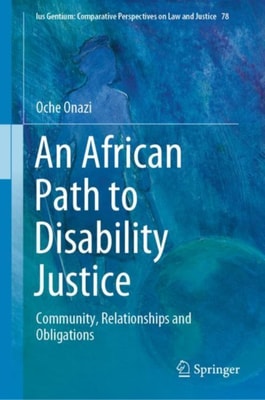
How should disability justice be conceptualised, not by orthodox human rights or capabilities approaches, but by a legal philosophy that mirrors an African relational community ideal?
This book offers a comprehensive examination of the ways in which the criminal justice system of England and Wales has regulated, and failed or refused to regulate, lesbianism.
The book defines and critically discusses the following five principles: the harm principle, legal paternalism, the offense principle, legal moralism and the dignity principle of criminalization.
This book represents a unique resource about Stewart Macaulay one of the common law world's leading scholars of the law of contract and of the law in action approach to the study of law.
In this book the author argues that judicial activism in respect of the protection of human rights and dignity and the right to due process is an essential element of the democratic rule of law in a constitutional democracy as opposed to being 'judicial overreach'.
On behalf of Professor Hugh Brady, Director and Senior Fellow, The Flag Research Center at the University of Texas School of Law, "e;Flags, Color, and the Legal Narrative: Public Memory, Identity, and Critique (Springer 2021) has been selected as the recipient of our Gherardi Davis Prize is presented for a significant contribution to vexillological research for the year 2021.
Looking at discrimination, education, environment, health and crime, this volume analyses United States Supreme Court rulings on several legal issues and proposed libertarian solutions to each problem.
This volume showcases emerging interdisciplinary scholarship that captures the complex ways in which biological knowledge is testing the nature and structure of legal personhood.
This book contends that, with regard to the likelihood of confusion standard, European trademark law applies the average consumer incoherently and inconsistently.
A theme of growing importance in both the law and philosophy and socio-legal literature is how regulatory dynamics can be identified (that is, conceptualised and operationalised) and normative expectations met in an age when transnational actors operate on a global plane and in increasingly fragmented and transformative contexts.
This book explores the cultures of philosophy and the law as they interact with neuroscience and biology, through the perspective of American jurist Oliver Wendell Holmes' Jr.
Any contemporary state presents itself as committed to the "e;rule of law"e;, and this notion is perhaps the most powerful political ideal within the current global discourse on legal and political institutions.
This monograph proposes a new (dialogical) way of studying the different forms of correlational inference, known in the Islamic jurisprudence as qiyas.
This book puts forward a new theoretical concept of the juridical act, this concept is not described from the perspective of a specific national legal system, but instead represents the commonalities and ideas that stem from the Western legal tradition.
This book engages in an analytical and realistic enquiry into legal interpretation and a selection of related matters including legal gaps, judicial fictions, judicial precedent, legal defeasibility, and legislation.
This book centers on a relatively neglected theme in the scholarly literature on Hannah Arendt's political thought: her support for a new form of government in which citizen councils would replace contemporary representative democracy and allow citizens to participate directly in decision-making in the public sphere.