When news breaks that a convicted murderer, released from prison, has killed again, or that an innocent person has escaped the death chamber in light of new DNA evidence, arguments about capital punishment inevitably heat up.
When news breaks that a convicted murderer, released from prison, has killed again, or that an innocent person has escaped the death chamber in light of new DNA evidence, arguments about capital punishment inevitably heat up.
In the United States today criminal justice can vary from state to state, as various states alter the Modern Penal Code to suit their own local preferences and concerns.
At no time in history, and certainly in no other democratic society, have prisons been filled so quickly and to such capacity than in the United States.
The Grammar of Criminal Law is a 3-volume work that addresses the field of international and comparative criminal law, with its primary focus on the issues of international concern, ranging from genocide, to domestic efforts to combat terrorism, to torture, and to other international crimes.
Oscar, physically and sexually abusive, stabbed his partner and two stepdaughters to death, buried the bodies, and fled the state with his two younger children.
How did the United States, a nation known for protecting the "e;right to remain silent"e; become notorious for condoning and using controversial tactics like water boarding and extraordinary rendition to extract information?
The rules governing who will be punished and how much determine a society's success in two of its most fundamental functions: doing justice and protecting citizens from crime.
Prisoners' Self-Help Litigation Manual, in its much-anticipated fourth edition, is an indispensable guide for prisoners and prisoner advocates seeking to understand the rights guaranteed to prisoners by law and how to protect those rights.
People convicted of crimes are subject to a criminal sentence, but they also face a host of other restrictive legal measures: Some are denied access to jobs, housing, welfare, the vote, or other goods.
The terrorist attacks of 9/11 precipitated significant legal changes over the ensuing ten years, a "e;long decade"e; that saw both domestic and international legal systems evolve in reaction to the seemingly permanent threat of international terrorism.
The terrorist attacks of 9/11 precipitated significant legal changes over the ensuing ten years, a "e;long decade"e; that saw both domestic and international legal systems evolve in reaction to the seemingly permanent threat of international terrorism.
Habeas Corpus in Wartime unearths and presents a comprehensive account of the legal and political history of habeas corpus in wartime in the Anglo-American legal tradition.
In a criminal procedure class, students are asked to determine whether a citizen's constitutional rights were violated, and this question is consistently posed under a myriad of factual circumstances.
In a criminal procedure class, students are asked to determine whether a citizen's constitutional rights were violated, and this question is consistently posed under a myriad of factual circumstances.
This scholarly legal work focuses on the dilemma of prosecuting gender-based crimes under the statutes of the international criminal tribunals with reference to the principle of fair labelling.
After the 9/11 terrorist attacks, the United States and the United Kingdom detained suspected terrorists in a manner incompatible with the due process, fair trial, and equality requirements of the Rule of Law.
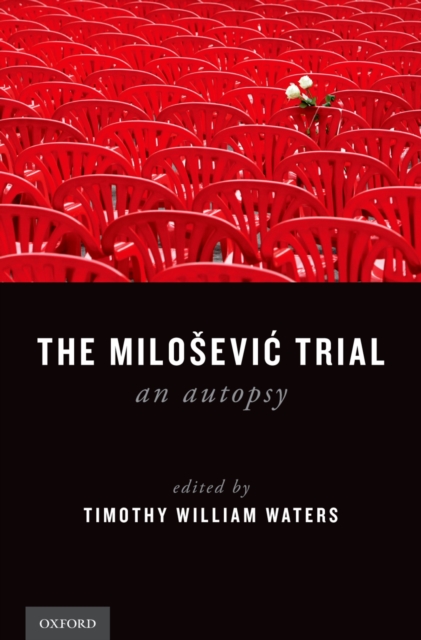
The Milosevic Trial - An Autopsy provides a cross-disciplinary examination of one of the most controversial war crimes trials of the modern era and its contested legacy for the growing fields of international criminal law and post-conflict justice.
Although the issue of offender decision-making pervades almost every discussion of crime and law enforcement, only a few comprehensive texts cover and integrate information about the role of decision-making in crime.
Confronting the Death Penalty: How Language Influences Jurors in Capital Cases probes how jurors make the ultimate decision about whether another human being should live or die.
The Milosevic Trial - An Autopsy provides a cross-disciplinary examination of one of the most controversial war crimes trials of the modern era and its contested legacy for the growing fields of international criminal law and post-conflict justice.
This is a practical guide for both beginning and established linguists who have been asked by lawyers to address the language issues in their civil and criminal cases.
Across America today gated communities sprawl out from urban centers, employers enforce mandatory drug testing, and schools screen students with metal detectors.