A book which offers fresh perspectives on the scientific developments of the past hundred years through the complementary work of two of the century's greatest thinkers, Einstein and Freud.
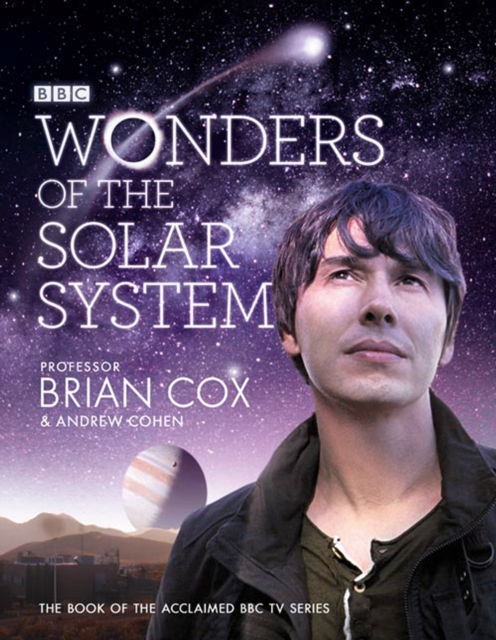
The Sunday Times BestsellerIn Wonders of the Solar System - the book of the acclaimed BBC TV series - Professor Brian Cox will take us on a journey of discovery where alien worlds from your imagination become places we can see, feel and visit.
The bestselling author of Fermat's Last Theorem and The Code Book tells the story of the brilliant minds that deciphered the mysteries of the Big Bang.
J P McEvoy looks at remarkable phenomenon of a solar eclipse through a thrilling narrative that charts the historical, cultural and scientific relevance of solar eclipses through the ages and explores the significance of this rare event.
110 times wider than Earth; 15 million degrees at its core; an atmosphere so huge that Earth is actually within it: come and meet the star of our solar systemLight takes eight minutes to reach Earth from the surface of the Sun.
The Ballet of the Planets unravels the beautiful mystery of planetary motion, revealing how our understanding of astronomy evolved from Archimedes and Ptolemy to Copernicus, Kepler, and Newton.
The discovery of life on other planets would be perhaps the most momentous revelation in human history, more disorienting and more profound than either the Copernican or Darwinian revolutions, which knocked the earth from the center of the universe and humankind from its position of lofty self-regard.
The Great Silence explores the multifaceted problem named after the great Italian physicist Enrico Fermi and his legendary 1950 lunchtime question "e;Where is everybody?
The Great Silence explores the multifaceted problem named after the great Italian physicist Enrico Fermi and his legendary 1950 lunchtime question "e;Where is everybody?
Working physicists, and especially astrophysicists, value a good `back-of-the-envelope' calculation, meaning a short, elegant computation or argument that starts from general principles and leads to an interesting result.
This textbook on the nature of space and time explains the new theory of Space Dynamics, which describes the dynamics of gravity as the evolution of conformal 3-dimensional geometry.
Fred Hoyle was one of the most widely acclaimed and colourful scientists of the twentieth century, a down-to-earth Yorkshireman who combined a brilliant scientific mind with a relish for communication and controversy.
This book provides an extensive survey of all the physics necessary to understand the current developments in the field of fundamental cosmology, as well as an overview of the observational data and methods.
Relativistic cosmology has in recent years become one of the most active and exciting branches of research, often considered to be today where particle physics was forty years ago, with major discoveries just waiting to happen.
"e;Kinetic Theory of Granular Gases"e; provides an introduction to the rapidly developing theory of dissipative gas dynamics - a theory which has mainly evolved over the last decade.
This book is a history of the development of mathematical astronomy in China, from the late third century BCE, to the early 3rd century CE - a period often referred to as 'early imperial China'.
Basic Physics of Nanoscience: Traditional Approaches and New Aspects at the Ultimate Level deals with the description of properties at the Nano level and self-organizing quantum processes of Nano systems.
The Foundations of Celestial Reckoning gives the reader direct access to the foundational documents of the tradition of calculation created by astronomers of the early Chinese empire between the late second century BCE and the third century CE.