Living in biofilms is the common way of life of microorganisms, transiently immobilized in their matrix of extracellular polymeric substances (EPS), interacting in many ways and using the matrix as an external digestion and protection system.
The rapid population growth and the increase in the per capita income, especially in the group of emerging countries referred to as BRIC countries (Brazil, Russia, India, China and South Africa) has created huge pressure for the expansion of the agricultural growing area and the crop yields to meet the rising demand.
Dieses umfassende Lehrbuch wendet sich an Studenten, Fachleute und Wissenschaftler und liegt somit im Niveau deutlich über den üblichen Sachbüchern zur Bionik.
Endothelial cell biology has developed into a vibrant discipline and has become a critical instrument to study several disease processes on the cellular and molecular level.
Following an introduction to biogenic metal nanoparticles, this book presents how they can be biosynthesized using bacteria, fungi and yeast, as well as their potential applications in biomedicine.
Die Systembiologie untersucht, wie die Komponenten einer Zelle oder eines Organismus Interaktionsnetzwerke bilden und wie diese Netzwerke die Funktionen der Zelle hervorrufen, die dem beobachtbaren Erscheinungsbild - dem Phänotyp - entsprechen.
Coordination in Human and Primate Groups presents one of the first collections of the different approaches and methods used to assess coordination processes in groups.
A multi-authored work on the basic biology of Asian honeybees, written by expert specialists in the field, this book highlights phylogeny, classification, mitochondrial and nuclear DNA, biogeography, genetics, physiology, pheromones, nesting, self-assembly processes, swarming, migration and absconding, reproduction, ecology, foraging and flight, dance languages, pollination, diseases/pests, colony defensiveness and natural enemies, honeybee mites, and interspecific interactions.
This set of six volumes provides a systematic and standardized description of 23,033 chemical components isolated from 6,926 medicinal plants, collected from 5,535 books/articles published in Chinese and international journals.
This set of six volumes provides a systematic and standardized description of 23,033 chemical components isolated from 6,926 medicinal plants, collected from 5,535 books/articles published in Chinese and international journals.
Heavy metal accumulation in soil and water from natural sources or anthropogenic activities have produced severe environmental contamination in some parts of the world due to the persistence of metals in the environment by their accumulation throughout the food chain.
In the last decade, fluorescence microscopy has evolved from a classical "e;retrospective"e; microscopy approach into an advanced imaging technique that allows the observation of cellular activities in living cells with increased resolution and dimensions.
The annual Evolutionary Biology Meetings in Marseille aim to bring together leading scientists, promoting an exchange of state-of-the-art knowledge and the formation of inter-group collaborations.
Plants are composed of 17 essential and at least 5 beneficial elements, and these must be taken up as metal or nutrient ions to allow for growth and cell division.
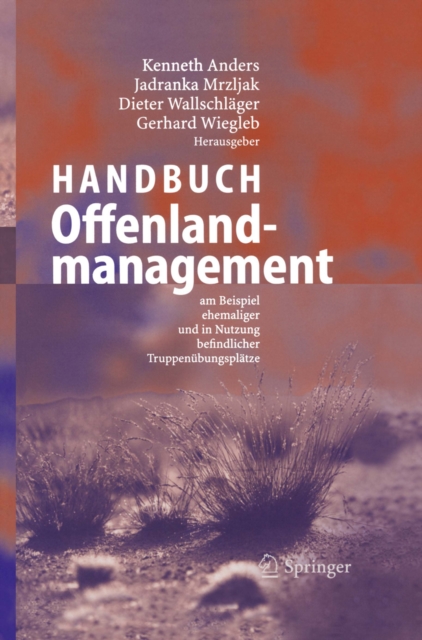
Das Handbuch Offenlandmanagement bietet Grundlagen und Konzepte, mit deren Hilfe wertvolle Offenlandschaften in der Kulturlandschaft Mitteleuropas erhalten, gestaltet und entwickelt werden können.