Physical Methods in Chemical Analysis, Volume IV focuses on the application of physical methods in chemical analysis, including dialysis, chromatography, electromagnetic separations, and thermal diffusion.
Physical Methods in Chemical Analysis, Volume III focuses on the application of physical methods in chemical analysis, including chromatography, spectroscopy, nuclear magnetic resonance, and photometry.
Principles of Polarography is a revised and extended version of an original Czech edition that appeared in 1962 at the Publishing House of the Czechoslovak Academy of Sciences in Prague.
Trace Analysis, Volume 4 presents critical discussions of selected topics in organic and inorganic analytical chemistry including instrumentation, techniques, and applications to the detection, identification, and quantitation of trace quantities of substances in a large variety of sample materials.
Trace Analysis, Volume 3 focuses on critical discussions of selected topics in organic and inorganic analytical chemistry including instrumentation, techniques, and applications to the detection, identification, and quantitation of trace quantities of substances in a large variety of sample materials.
Trace Analysis, Volume 2 is devoted to critical discussions of selected topics in organic and inorganic analytical chemistry including instrumentation, techniques, and applications to the detection, identification, and quantitation of trace quantities of substances in a large variety of sample materials.
High-Performance Liquid Chromatography: Advances and Perspectives, Volume 1 deals with the fundamental aspects of high-performance liquid chromatography, a technique used in chemical analysis.
High-Performance Liquid Chromatography: Advances and Perspectives, Volume 4 is an authoritative publication that deals with the fundamentals, instrumentation, and applications of high-performance liquid chromatography.
High-Performance Liquid Chromatography: Advances and Perspectives, Volume 5 presents the applications of high-performance liquid chromatography to the analysis and purification of biopolymers.
High-Performance Liquid Chromatography: Advances and Perspectives, Volume 2 presents the fundamental aspects of high-performance liquid chromatography, laboratory technique for chemical analysis with a wide range of applications.
Gas Chromatography: Principles, Techniques, and Applications, Second Edition, is a general textbook on gas chromatography suitable for users of the technique and for research workers.
Molecular Biology: An International Series of Monographs and Textbooks: Fluorescence Assay in Biology and Medicine, Volume II covers the many applications of fluorescence and phosphorescence.
Analytical Chemistry, Volume 24: The Analytical Chemistry of the Noble Metals describes the procedures for the separation, extraction, and analysis of noble metals.
Selected Constants: Oxydo-Reduction Potentials contains Tables of the most probable value of the normal oxidation-reduction potential, or of the formal or apparent potential, of a given oxidation-reduction system.
Advances in Polarography, Volume 2 covers the proceedings of the Second International Congress held at Cambridge in 1959 in honor of the 70th birthday of Professor Heyrovsky.
Advances in Polarography, Volume 1 is a collection of papers presented at the Second International Congress of Polarography held at Cambridge in 1959 in honor of the 70th birthday of Professor Heyrovsky.
Chromatography and Electrophoretic Techniques, Volume II: Zone Electrophoresis presents a number of methods, all based on zone electrophoresis, which has been carried out on commercially available apparatus offering many advantages to the majority of laboratories.
EDTA Titrations: An Introduction to Theory and Practice, Second Edition considers the theoretical background, full procedural details, and some practical applications of EDTA titrations.
Systematic Materials Analysis, Volume III presents brief discussions on a broad range of instrumental methods and approaches that will yield the desired information about a given material.
Analytical Pyrolysis: Techniques and Applications provides an overview of analytical pyrolysis applied to geochemistry, biology, polymers, and biomass.
Essays on Analytical Chemistry: In Memory of Professor Anders Ringbom is a collection of analytical chemistry papers and research studies in honor of the memory of Professor Anders Ringbom, a highly esteemed researcher and teacher.
The Application of Mathematical Statistics to Chemical Analysis presents the methods of mathematical statistics as applied to problems connected with chemical analysis.
Analytical Chemistry, Volume 38: Ion Exchange in Analytical Chemistry provides a broad survey of the important role that ion exchange can and should play in chemical analysis.
Analysis of the New Metals: Titanium, Zirconium, Hafnium, Niobium, Tantalum, Tungsten and their Alloys focuses on methods for the analysis of titanium, zirconium, hafnium, niobium, tantalum, tungsten, and their alloys.
An Approach to Chemical Analysis: Its Development and Practice provides an overview of the development of chemical analysis and its application in solving analytical problems in chemistry.
International Series of Monographs in Analytical Chemistry, Volume 22: Newer Redox Titrants focuses on the processes, reactions, methodologies, and approaches involved in the study of redox titrants.
Pergamon Texts in Inorganic Chemistry, Volume 14: The Chemistry of Germanium, Tin, and Lead focuses on the properties, characteristics, transformations, and reactions of lead, germanium, and tin.
Absorption Spectra and Chemical Bonding in Complexes focuses on chemical bonding in transition group complexes and molecules, including molecular orbitals, absorption bands, and energy levels.
Advances in Mass Spectrometry documents the proceedings of a Joint Conference on Mass Spectrometry held at the University of London, Great Britain on September 24-26, 1958.
Guide to Trivial Names, Trade Names and Synonyms for Substances Used in Analytical Nomenclature is a list of trivial names, trade names, and synonyms for substances used in analytical chemistry, from acetol and acetylacetone to bromoxine, choline, dithiol, and zincon.
Analytical Techniques in Environmental Chemistry 2 focuses on the establishment of analytical techniques in the management of compounds relative to their effects on health and nature.
Fluorescence and Phosphorescence Spectroscopy: Physicochemical Principles and Practice deals with the physicochemical principles and applications of fluorescence and phosphorescence spectroscopy in experimental biology and chemistry.
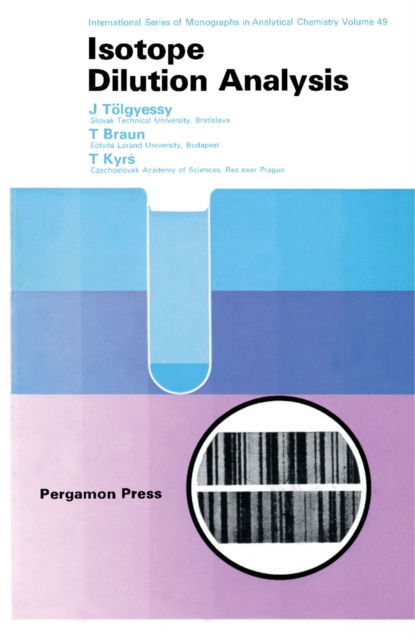
International Series of Monographs in Analytical Chemistry, Volume 49: Isotope Dilution Analysis focuses on the method of isotope dilution analysis (IDA).
Stationary Phases in Gas Chromatography is a four-chapter book that begins with a description of chromatographic column, including its retention parameters; mobile and stationary phases; optimization of its process; and types of column in gas chromatography.
Analytical Chemistry, Second Edition, Volume 6: Atomic-Absorption Spectrophotometry focuses on the use of atomic absorption spectrophotometry as an analytical technique.
Field Ionization Mass Spectrometry focuses on developments in field ionization (FI) mass spectrometry and describes its applications in physical chemistry, with emphasis on mass spectrometric problems.
Coulometry in Analytical Chemistry reviews significant developments concerning the applications of coulometry, particularly constant-current coulometry and constant-potential coulometry, to analytical chemistry.
Analytical Applications of EDTA and Related Compounds examines the analytical applications of ethylenediaminetetra-acetic acid (EDTA) and related compounds.
International Series of Monographs on Analytical Chemistry, Volume 13: Controlled-Potential Analysis provides information pertinent to controlled-potential analysis involving the measurement of the quantity of electricity passed in the course of electrolysis.
Thermometric Titrimetry covers the significant progress in the application of thermometric titrimetry to routine analysis and as a research tool in the investigations of the basic phenomena associated with chemical reactions.
Introductory Titrimetric and Gravimetric Analysis is an introductory course to the general principles of titrimetric and gravimetric analysis of chemical solutions and substances.
Oscillometry and Conductometry deals with oscillometry and conductometry and covers topics ranging from the conductivity and dielectric constant of a solution and their determination, to instruments used in carrying out conductometric and oscillometric measurements.