This richly illustrated textbook explores the amazing interaction between combinatorics, geometry, number theory, and analysis which arises in the interplay between polyhedra and lattices.
Completely revised and greatly expanded, the new edition of this text takes readers who have been exposed to only basic courses in analysis through the modern general theory of random processes and stochastic integrals as used by systems theorists, electronic engineers and, more recently, those working in quantitative and mathematical finance.
This book presents the authors' recent work on the numerical methods for the stability analysis of linear autonomous and periodic delay differential equations, which consist in applying pseudospectral techniques to discretize either the solution operator or the infinitesimal generator and in using the eigenvalues of the resulting matrices to approximate the exact spectra.
The implicit function theorem is one of the most important theorems in analysis and its many variants are basic tools in partial differential equations and numerical analysis.
With applications to climate, technology, and industry, the modeling and numerical simulation of turbulent flows are rich with history and modern relevance.
Employ essential tools and functions of the MATLAB and Simulink packages, which are explained and demonstrated via interactive examples and case studies.
Employ the essential and hands-on tools and functions of MATLAB's ordinary differential equation (ODE) and partial differential equation (PDE) packages, which are explained and demonstrated via interactive examples and case studies.
Employ essential and hands-on tools and functions of the MATLAB and Simulink packages, which are explained and demonstrated via interactive examples and case studies.
Numerical Methods, Software, and Analysis, Second Edition introduces science and engineering students to the methods, tools, and ideas of numerical computation.
Applied Nonlinear Analysis contains the proceedings of an International Conference on Applied Nonlinear Analysis, held at the University of Texas at Arlington, on April 20-22, 1978.
Computational Methods in Nonlinear Structural and Solid Mechanics covers the proceedings of the Symposium on Computational Methods in Nonlinear Structural and Solid Mechanics.
Since its original publication in 1969, Mathematics for Engineers and Scientists has built a solid foundation in mathematics for legions of undergraduate science and engineering students.
Early training in the elementary techniques of partial differential equations is invaluable to students in engineering and the sciences as well as mathematics.
Do big math on small machines Write fast and accurate library functions Master analytical and numerical calculus Perform numerical integration to any order Implement z-transform formulas Need to learn the ins and outs of the fundamental math functions in
Proceedings of Sino-US Joint Symposium/Workshop on Recent Developments and Future Trends of Computational Mechanics in Structural Engineering, Beijing, China, September 24-28 1991
A monotone iterative technique is used to obtain monotone approximate solutions that converge to the solution of nonlinear problems of partial differential equations of elliptic, parabolic and hyperbolic type.
Designed for use in a second course on linear algebra, Matrix Theory and Applications with MATLAB covers the basics of the subject-from a review of matrix algebra through vector spaces to matrix calculus and unitary similarity-in a presentation that stresses insight, understanding, and applications.
This book comprises papers that were presented at the Symposium on Configurational Mechanics, during the 5th EUROMECH Soil Mechanics Conference in Thessaloniki in August 2003.
This important new book sets forth a comprehensive description of various mathematical aspects of problems originating in numerical solution of hyperbolic systems of partial differential equations.
The aim of this book is to provide professional engineers and students of engineering with a sound working knowledge of the finite element method for engineering analysis and engineering design.
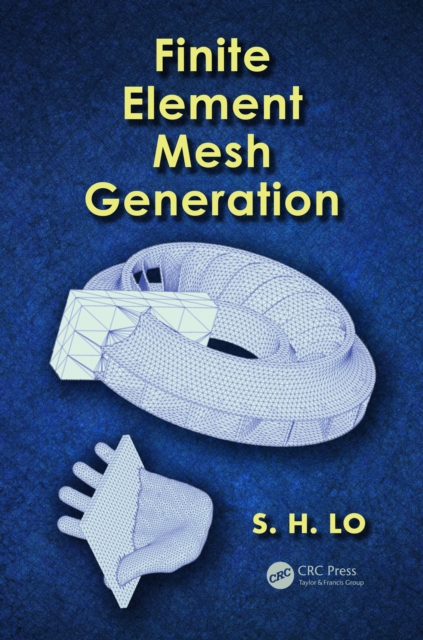
Highlights the Progression of Meshing Technologies and Their ApplicationsFinite Element Mesh Generation provides a concise and comprehensive guide to the application of finite element mesh generation over 2D domains, curved surfaces, and 3D space.