Mathematics is playing an ever more important role in the physical and biological sciences, provoking a blurring of boundaries between scientific disciplines and a resurgence of interest in the modern as well as the clas- sical techniques of applied mathematics.
This book was written as a comprehensive introduction to the theory of ordinary differential equations with a focus on mechanics and dynamical systems as time-honored and important applications of this theory.
In the past 15 to 20 years, the computer has become a popular tool for exploring the relationship between a measured response and factors thought to affect the response.
Many important problems in applied science and engineering, such as the Navier- Stokes equations in fluid dynamics, the primitive equations in global climate mod- eling, the strain-stress equations in mechanics, the neutron diffusion equations in nuclear engineering, and MRIICT medical simulations, involve complicated sys- tems of nonlinear partial differential equations.
Mathematics is playing an ever more important role in the physical and biological sciences, provoking a blurring of boundaries between scientific disciplines and a resurgence of interest in the modern as well as the classical techniques of applied mathematics.
In complementarity theory, which is a relatively new domain of applied mathematics, several kinds of mathematical models and problems related to the study of equilibrium are considered from the point of view of physics as well as economics.
Discrete-event simulation consists of a collection of techniques that when applied to a discrete-event dynamical system, generates sequences called sample paths that characterize its behavior.
Interest in constrained optimization originated with the simple linear pro- gramming model since it was practical and perhaps the only computationally tractable model at the time.
Probabilistic and percentile/quantile functions play an important role in several applications, such as finance (Value-at-Risk), nuclear safety, and the environment.
Mathematics is playing an ever more important role in the physical and biological sciences, provoking a blurring of boundaries between scientific disciplines and a resurgence of interest in the modem as weIlas the classical techniques of applied mathematics.
Since I started working in the area of nonlinear programming and, later on, variational inequality problems, I have frequently been surprised to find that many algorithms, however scattered in numerous journals, monographs and books, and described rather differently, are closely related to each other.
Though the volume covers 22 papers by 36 authors from 12 countries, the history in the background is bound to Hungary where, in 1973 Andras Pnkopa started to lay the foundation of a scientific forum, which can be a regular meeting spot for experts of the world in the field.
This book represents the first attempt at a unified picture for the pres- ence of the Gibbs (or Gibbs-Wilbraham) phenomenon in applications, its analysis and the different methods of filtering it out.
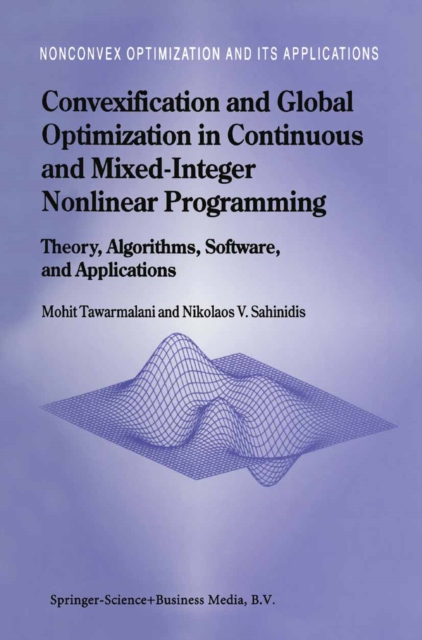
Due to the general complementary convex structure underlying most nonconvex optimization problems encountered in applications, convex analysis plays an essential role in the development of global optimization methods.
Targeted audience * Specialists in numerical computations, especially in numerical optimiza- tion, who are interested in designing algorithms with automatie result ver- ification, and who would therefore be interested in knowing how general their algorithms caIi in principle be.
In recent years global optimization has found applications in many interesting areas of science and technology including molecular biology, chemical equilibrium problems, medical imaging and networks.
Using meaningful examples, credible applications, and incisive technology, Vector Calculus strives to empower students, enhance their critical thinking skills, and equip them with the knowledge and skills to succeed in the major or discipline they ultimately choose to study.
This proceedings volume gathers selected, peer-reviewed papers presented at the Dynamical Systems Theory and Applications International Conference - DSTA 2021, held virtually on December 6-9, 2021, organized by the Department of Automation, Biomechanics, and Mechatronics at Lodz University of Technology, Poland.
This book covers a wide range of topics such as mathematical modeling, computational methods, simulation techniques in engineering, and their applications in environmental sciences.
~his Monograph has two objectives : to analyze a f inite e l e m en t m e th o d useful for solving a large class of t hi n shell prob l e ms, and to show in practice how to use this method to simulate an arch dam prob lem.
In many scientific or engineering applications, where ordinary differen- tial equation (OOE),partial differential equation (POE), or integral equation (IE) models are involved, numerical simulation is in common use for prediction, monitoring, or control purposes.
In this book, the new and rapidly expanding field of scientific computing is understood in a double sense: as computing for scientific and engineering problems and as the science of doing such computations.
In contemporary research, the supercomputer now ranks, along with radio telescopes, particle accelerators and the other apparatus of "e;big science"e;, as an expensive resource, which is nevertheless essential for state of the art research.
This book contains both a synthesis and mathematical analysis of a wide set of algorithms and theories whose aim is the automatic segmen- tation of digital images as well as the understanding of visual perception.
Effectively Construct Integral Formulations Suitable for Numerical ImplementationFinite Element and Boundary Methods in Structural Acoustics and Vibration provides a unique and in-depth presentation of the finite element method (FEM) and the boundary element method (BEM) in structural acoustics and vibrations.