From specialists in the field, you will learn about interesting connections and recent developments in the field of graph theory by looking in particular at Cartesian products-arguably the most important of the four standard graph products.
Written for graduate students in mathematics or non-specialist mathematicians who wish to learn the basics about some of the most important current research in the field, this book provides an intensive, yet accessible, introduction to the subject of algebraic combinatorics.
Bringing the material up to date to reflect modern applications, this second edition has been completely rewritten and reorganized to incorporate a new style, methodology, and presentation.
Helping current and future system designers take a more productive approach in the field, Communication System Security shows how to apply security principles to state-of-the-art communication systems.
Building on the author's previous book in the series, Complex Analysis with Applications to Flows and Fields (CRC Press, 2010), Transcendental Representations with Applications to Solids and Fluids focuses on four infinite representations: series expansions, series of fractions for meromorphic functions, infinite products for functions with infinit
Combinatorial Scientific Computing explores the latest research on creating algorithms and software tools to solve key combinatorial problems on large-scale high-performance computing architectures.
Cryptography, in particular public-key cryptography, has emerged in the last 20 years as an important discipline that is not only the subject of an enormous amount of research, but provides the foundation for information security in many applications.
Today, with physician and hospital reimbursement being cut and tied to quality incentives, physicians and health plans are revisiting the concept of integration.
Taking an approach to the subject that is suitable for a broad readership, Discrete Mathematics: Proofs, Structures, and Applications, Third Edition provides a rigorous yet accessible exposition of discrete mathematics, including the core mathematical foundation of computer science.
Unique in its approach, Models of Network Reliability: Analysis, Combinatorics, and Monte Carlo provides a brief introduction to Monte Carlo methods along with a concise exposition of reliability theory ideas.
Methods Used to Solve Discrete Math ProblemsInteresting examples highlight the interdisciplinary nature of this areaPearls of Discrete Mathematics presents methods for solving counting problems and other types of problems that involve discrete structures.
Parents and teachers can use this laminated 6-page guide with their kindergartener to hit specific learning requirements of The Common Core State Standards for Mathematics.
The reach of algebraic curves in cryptography goes far beyond elliptic curve or public key cryptography yet these other application areas have not been systematically covered in the literature.
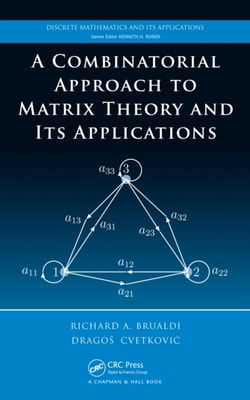
Unlike most elementary books on matrices, A Combinatorial Approach to Matrix Theory and Its Applications employs combinatorial and graph-theoretical tools to develop basic theorems of matrix theory, shedding new light on the subject by exploring the connections of these tools to matrices.
Exploring one of the most dynamic areas of mathematics, Advanced Number Theory with Applications covers a wide range of algebraic, analytic, combinatorial, cryptographic, and geometric aspects of number theory.
A One-Stop Source of Known Results, a Bibliography of Papers on the Subject, and Novel Research Directions Focusing on a very active area of research in the last decade, Combinatorics of Compositions and Words provides an introduction to the methods used in the combinatorics of pattern avoidance and pattern enumeration in compositions and words.
Like its bestselling predecessor, Elliptic Curves: Number Theory and Cryptography, Second Edition develops the theory of elliptic curves to provide a basis for both number theoretic and cryptographic applications.
The discrete mathematics and theoretical computer science communities have recently witnessed explosive growth in the area of algorithmic combinatorics on words.
An update of the most accessible introductory number theory text available, Fundamental Number Theory with Applications, Second Edition presents a mathematically rigorous yet easy-to-follow treatment of the fundamentals and applications of the subject.
Emphasizing the search for patterns within and between biological sequences, trees, and graphs, Combinatorial Pattern Matching Algorithms in Computational Biology Using Perl and R shows how combinatorial pattern matching algorithms can solve computational biology problems that arise in the analysis of genomic, transcriptomic, proteomic, metabolomic
The Handbook of Financial Cryptography and Security elucidates the theory and techniques of cryptography and illustrates how to establish and maintain security under the framework of financial cryptography.
Sums of Squares of Integers covers topics in combinatorial number theory as they relate to counting representations of integers as sums of a certain number of squares.
Sharkovsky's Theorem, Li and Yorke's "e;period three implies chaos"e; result, and the (3x+1) conjecture are beautiful and deep results that demonstrate the rich periodic character of first-order, nonlinear difference equations.
An effective blend of carefully explained theory and practical applications, this text imparts the fundamentals of both information theory and data compression.
Although much literature exists on the subject of RSA and public-key cryptography, until now there has been no single source that reveals recent developments in the area at an accessible level.
Understanding the causes and effects of explosions is important to experts in a broad range of disciplines, including the military, industrial and environmental research, aeronautic engineering, and applied mathematics.
From the Rosetta Stone to public-key cryptography, the art and science of cryptology has been used to unlock the vivid history of ancient cultures, to turn the tide of warfare, and to thwart potential hackers from attacking computer systems.
Continuing a bestselling tradition, An Introduction to Cryptography, Second Edition provides a solid foundation in cryptographic concepts that features all of the requisite background material on number theory and algorithmic complexity as well as a historical look at the field.