This volume records the proceedings of an international conference that explored recent developments and the interaction between mathematical theory and physical phenomena.
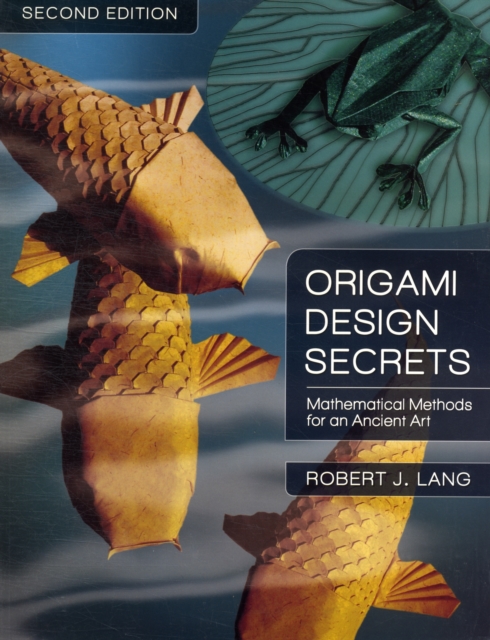
The magnum opus of one of the world's leading origami artists, the second edition of Origami Design Secrets reveals the underlying concepts of origami and how to create original origami designs.
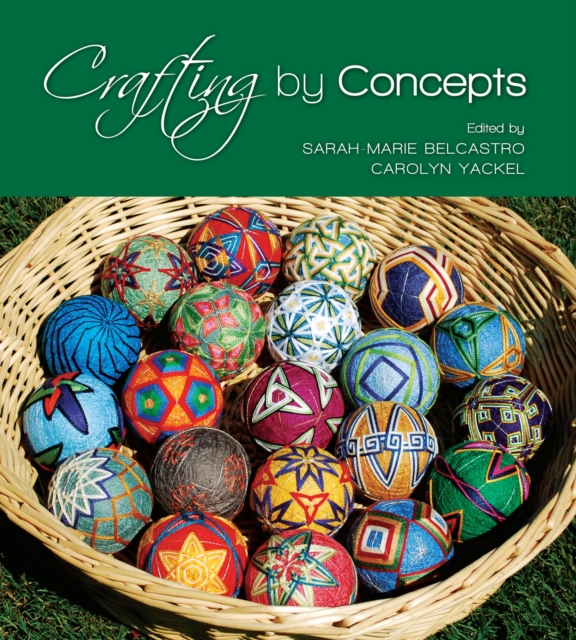
From the editors of the popular Making Mathematics with Needlework, this book presents projects that highlight the relationship between types of needlework and mathematics.
A dissection involves cutting a polygon into pieces in such a way that those pieces form another polygon; for a hinged dissection, the pieces must be attached by hinges.
Based on the lecture notes of a graduate course given at MIT, this sophisticated treatment leads to a variety of current research topics and will undoubtedly serve as a guide to further studies.
This book documents the results of a workshop held at the Geometry Center (University of Minnesota, Minneapolis) and captures the excitement of the week.
This book unravels the mystery of Geometry in Origami with a unique approach: 64 Polyhedra designs, each made from a single square sheet of paper, no cuts, no glue; each polyhedron the largest possible from the starting size of square and each having an ingenious locking mechanism to hold its shape.
Focusing on Sobolev inequalities and their applications to analysis on manifolds and Ricci flow, Sobolev Inequalities, Heat Kernels under Ricci Flow, and the Poincare Conjecture introduces the field of analysis on Riemann manifolds and uses the tools of Sobolev imbedding and heat kernel estimates to study Ricci flows, especially with surgeries.
Derived from the author's course on the subject, Elements of Differential Topology explores the vast and elegant theories in topology developed by Morse, Thom, Smale, Whitney, Milnor, and others.
The main focus of this unique book is an in-depth examination of the polygonal technique; the primary method used by master artists of the past in creating Islamic geometric patterns.
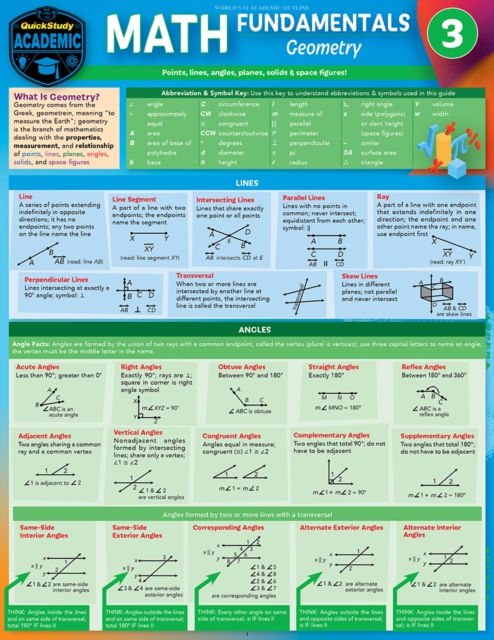
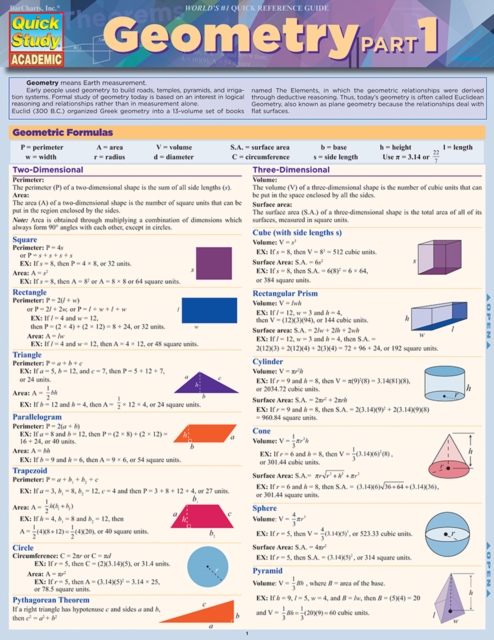
Essential core elements of mathematics to support early learning, continued development, and as a reference to review during and after building a strong foundation.
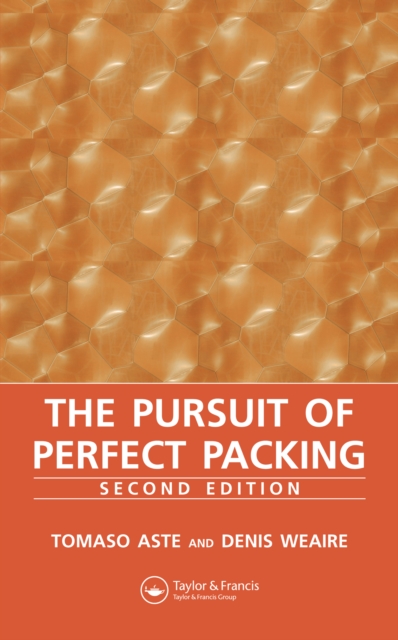
Coauthored by one of the creators of the most efficient space packing solution, the Weaire-Phelan structure, The Pursuit of Perfect Packing, Second Edition explores a problem of importance in physics, mathematics, chemistry, biology, and engineering: the packing of structures.
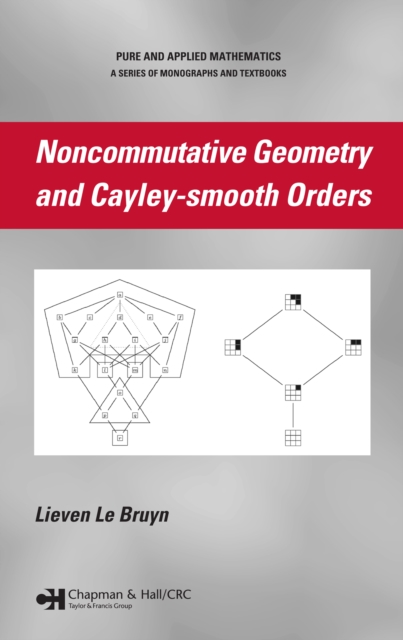
Noncommutative Geometry and Cayley-smooth Orders explains the theory of Cayley-smooth orders in central simple algebras over function fields of varieties.
Intrinsically noncommutative spaces today are considered from the perspective of several branches of modern physics, including quantum gravity, string theory, and statistical physics.
Accessible, concise, and self-contained, this book offers an outstanding introduction to three related subjects: differential geometry, differential topology, and dynamical systems.
Although research in curve shortening flow has been very active for nearly 20 years, the results of those efforts have remained scattered throughout the literature.
The theory of holomorphic functions of several complex variables emerged from the attempt to generalize the theory in one variable to the multidimensional situation.
The analysis and topology of elliptic operators on manifolds with singularities are much more complicated than in the smooth case and require completely new mathematical notions and theories.
Differential Forms on Singular Varieties: De Rham and Hodge Theory Simplified uses complexes of differential forms to give a complete treatment of the Deligne theory of mixed Hodge structures on the cohomology of singular spaces.
The Handbook of Finite Translation Planes provides a comprehensive listing of all translation planes derived from a fundamental construction technique, an explanation of the classes of translation planes using both descriptions and construction methods, and thorough sketches of the major relevant theorems.
While maintaining the lucidity of the first edition, Discrete Chaos, Second Edition: With Applications in Science and Engineering now includes many recent results on global stability, bifurcation, chaos, and fractals.
Presenting theory while using Mathematica in a complementary way, Modern Differential Geometry of Curves and Surfaces with Mathematica, the third edition of Alfred Gray's famous textbook, covers how to define and compute standard geometric functions using Mathematica for constructing new curves and surfaces from existing ones.
This book was written for high school students and teachers who love exploring beyond standard math curricula for a deeper understanding of the principles and applications of mathematics.
The EUCOMES08, Second European Conference on Mechanism Science is the second event of a series that has been started in 2006 as a conference activity for an European community working in Mechanism Science.
The last half century has seen the development of many biological or physical t- ories that have explicitly or implicitly involved medial descriptions of objects and other spatial entities in our world.
Stochastic geometry, based on current developments in geometry, probability and measure theory, makes possible modeling of two- and three-dimensional random objects with interactions as they appear in the microstructure of materials, biological tissues, macroscopically in soil, geological sediments etc.