The Quine-Putnam indispensability argument in the philosophy of mathematics urges us to place mathematical entities on the same ontological footing as other theoretical entities essential to our best scientific theories.
When Archimedes, while bathing, suddenly hit upon the principle of buoyancy, he ran wildly through the streets of Syracuse, stark naked, crying "e;eureka!
In this collection of essays written over a period of twenty years, Solomon Feferman explains advanced results in modern logic and employs them to cast light on significant problems in the foundations of mathematics.
There are many proposed aims for scientific inquiry--to explain or predict events, to confirm or falsify hypotheses, or to find hypotheses that cohere with our other beliefs in some logical or probabilistic sense.
This book explores an important central thread that unifies Russell's thoughts on logic in two works previously considered at odds with each other, the Principles of Mathematics and the later Principia Mathematica.
This is a charming and insightful contribution to an understanding of the "e;Science Wars"e; between postmodernist humanism and science, driving toward a resolution of the mutual misunderstanding that has driven the controversy.
This work is a sequel to the author's Godel's Incompleteness Theorems, though it can be read independently by anyone familiar with Godel's incompleteness theorem for Peano arithmetic.
When ordinary people--mathematicians among them--take something to follow (deductively) from something else, they are exposing the backbone of our self-ascribed ability to reason.
Very Short Introductions: Brilliant, Sharp, Inspiring Kurt Godel first published his celebrated theorem, showing that no axiomatization can determine the whole truth and nothing but the truth concerning arithmetic, nearly a century ago.
Very Short Introductions: Brilliant, Sharp, Inspiring Kurt Godel first published his celebrated theorem, showing that no axiomatization can determine the whole truth and nothing but the truth concerning arithmetic, nearly a century ago.
An Introduction to Proof Theory provides an accessible introduction to the theory of proofs, with details of proofs worked out and examples and exercises to aid the reader's understanding.
Quantitative thinking is our inclination to view natural and everyday phenomena through a lens of measurable events, with forecasts, odds, predictions, and likelihood playing a dominant part.
Quantitative thinking is our inclination to view natural and everyday phenomena through a lens of measurable events, with forecasts, odds, predictions, and likelihood playing a dominant part.
A Dictionary of Logic expands on Oxford's coverage of the topic in works such as The Oxford Dictionary of Philosophy, The Concise Oxford Dictionary of Mathematics, and A Dictionary of Computer Science.
Roy T Cook examines the Yablo paradox--a paradoxical, infinite sequence of sentences, each of which entails the falsity of all others later than it in the sequence--with special attention paid to the idea that this paradox provides us with a semantic paradox that involves no circularity.
The interplay between computability and randomness has been an active area of research in recent years, reflected by ample funding in the USA, numerous workshops, and publications on the subject.
The interplay between computability and randomness has been an active area of research in recent years, reflected by ample funding in the USA, numerous workshops, and publications on the subject.
Assuming no previous study in logic, this informal yet rigorous text covers the material of a standard undergraduate first course in mathematical logic, using natural deduction and leading up to the completeness theorem for first-order logic.
Model theory, a major branch of mathematical logic, plays a key role connecting logic and other areas of mathematics such as algebra, geometry, analysis, and combinatorics.
Neil Tennant presents an original logical system with unusual philosophical, proof-theoretic, metalogical, computational, and revision-theoretic virtues.
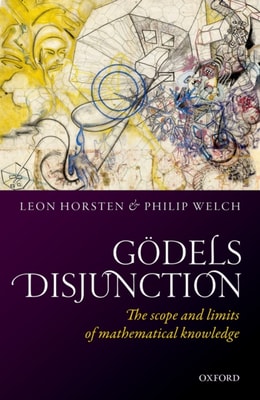
The logician Kurt Godel in 1951 established a disjunctive thesis about the scope and limits of mathematical knowledge: either the mathematical mind is not equivalent to a Turing machine (i.
The logician Kurt Godel in 1951 established a disjunctive thesis about the scope and limits of mathematical knowledge: either the mathematical mind is not equivalent to a Turing machine (i.
Roy T Cook examines the Yablo paradox--a paradoxical, infinite sequence of sentences, each of which entails the falsity of all others later than it in the sequence--with special attention paid to the idea that this paradox provides us with a semantic paradox that involves no circularity.
Kurt Godel (1906 - 1978) was the most outstanding logician of the twentieth century, famous for his hallmark works on the completeness of logic, the incompleteness of number theory, and the consistency of the axiom of choice and the continuum hypothesis.
Kurt Godel (1906 - 1978) was the most outstanding logician of the twentieth century, famous for his hallmark works on the completeness of logic, the incompleteness of number theory, and the consistency of the axiom of choice and the continuum hypothesis.
The term "e;fuzzy logic,"e; as it is understood in this book, stands for all aspects of representing and manipulating knowledge based on the rejection of the most fundamental principle of classical logic---the principle of bivalence.
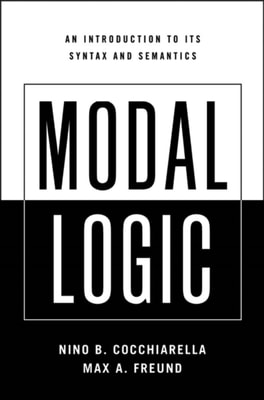
In this text, a variety of modal logics at the sentential, first-order, and second-order levels are developed with clarity, precision and philosophical insight.