The Only Undergraduate Textbook to Teach Both Classical and Virtual Knot TheoryAn Invitation to Knot Theory: Virtual and Classical gives advanced undergraduate students a gentle introduction to the field of virtual knot theory and mathematical research.
This textbook gives students a comprehensive introduction to formal methods and their application in software and hardware specification and verification.
This textbook gives students a comprehensive introduction to formal methods and their application in software and hardware specification and verification.
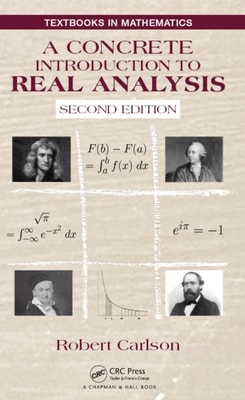
A Concrete Introduction to Analysis, Second Edition offers a major reorganization of the previous edition with the goal of making it a much more comprehensive and accessible for students.
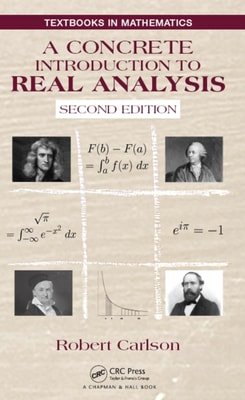
A Concrete Introduction to Analysis, Second Edition offers a major reorganization of the previous edition with the goal of making it a much more comprehensive and accessible for students.
CHOICE: Highly RecommendedQuarks, Leptons and The Big Bang, Third Edition, is a clear, readable and self-contained introduction to particle physics and related areas of cosmology.
Easily Create Origami with Curved Folds and SurfacesOrigami-making shapes only through folding-reveals a fascinating area of geometry woven with a variety of representations.
Accessible to all students with a sound background in high school mathematics, A Concise Introduction to Pure Mathematics, Fourth Edition presents some of the most fundamental and beautiful ideas in pure mathematics.
Understanding Interaction is a book that explores the interaction between people and technology, in the broader context of the relations between the human made and the natural environments.
DDoS Attacks: Evolution, Detection, Prevention, Reaction, and Tolerance discusses the evolution of distributed denial-of-service (DDoS) attacks, how to detect a DDoS attack when one is mounted, how to prevent such attacks from taking place, and how to react when a DDoS attack is in progress, with the goal of tolerating the attack.
This book is devoted to efficient pairing computations and implementations, useful tools for cryptographers working on topics like identity-based cryptography and the simplification of existing protocols like signature schemes.
Mathematics in Games, Sports, and Gambling: The Games People Play, Second Edition demonstrates how discrete probability, statistics, and elementary discrete mathematics are used in games, sports, and gambling situations.
The Only Undergraduate Textbook to Teach Both Classical and Virtual Knot TheoryAn Invitation to Knot Theory: Virtual and Classical gives advanced undergraduate students a gentle introduction to the field of virtual knot theory and mathematical research.
In Mathematical Foundations of Public Key Cryptography, the authors integrate the results of more than 20 years of research and teaching experience to help students bridge the gap between math theory and crypto practice.
The powers not delegated to the United States by the Constitution, nor prohibited by it to the States, are (reserved power clause) reserved to the States respectively, or to the people.
This text for the first or second year undergraduate in mathematics, logic, computer science, or social sciences, introduces the reader to logic, proofs, sets, and number theory.
Alfred Tarski (1901-1983) was a renowned Polish/American mathematician, a giant of the twentieth century, who helped establish the foundations of geometry, set theory, model theory, algebraic logic and universal algebra.
This expanded second edition presents the fundamentals and touchstone results of real analysis in full rigor, but in a style that requires little prior familiarity with proofs or mathematical language.
The hexaflexagon is a folded paper strip of colored triangles that has long delighted people with how it "e;magically"e; changes its appearance when "e;flexed"e;.
This book is a compilation of the author's many observations, and all the crazy ideas that he has had in his lifetime, that he has been posting on his blog digitaldoodlesandmind-farts.
Collected here for the first time, this series of lectures delivered by Lonergan at Boston College in 1957 illustrates a pivotal time in Lonergan's intellectual history, marking both the transition from the faculty psychology still present in his work Insight to intentionality analysis and his initial differentiation of the existential level of consciousness.
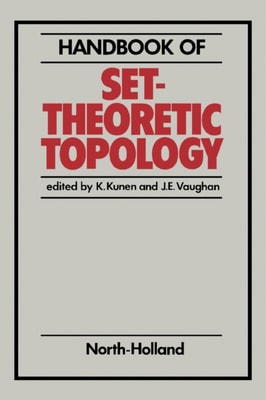
This Handbook is an introduction to set-theoretic topology for students in the field and for researchers in other areas for whom results in set-theoretic topology may be relevant.