In recent years, research in K3 surfaces and Calabi-Yau varieties has seen spectacular progress from both arithmetic and geometric points of view, which in turn continues to have a huge influence and impact in theoretical physics-in particular, in string theory.
"e;Number Theory and Related Fields"e; collects contributions based on the proceedings of the "e;International Number Theory Conference in Memory of Alf van der Poorten,"e; hosted by CARMA and held March 12-16th 2012 at the University of Newcastle, Australia.
Drinfeld Moduli Schemes and Automorphic Forms: The Theory of Elliptic Modules with Applications is based on the author's original work establishing the correspondence between ell-adic rank r Galois representations and automorphic representations of GL(r) over a function field, in the local case, and, in the global case, under a restriction at a single place.
Recent Advances in Harmonic Analysis and Applications features selected contributions from the AMS conference which took place at Georgia Southern University, Statesboro in 2011 in honor of Professor Konstantin Oskolkov's 65th birthday.
As a student moves from basic calculus courses into upper-division courses in linear and abstract algebra, real and complex analysis, number theory, topology, and so on, a "e;bridge"e; course can help ensure a smooth transition.
In the spring of 1976, George Andrews of Pennsylvania State University visited the library at Trinity College, Cambridge to examine the papers of the late G.
Rainbow connections are natural combinatorial measures that are used in applications to secure the transfer of classified information between agencies in communication networks.
Number theory, spectral geometry, and fractal geometry are interlinked in this in-depth study of the vibrations of fractal strings, that is, one-dimensional drums with fractal boundary.
The text that comprises this volume is a collection of surveys and original works from experts in the fields of algebraic number theory, analytic number theory, harmonic analysis, and hyperbolic geometry.
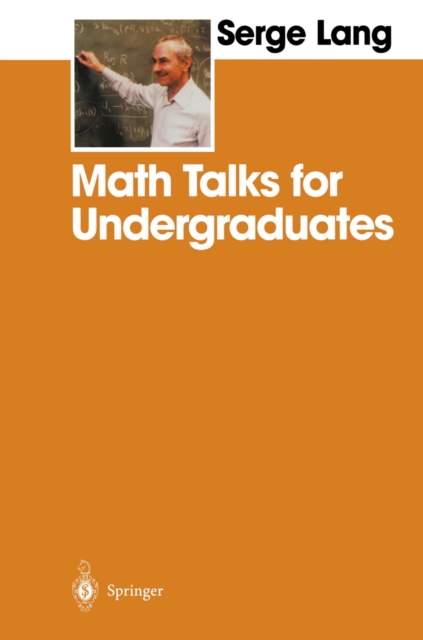
Serge Lang was an iconic figure in mathematics, both for his own important work and for the indelible impact he left on the field of mathematics, on his students, and on his colleagues.
Partitions, q-Series, and Modular Forms contains a collection of research and survey papers that grew out of a Conference on Partitions, q-Series and Modular Forms at the University of Florida, Gainesville in March 2008.
This volume is the offspring of a week-long workshop on "e;Galois groups over Q and related topics,"e; which was held at the Mathematical Sciences Research Institute during the week March 23-27, 1987.
THIS volume is concerned with a substantial branch of number theory of which no connected account appears to exist; we describe the general nature of the constituent topics in the introduction.
This book presents a selection of papers presented to the Second Inter- national Symposium on Semi-Markov Models: Theory and Applications held in Compiegne (France) in December 1998.
Number theory, the branch of mathematics which studies the properties of the integers, is a repository of interesting and quite varied problems, sometimes impossibly difficult ones.
Kummer's work on cyclotomic fields paved the way for the development of algebraic number theory in general by Dedekind, Weber, Hensel, Hilbert, Takagi, Artin and others.
In the summer quarter of 1949, I taught a ten-weeks introductory course on number theory at the University of Chicago; it was announced in the catalogue as "e;Alge- bra 251"e;.
During the academic year 1916-1917 I had the good fortune to be a student of the great mathematician and distinguished teacher Adolf Hurwitz, and to attend his lectures on the Theory of Functions at the Polytechnic Institute of Zurich.
The aim of this book is to illustrate by significant special examples three aspects of the theory of Diophantine approximations: the formal relationships that exist between counting processes and the functions entering the theory; the determination of these functions for numbers given as classical numbers; and certain asymptotic estimates holding almost everywhere.
On April 25-27, 1989, over a hundred mathematicians, including eleven from abroad, gathered at the University of Illinois Conference Center at Allerton Park for a major conference on analytic number theory.
On May 16 -20, 1995, approximately 150 mathematicians gathered at the Conference Center of the University of Illinois at Allerton Park for an Inter- national Conference on Analytic Number Theory.
This volume contains expanded versions of lectures given at an instructional conference on number theory and arithmetic geometry held August 9 through 18, 1995 at Boston University.
A pro-p group is the inverse limit of some system of finite p-groups, that is, of groups of prime-power order where the prime - conventionally denoted p - is fixed.
For many years Serge Lang has given talks to undergraduates on selected items in mathematics which could be extracted at a level understandable by students who have had calculus.