Conditional Monte Carlo: Gradient Estimation and Optimization Applications deals with various gradient estimation techniques of perturbation analysis based on the use of conditional expectation.
Optimization in Quality Control presents a broad survey of the state of the art in optimization in quality, and focuses on industrial and national competitiveness.
This volume of research papers comprises the proceedings of the first International Conference on Mathematics of Neural Networks and Applications (MANNA), which was held at Lady Margaret Hall, Oxford from July 3rd to 7th, 1995 and attended by 116 people.
Faced with the challenge of solving hard optimization problems that abound in the real world, classical methods often encounter great difficulty - even when equipped with a theoretical guarantee of finding an optimal solution.
Meta-Heuristics: Advances and Trends in Local Search Paradigms for Optimizations comprises a carefully refereed selection of extended versions of the best papers presented at the Second Meta-Heuristics Conference (MIC 97).
Sample-Path Analysis of Queueing Systems uses a deterministic (sample-path) approach to analyze stochastic systems, primarily queueing systems and more general input-output systems.
The aim of Stability of Finite and Infinite Dimensional Systems is to provide new tools for specialists in control system theory, stability theory of ordinary and partial differential equations, and differential-delay equations.
Driven by the request for increased productivity, flexibility, and competitiveness, modern civilization increasingly has created high-performance discrete event dynamic systems (DEDSs).
260 2 Crew Legalities and Crew Pairing Repair 264 3 Model and Mathematical Formulation 266 4 Solution Methodology 271 5 Computational Experiences 277 6 Conclusion 285 REFERENCES 286 10 THE USE OF OPTIMIZATION TO PERFORM AIR TRAFFIC FLOW MANAGEMENT Kenneth Lindsay, E.
VII Preface In many fields of mathematics, geometry has established itself as a fruitful method and common language for describing basic phenomena and problems as well as suggesting ways of solutions.
This book demonstrates what the discipline of economics has to offer as support for analyzing cooperation on management of trans-boundary water resources.
Fuzzy Sets in Decision Analysis, Operations Research and Statistics includes chapters on fuzzy preference modeling, multiple criteria analysis, ranking and sorting methods, group decision-making and fuzzy game theory.
At a practical level, mathematical programming under multiple objectives has emerged as a powerful tool to assist in the process of searching for decisions which best satisfy a multitude of conflicting objectives, and there are a number of distinct methodologies for multicriteria decision-making problems that exist.
These days, the nature of services and the volume of demand in the telecommu- nication industry is changing radically, with the replacement of analog transmis- sion and traditional copper cables by digital technology and fiber optic transmis- sion equipment.
This book should be considered as an introduction to a special dass of hierarchical systems of optimal control, where subsystems are described by partial differential equations of various types.
Project management has become a widespread instrument enabling organizations to efficiently master the challenges of steadily shortening product life cycles, global markets and decreasing profit margins.
Motivation Stochastic Linear Programming with recourse represents one of the more widely applicable models for incorporating uncertainty within in which the SLP optimization models.
Discrete Event Systems: Analysis and Control is the proceedings of WODES2000 (the 5th Workshop on Discrete Event Systems, held in Ghent, Belgium, on August 21-23, 2000).
Multicriterion Decision in Management: Principles and Practice is the first multicriterion analysis book devoted exclusively to discrete multicriterion decision making.
Computing Tools for Modeling, Optimization and Simulation reflects the need for preserving the marriage between operations research and computing in order to create more efficient and powerful software tools in the years ahead.
Modeling by Object-Driven Linear Elemental Relations (MODLER) is a computer language for representing linear programming models, completely separate from instances defined by data realizations.
In earlier forewords to the books in this series on Discrete Event Dynamic Systems (DEDS), we have dwelt on the pervasive nature of DEDS in our human-made world.
In Linear Programming: A Modern Integrated Analysis, both boundary (simplex) and interior point methods are derived from the complementary slackness theorem and, unlike most books, the duality theorem is derived from Farkas's Lemma, which is proved as a convex separation theorem.
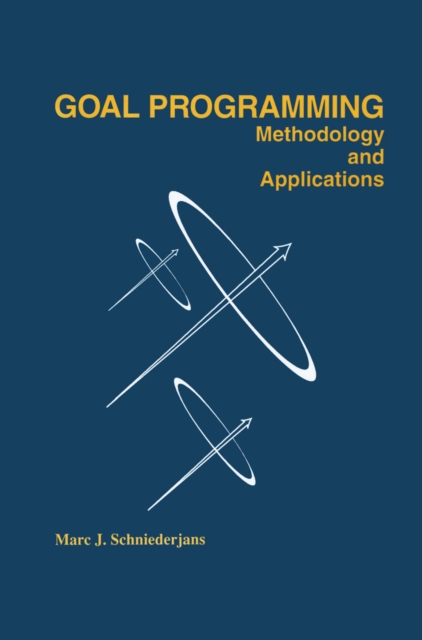
Goal Programming Applications in Accounting 74 Goal Programming Applications in Agriculture 76 Goal Programming Applications in Economics 78 Goal Programming Applications in Engineering 79 Goal Programming Applications in Finance 80 Goal Programming Applications in Government 83 Goal Programming Applications in an International Context 88 Goal Programming Applications in Management 90 Goal Programming Applications in Marketing 97 Summary 98 CHAPTER 5.
A Paradigm for Decentralized Process Modeling presents a novel approach to decentralized process modeling that combines both trends and suggests a paradigm for decentralized PCEs, supporting concerted efforts among geographically-dispersed teams - each local individual or team with its own autonomous process - with emphasis on flexible control over the degree of collaboration versus autonomy provided.
Evolutionary Algorithms and Agricultural Systems deals with the practical application of evolutionary algorithms to the study and management of agricultural systems.
Challenges in Design and Implementation of Middlewares for Real-Time Systems brings together in one place important contributions and up-to-date research results in this fast moving area.
Finding exact solutions to many combinatorial optimization problems in busi- ness, engineering, and science still poses a real challenge, despite the impact of recent advances in mathematical programming and computer technology.
Since the introduction of genetic algorithms in the 1970s, an enormous number of articles together with several significant monographs and books have been published on this methodology.