The book discusses, based on a series of lectures given by the authors at the Universidad Autonoma of Madrid discusses the relation between cosmology and particle physics at a pedagogical level.
Creation of the Universe traces the development of the Big Bang theory, from the expansion of the universe to quantum cosmology, from the formation of large scale structure to the physics of the Planck era.
This textbook is a unique and ambitious primer of nuclear physics, which introduces recent theoretical and experimental progresses starting from basics in fundamental quantum mechanics.
The first edition of the monumental book Diseases from Space by Sir Fred Hoyle and N Chandra Wickramasinghe appeared some 40 years ago, encapsulating the key principles of Panspermia, and it has been the guiding principle in the new scientific field of Astrobiology.
This textbook introduces the current astrophysical observations of black holes, and discusses the leading techniques to study the strong gravity region around these objects with electromagnetic radiation.
This book provides results of analysis of typical solar events, statistical analysis, the diagnostics of energetic electrons and magnetic field, as well as the global behavior of solar flaring loops such as their contraction and expansion.
The workshop on The Cosmology of Extra Dimensions and Varying Fundamental Constants, which was part of JENAM 2002, was held at the Physics Department of the University of Porto (FCUP) from the 3rd to the 5th of September 2002.
Our knowledge of the heliosphere in three dimensions near solar minimum has advanced significantly in the last 10 years, largely as a result of the on-going ESAINASA Ulysses mission.
Recent advances in our understanding of instabilities in galactic type systems have led to an unravelling of some of the mysteries of what determines the form galaxies take.
Over the last decade we entered a new exploration phase of solar flare physics, equipped with powerful spacecraft such as Yohkoh, SoHO, and TRACE that pro- vide us detail-rich and high-resolution images of solar flares in soft X-rays, hard X -rays, and extreme-ultraviolet wavelengths.
It is now a well-established tradition that every four years, at the end of winter, a group of 'celestial mechanicians' from all over the world gather in the Austrian Alps at the invitation of R.
This volume, the fourteenth in the Space Sciences Series of ISS/, is dedicated to the matter in the universe, which was the topic of a workshop organized by ISSI from 19 to 22 March 2001 in Bern.
In every scientific discipline there are milestones - periods of significant accom- plishment when it is appropriate to pause and summarize the state of the field.
The year 1998 marked the 50th anniversary of the invention of the neutron monitor, a key research tool in the field of space physics and solar-terrestrial relations.
Mars is about one-eighth the mass of the Earth and it may provide an analogue of what the Earth was like when it was at such an early stage of accretion.
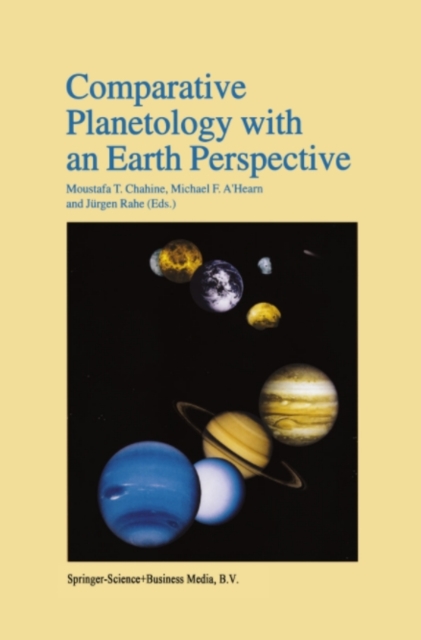
The systematic study of the planets has experienced a slow but steady progress from the efforts of a single individual (Galileo Galilei, 1564-1642) to nations that individually and collectively create whole agencies and complex infrastructures devoted to the exploration and understanding of our solar system.
The Symposium entitled: Causality and Locality in Modern Physics and As- tronomy: Open Questions and Possible Solutions was held at York University, Toronto, during the last week of August 1997.
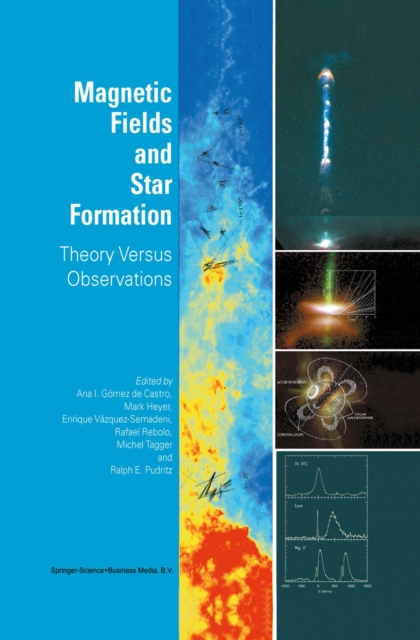
Magnetic Fields play a key role in the physics of star formation on all scales: from the formation of the large complexes of molecular clouds to the formation of solar-like planetary systems.