Cross-Scale Coupling and Energy Transfer in the Magnetosphere-Ionosphere-Thermosphere System provides a systematic understanding of Magnetosphere-Ionosphere-Thermosphere dynamics.
Machine Learning for Planetary Science presents planetary scientists with a way to introduce machine learning into the research workflow as increasingly large nonlinear datasets are acquired from planetary exploration missions.
This book on high-energy cosmic rays deals in its first part with the standard model of cosmic rays, describing how they are born in a wide range of cosmic processes, how they are accelerated and how they interact with matter, magnetic fields and radiation during their journey across the Galaxy.
This textbook is a unique and ambitious primer of nuclear physics, which introduces recent theoretical and experimental progresses starting from basics in fundamental quantum mechanics.
This non-technical biography of Jacobus Cornelius Kapteyn (1851-1922) presents to the general reader the scientific life of the astronomer who pioneered the studies of the structure of the Milky Way Galaxy.
This edited volume presents the current state of gas accretion studies from both observational and theoretical perspectives, and charts our progress towards answering the fundamental yet elusive question of how galaxies get their gas.
Dive into a mind-bending exploration of the physics of black holesBlack holes, predicted by Albert Einstein's general theory of relativity more than a century ago, have long intrigued scientists and the public with their bizarre and fantastical properties.
The physics of neutrinos--uncharged elementary particles that are key to helping us better understand the nature of our universe--is one of the most exciting frontiers of modern science.
The series of books discusses the physics of laser and matter interaction, fluid dynamics of high-temperature and high-density compressible plasma, and kinetic phenomena and particle dynamics in laser-produced plasma.
This book is a collection of lectures given in July 2007 at the Les Houches Summer School on "e;String Theory and the Real World: From particle physics to astrophysics.
It is only several decades since galaxies were recognized as huge aggregations of matter in the universe which consist of myriads of stars and vast clouds of gas.
It is only several decades since galaxies were recognized as huge aggregations of matter in the universe which consist of myriads of stars and vast clouds of gas.
This is a follow-on book to the introductory textbook "e;Physics of the Solar Corona"e; previously published in 2004 by the same author, which provided a systematic introduction and covered mostly scientific results from the pre-2000 era.
Since the last joint IAU and COSPAR Colloquium in Gainesville in 1995, there have been dramatic changes in the field resulting from in-situ space experiments, Earth orbiting satellites and ground based observations.
The emerging multidisciplinary field of earth system science sets out to improve our understanding functioning ecosystems, at a global level across the entire planet.
Long before Galileo published his discoveries about Jupiter, lunar craters, and the Milky Way in the Starry Messenger in 1610, people were fascinated with the planets and stars around them.
Physics and Chemistry of the Solar System, 2nd Edition, is a comprehensive survey of the planetary physics and physical chemistry of our own solar system.
This book is a collection of contributions presented at the 16th annual international symposium "e;Frontiers of Fundamental Physics"e; (FFP16), supported by Istanbul University.
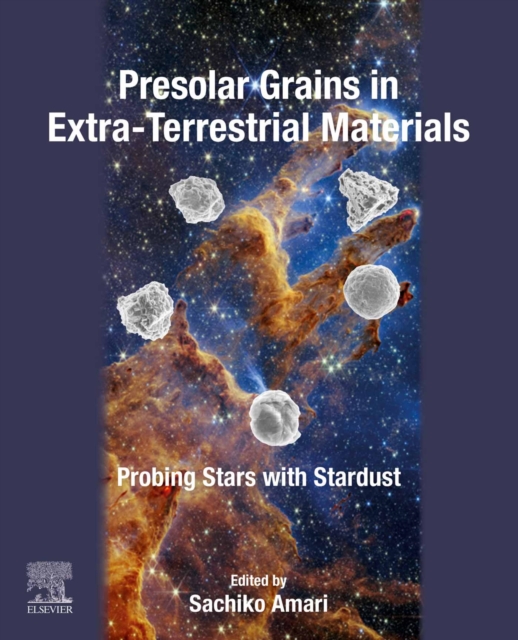
Presolar Grains in Extra-Terrestrial Materials: Probing Stars with Stardust presents the latest research on presolar grains and their stellar sources in a cohesive resource for bringing researchers in cosmochemistry, astrophysics, and astronomy up to speed on the state-of-the-art developments, analysis, and future implications.