A comprehensive and updated overview of the theory, algorithms and applications of for electromagnetic inverse scattering problems Offers the recent and most important advances in inverse scattering grounded in fundamental theory, algorithms and practical engineering applications Covers the latest, most relevant inverse scattering techniques like signal subspace methods, time reversal, linear sampling, qualitative methods, compressive sensing, and noniterative methods Emphasizes theory, mathematical derivation and physical insights of various inverse scattering problems Written by a leading expert in the field
A comprehensive and updated overview of the theory, algorithms and applications of for electromagnetic inverse scattering problems Offers the recent and most important advances in inverse scattering grounded in fundamental theory, algorithms and practical engineering applications Covers the latest, most relevant inverse scattering techniques like signal subspace methods, time reversal, linear sampling, qualitative methods, compressive sensing, and noniterative methods Emphasizes theory, mathematical derivation and physical insights of various inverse scattering problems Written by a leading expert in the field
Covers the theory and practice of innovative new approaches to modelling acoustic propagation There are as many types of acoustic phenomena as there are media, from longitudinal pressure waves in a fluid to S and P waves in seismology.
Covers the theory and practice of innovative new approaches to modelling acoustic propagation There are as many types of acoustic phenomena as there are media, from longitudinal pressure waves in a fluid to S and P waves in seismology.
Offers an integrated account of the mathematical hypothesis of wave motion in liquids with a free surface, subjected to gravitational and other forces.
Linear and Nonlinear Waves Now in an accessible paperback edition, this classic work is just as relevant as when it first appeared in 1974, due to the increased use of nonlinear waves.
INTRODUCTORY APPLICATIONS OF PARTIAL DIFFERENTIAL EQUATIONS With Emphasis on Wave Propagation and Diffusion This is the ideal text for students and professionals who have somefamiliarity with partial differential equations, and who now wishto consolidate and expand their knowledge.
Wave Propagation Analysis of Smart Nanostructures presents a mathematical framework for the wave propagation problem of small-scale nanobeams and nanoplates manufactured from various materials, including functionally graded composites, smart piezoelectric materials, smart magneto-electro-elastic materials, smart magnetostrictive materials, and porous materials.
Wave Propagation Analysis of Smart Nanostructures presents a mathematical framework for the wave propagation problem of small-scale nanobeams and nanoplates manufactured from various materials, including functionally graded composites, smart piezoelectric materials, smart magneto-electro-elastic materials, smart magnetostrictive materials, and porous materials.
Although the analysis of scattering for closed bodies of simple geometric shape is well developed, structures with edges, cavities, or inclusions have seemed, until now, intractable to analytical methods.
Elastic Wave Propagation in Structures and Materials initiates with a brief introduction to wave propagation, different wave equations, integral transforms including fundamentals of Fourier Transform, Wavelet Transform, Laplace Transform and their numerical implementation.
Elastic Wave Propagation in Structures and Materials initiates with a brief introduction to wave propagation, different wave equations, integral transforms including fundamentals of Fourier Transform, Wavelet Transform, Laplace Transform and their numerical implementation.
Although the theory behind solitary waves of strain shows that they hold significant promise in nondestructive testing and a variety of other applications, an enigma has long persisted-the absence of observable elastic solitary waves in practice.
Dynamics of Water Surface Flows and Waves provides theoretical descriptions of the whole life of water surface waves through their birth, propagation, evolution and finally breaking.
Dynamics of Water Surface Flows and Waves provides theoretical descriptions of the whole life of water surface waves through their birth, propagation, evolution and finally breaking.
This book uses asymptotic methods to obtain simple approximate analytic solutions to various problems within mechanics, notably wave processes in heterogeneous materials.
This book uses asymptotic methods to obtain simple approximate analytic solutions to various problems within mechanics, notably wave processes in heterogeneous materials.
Although the analysis of scattering for closed bodies of simple geometric shape is well developed, structures with edges, cavities, or inclusions have seemed, until now, intractable to analytical methods.
Although the analysis of scattering for closed bodies of simple geometric shape is well developed, structures with edges, cavities, or inclusions have seemed, until now, intractable to analytical methods.
In this audacious book, Ana Maria Ochoa Gautier explores how listening has been central to the production of notions of language, music, voice, and sound that determine the politics of life.
A compelling history of silence as a shaper of the human mind-in prisons, in places of contemplation, and in our own lives-from the author of Brilliant.
Focusing on applications rather than rigorous proofs, this volume is suitable for upper-level undergraduates and graduate students concerned with vibration problems.
A complete survey of modern design and analysis techniques for optical waveguides This volume thoroughly details modern and widely accepted methods for designing the optical waveguides used in telecommunications systems.
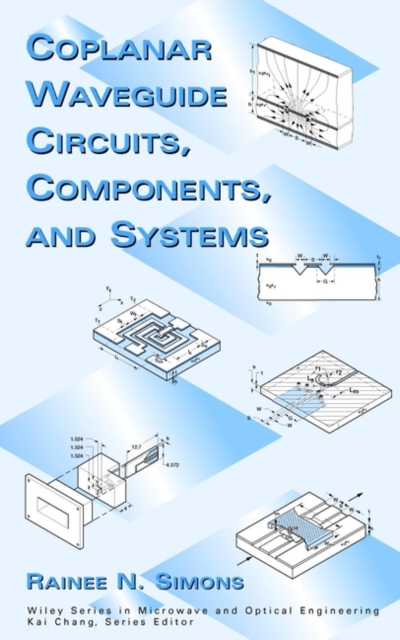
Up-to-date coverage of the analysis and applications of coplanar waveguides to microwave circuits and antennas The unique feature of coplanar waveguides, as opposed to more conventional waveguides, is their uniplanar construction, in which all of the conductors are aligned on the same side of the substrate.