The aim of this work is to present a broad overview of the theory of hyperbolic c- servation laws, with emphasis on its genetic relation to classical continuum physics.
All over the world sport plays a prominent role in society: as a leisure activity for many, as an ingredient of culture, as a business and as a matter of national prestige in such major events as the World Cup in soccer or the Olympic Games.
This volume compiles three series of lectures on applications of the theory of Hamiltonian systems, contributed by some of the specialists in the field.
Applied Mathematics: Body&Soul is a mathematics education reform p- gram including a series of books, together with associated educational ma- rial and open source software freely available from the project web page at www.
The theory of generalized functions is a general method that makes it possible to consider and compute divergent integrals, sum divergent series, differentiate discontinuous functions, perform the operation of integration to any complex power and carry out other such operations that are impossible in classical analysis.
This book consists of six survey contributions that are focused on several open problems of theoretical fluid mechanics both for incompressible and compressible fluids.
This book provides readers with a deep understanding of the principles for generating formulations of compressible isotropic hyperelastic material models based on formulations of incompressible material models.
This book provides readers with a deep understanding of the principles for generating formulations of compressible isotropic hyperelastic material models based on formulations of incompressible material models.
This book is based on two principles:- the problem for an elastic body with initial stresses is similar to the elasticity theory problem, but the coefficients of the equations relating additional stresses and additional strains do not have all the symmetries incident to the elastic constants.
This book is based on two principles:- the problem for an elastic body with initial stresses is similar to the elasticity theory problem, but the coefficients of the equations relating additional stresses and additional strains do not have all the symmetries incident to the elastic constants.
Questo libro presenta la straordinaria storia di un esperimento di portata storica che ha permesso di scoprire i meccanismi alla base della produzione di energia solare e quelli che generano energia nelle stelle massicce.
Questo libro presenta la straordinaria storia di un esperimento di portata storica che ha permesso di scoprire i meccanismi alla base della produzione di energia solare e quelli che generano energia nelle stelle massicce.
The 10th IUTAM Symposium on Laminar-Turbulent Transition, held in September 2024 at Shinshu University in Nagano, Japan, attracted nearly 135 participants from 18 countries across five continents and featured more than 100 presentations in addition to keynote and plenary lectures by eight internationally renowned invited speakers.
The 10th IUTAM Symposium on Laminar-Turbulent Transition, held in September 2024 at Shinshu University in Nagano, Japan, attracted nearly 135 participants from 18 countries across five continents and featured more than 100 presentations in addition to keynote and plenary lectures by eight internationally renowned invited speakers.
During the past three decades, there has been a growing concern over the in- crease in noise pollution that comes as a direct result of the increased volume of automobile traffic, high-speed trains, and larger aircraft.
Inelastic Analysis of Solids and Structures presents in a unified manner the physical and theoretical background of inelastic material models and computational methods, and illustrates the behavior of the models in typical engineering conditions.
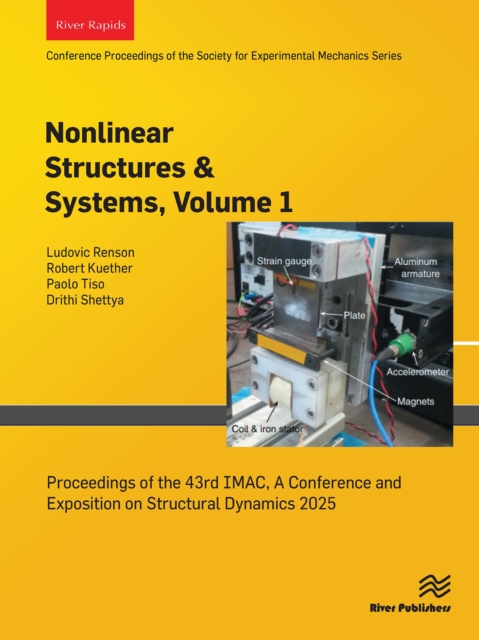
Nonlinear Structures & Systems, Volume 1: Proceedings of the 43rd IMAC, A Conference and Exposition on Structural Dynamics, 2025, the first volume of twelve from the Conference, brings together contributions to this important area of research and engineering.
Model Validation and Uncertainty Quantification, Volume 3: Proceedings of the 43rd IMAC, A Conference and Exposition on Structural Dynamics, 2025, the third volume of twelve from the Conference brings together contributions to this important area of research and engineering.
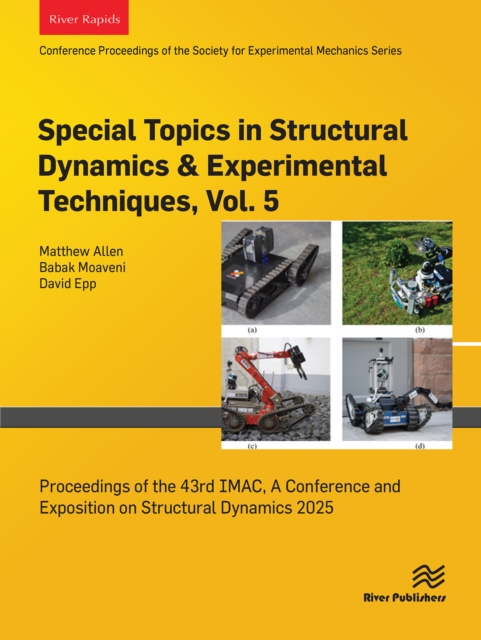
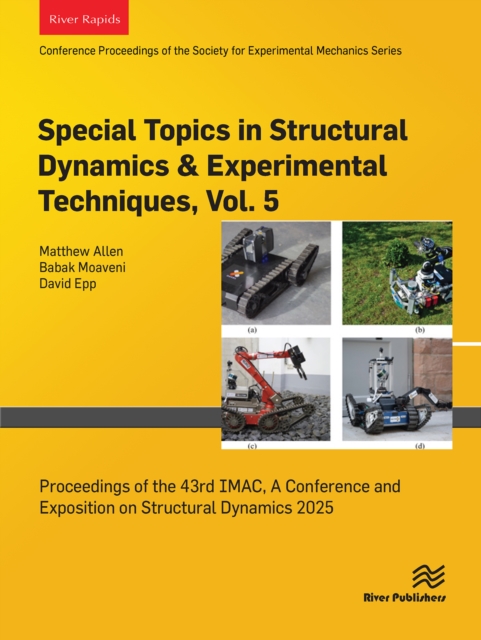
Special Topics in Structural Dynamics & Experimental Techniques, Volume 5: Proceedings of the 43rd IMAC, A Conference and Exposition on Structural Dynamics, 2025, the fifth volume of twelve from the Conference brings together contributions to this important area of research and engineering.
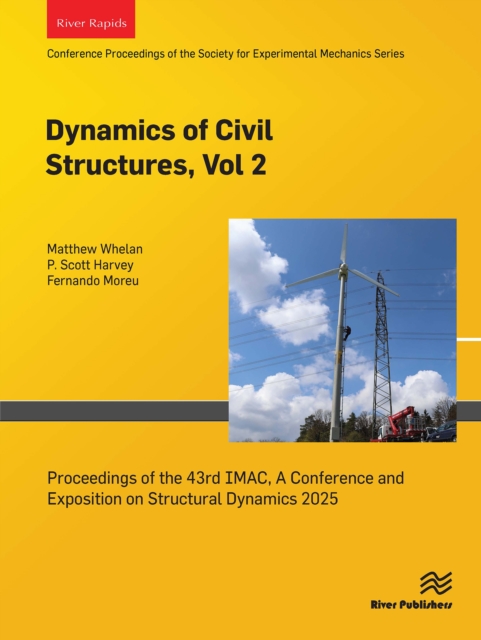
Dynamics of Civil Structures, Volume 2: Proceedings of the 43rd IMAC, A Conference and Exposition on Structural Dynamics, 2025, the second volume of twelve from the Conference brings together contributions to this important area of research and engineering.
Special Topics in Structural Dynamics & Experimental Techniques, Volume 5: Proceedings of the 43rd IMAC, A Conference and Exposition on Structural Dynamics, 2025, the fifth volume of twelve from the Conference brings together contributions to this important area of research and engineering.
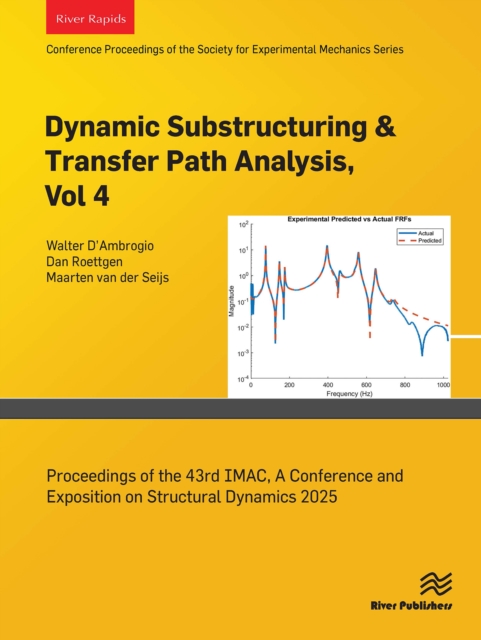
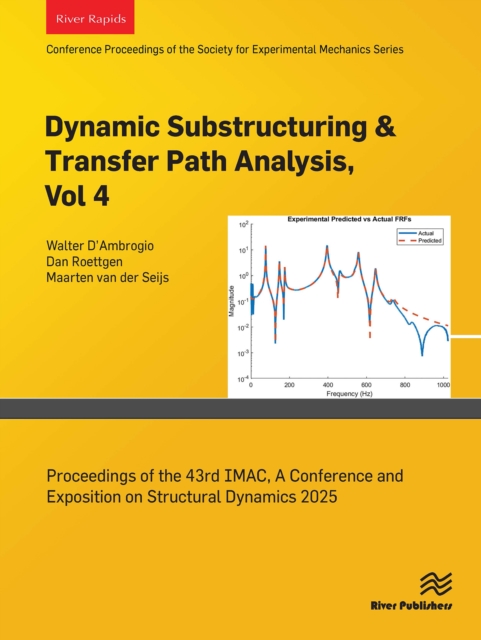
Dynamic Substructuring & Transfer Path Analysis, Volume 4: Proceedings of the 43rd IMAC, A Conference and Exposition on Structural Dynamics, 2025, the fourth volume of twelve from the Conference brings together contributions to this important area of research and engineering.
Dynamic Substructuring & Transfer Path Analysis, Volume 4: Proceedings of the 43rd IMAC, A Conference and Exposition on Structural Dynamics, 2025, the fourth volume of twelve from the Conference brings together contributions to this important area of research and engineering.
Model Validation and Uncertainty Quantification, Volume 3: Proceedings of the 43rd IMAC, A Conference and Exposition on Structural Dynamics, 2025, the third volume of twelve from the Conference brings together contributions to this important area of research and engineering.