This volume contains the proceedings of the Fourth Taniguchi International Symposium on the Theory of Condensed Matter, which was held at Senkari Semi- nar House of Kwansei Gakuin Universi~y in Sanda-shi, Japan, during the period of 3-8 November 1981.
This two-volume treatment grew out of lectures the author gave at the "e;Ecole Poly technique Federale de Lausanne"e; during the years 1975-1980 for graduate students in experimental physics in their last year of study.
When an area of research is in fast growth, it often happens that no one single journal is to be found where most of the relevant publications are contained.
Speech by Toyosaburo Taniguchi Welcome my friends to the Third International Symposium, Division on the Theory of Condensed Matter, of the Taniguchi Foundation.
This volume represents the Proceedings of the Oji International Seminar on the Application of High Magnetic Fields in the Physics of Semiconductors and Magnetic Materials, which was held at the Hakone Kanko Hotel, Hakone, Japan, from 10 to 13 September 1980.
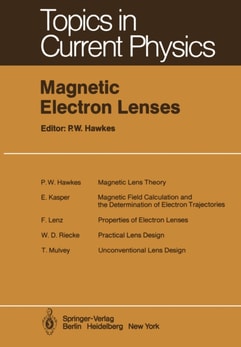
No single volume has been entirely devoted to the properties of magnetic lenses, so far as I am aware, although of course all the numerous textbooks on electron optics devote space to them.
This book is based on the results of many years of experimental work by the author and his colleagues, dealing with the electronic properties of organic crystals.
Discovery of new transport phenomena and invention of electron devices through exploitation of these phenomena have caused a great deal of interest in the properties of compound semiconductors in recent years.
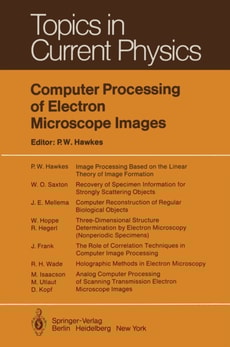
Towards the end of the 1960s, a number of quite different circumstances combined to launch a period of intense activity in the digital processing of electron micro- graphs.
Inelastic Electron Tunneling Spectroscop~ or lETS, provides a unique technique for electronically monitoring the vibrational modes of molecul (;5 adsorbed on a metal oxide surface.
Inelastic neutron scattering is a well established and important technique for studying the dynamical properties of condensed matter at the atomic level.
Over the past ten years liquid crystals have attracted much interest and considerable progress has been made with respect to our knowledge in this field.
Since the discovery of the corpuscular nature of radiation by Planck more than fifty years ago the quantum theory of radiation has gone through many stages of development which seemed to alternate between spectacular success and hopeless frustration.
In the continuing quest to explore structure and to relate struc- tural organization to functional significance, the scientist has developed a vast array of microscopes.
Since the first edition of "e;Scanning 'funneling Microscopy I"e; has been pub- lished, considerable progress has been made in the application of STM to the various classes of materials treated in this volume, most notably in the field of adsorbates and molecular systems.
Quantum Optics VI documents the most recent theoretical and experimental developments in this field, with particular emphasis on atomic optics and interferometry, which is a new and rapidly developing area of research.
This volume summarizes the papers presented at the First Osaka University Macromolecular Symposium OUMS'93 on "e;Ordering in Macromolecular Systems"e;, which was held at Senri Life Science Center, Osaka, Japan, on June 3 through June 6, 1993.
Laser Ablation provides a broad picture of the current understanding of laser ablation and its many applications, from the views of key contributors to the field.
Adsorption on Ordered Surfaces of Ionic Solids and ThinFilms introduces to a new and topical field of surfacescience for which rather little experience is available atpresent.
In this text experts review experimental studies thatdirectly reveal the relationship between the atomicstructure and physical behavior of high-Tc superconductors.
Nuclear physics between 1921 and 1947 shaped more than anyother science thepolitical landscape of our century and thepublic opinion on physical research.
As the role of computer simulations began to increase in importance, we sensed a need for a "e;meeting place"e; for both experienced simulators and neophytes to discuss new techniques and results in an evironment which promotes extended discussion.
This volume in the Springer Series on Surface Sciences presents a recent account of advances in the ever-broadening field of electron-and photon-stimulated sur- face processes.
This introduction to classical theoretical physics emerged from a course for students in the third and fourth semester, which the authors have given several times at the University of Freiburg (Germany).
Dieses als Kompendium konzipierte Buch - mit Lehrbuchcharakter - vermittelt das Grundwissen über die äußere Beschaffenheit sowie die chemischen, physikochemischen und physikalischen Eigenschaften textiler Faserstoffe.