Naturally Occurring Radioactive Materials in Construction (COST Action NORM4Building) discusses the depletion of energy resources and raw materials and its huge impact not only on the building market, but also in the development of new synthetic building materials, whereby the reuse of various (waste) residue streams becomes a necessity.
This book aims to provide a detailed introduction to the state-of-the-art covariant density functional theory, which follows the Lorentz invariance from the very beginning and is able to describe nuclear many-body quantum systems microscopically and self-consistently.
Unified Field Mechanics, the topic of the 9th international symposium honoring noted French mathematical physicist Jean-Pierre Vigier cannot be considered highly speculative as a myopic critic might surmise.
This book presents, in the form of reviews by world's leading physicists in wide-ranging fields in theoretical physics, the influence and prescience of Skyrme's daring idea of 1960, originally conceived for nuclear physics, that fermions can arise from bosons via topological solitons, pervasively playing a powerful role in wide-ranging areas of physics, from nuclear/astrophysics, to particle physics, to string theory and to condensed matter physics.
'Michael Days insightful aphilosophical biography of J Robert Oppenheimer stands out from other works on the so-called afather of the atomic bomb by its focus on the post-war period and by the depth of its philosophical engagement with his humanistic thought on science and culture.
The main goal of the School is to guide the young physicists on the methods of carrying out research and to propose to them some present open problems on fundamental modern physics.
This workshop was designed to meet the needs of those currently involved in or are planning a nuclear programme involving research and/or power fission reactors.
This proceedings volume collected papers presented at a recent symposium on Chiral Symmetry in Hadrons and Nuclei - the seventh in a series of international symposia - with an aim of providing a platform for discussions among the experts and an overview of the present status in the hadron and nuclear physics related to the chiral symmetry.
Computational power available to scientific researchers is increasing at such a rate in recent years that totally new numerical approaches to forefront problems are playing an increasingly important role in modern physics research.
This workshop was one of the first meetings where cosmologists, astronomers, astrophysicists, and nuclear physicists discussed research areas of mutual interest.
The proceedings presents articles exploring the wide range of physics with can be addressed with measurements using both polarized beams and polarized targets.
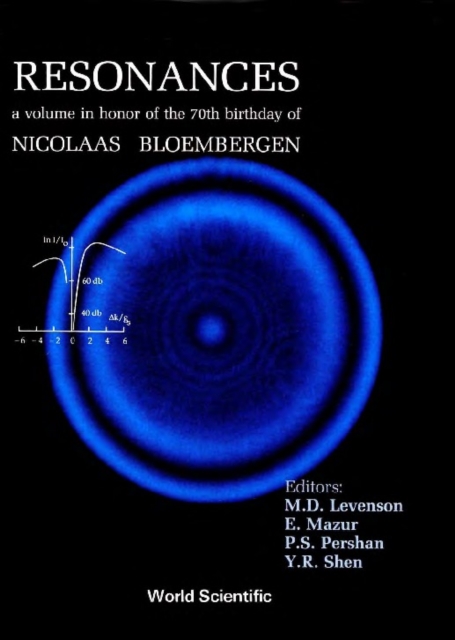
The authors are former students and research fellows of Prof Nicolaas Bloembergen, winner of the Nobel Prize, who has pioneered three distinct fields of science: NMR, masers and nonlinear optics.
The proceedings of the symposium on Nuclear Collective Motion and Nuclear Reaction Dynamics is dedicated to three main areas: to survey the present state of studies in nuclear collective motion and nuclear reaction dynamics, to study the possible future directions of these two topics and to commemorate the work of the late Taro Tamura.
This book constitutes the proceedings of the fourth meeting in a series of topical conferences dealing with the process of nuclear fission, mainly at low excitation energy.
This volume, consisting of articles written by experts with international repute and long experience, reviews the state of the art of accelerator physics and technologies and the use of accelerators in research, industry and medicine.
The science of magnetically confined plasmas covers the entire spectrum of physics from classical and relativistic electrodynamics to quantum mechanics.
The proceedings present the most recent results of experimental and theoretical nuclear spectroscopy, revealing the effects of rapid rotation and thermal fluctuations on the shapes and superfluid properties of a wide range of atomic nuclei.
The invited lectures of the 1990 Predeal summer school cover some of the main achievements and perspectives in the field of the nuclear structure, from both the experimental and theoretical points of view.
The symposium covered the following topics: Physical foundation of preequilibrium reaction models; Randomness in nuclei and nuclear reactions; Statistical multistep compound and direct reactions; Exit channels in nuclear reactions: n, p, a, and y-emission as well as fission; Multiple emission processes; Parameter systematics for nuclear model calculations; New approaches to angular distributions; Experiments for reaction mechanism studies; Applications for nuclear data evaluation.
This workshop was established as a forum for experts from different subfields in nuclear dynamics to investigate unifying concepts of nuclear reactions in different beam energy regimes.
The main goal of the School is to present to young physicists the major open problems in Hadronic Physics in the confinement region, and to show that they are closely linked to similar open problems in nuclear physics and condensed matter.
The proceedings reflect the recent experimental and theoretical progress in pion nuclear physics in topics like pionic atoms, pion absorption, charge exchange, (I , 2I ), and others involving pions in nuclei using different probes, as electron photons or heavy ions.
Organized in honor of K T Hecht, Professor of Physics at the University of Michigan, for his frontier research in group theory and nuclear physics, this symposium features papers by principal researchers who have contributed to the development and use of algebraic methods in nuclear physics.
The volume of proceedings of the Xth International Seminar on High Energy Physics, Relativistic Nuclear Physics and Quantum Chromodynamics brings together reports from the major experimental collaborations at JINR, Fermilab, Brookhaven, SATURNE, Orsay, GSI Darmstadt, Riken Cyclotron Lab.