This book focuses on the modern nuclear models and computer codes used in nuclear model calculations of nuclear data required for nuclear technology and nuclear safety applications.
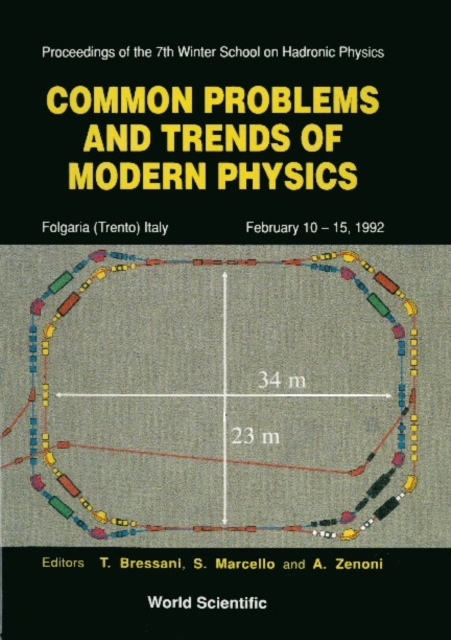
The papers in this proceedings present the major open problems in Hadronic Physics in the confinement region and discuss which experimental approaches seem to be the most adequate in the near future.
The basic theory of multistep nuclear reactions as developed by Feshbach, Kerman and Koonin in the seventies, and published in final form in 1980, has served as strong stimulus for both theorists and experimentalists working in this exciting field.
This volume describes the latest developments in the design, construction and operation of cyclotrons, from compact machines producing intense beams for isotope production, cancer therapy and industrial use, to the larger versions giving higher energy beams of ions of various elements for nuclear and particle physics.
The workshop on Electronuclear Physics with Internal Targets brought together many experimentalists and theories in the field of electronuclear physics to discuss the next generation of experiments in this area.
This book consists of pedagogical contributions on currently viable theories of nuclear structure and critical evaluative comments on each of these theories.
The main theme of the workshop is to discuss problems of nucleosynthesis in the Universe, specifically in connections to the unstable atomic nuclei, which would play a crucial role in explosive burning processes.
This workshop proceedings presents interesting lectures on the theoretical and experimental problems which may be studied using the new GeV accelerators.
This seminar focusses on the key issues addressed in measuring the hyperon-nucleon strong and weak interaction observables and in modelling the hyperon-nucleon interaction.
These proceedings treat the production of high energy gamma rays and particles (mesons and dileptons) in heavy ion reactions from energies of about 30 MeV*A to a few GeV*A, and its application to the study of the Nuclear Equation of State from both the experimental and theoretical points of view.
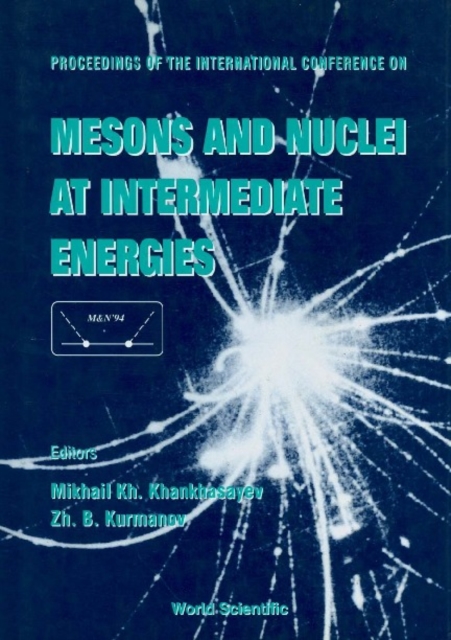
One of the main goals of intermediate energy nuclear physics, which serves an important role as a bridge between nuclear and particle physics, is to construct the theory of strong interaction phenomena in terms of conventional degrees of freedom (nucleons, deltas and mesons) as well as of quark degrees of freedom.
Major developments have taken place during the last few years in the study of the nuclear paradigm as a result of recent detector and accelerator developments, and of improved theoretical models.
This volume contains the lectures of invited speakers on the following topics: Collective excitations at zero and finite temperature; Algebraic and geometric symmetric nuclear models; Fundamental symmetries in nuclear physics; Fast rotating nuclei; Nuclei far from stability; Nuclear multifragmentation; Nuclear astrophysics; Subnucleonic degrees of freedom; Relativistic effects in nuclear physics; Quark-gluon plasma physics; Order and chaos in nuclear physics; Nuclear physics and atomic aggregates; Applied nuclear physics.
This conference brought together the people working on 4I detectors to discuss what had been achieved, whether the results agreed, and to think about possible collaborations to measure the excitation function of several observables.
This book covers recent topics on studies of heavy ion collisions in the energy domain from several MeV/nucleon to several GeV/nucleon: exotic nuclei and radiactive beams; hot nuclei; hot and cold giant resonances; high spin and some applications; and panel for future collaboration.
Non-nucleonic degrees of freedom in the nucleus must be understood in the nucleonic framework of nucleus in relation with the structure of the nucleons from which mesons are emitted to link the nucleons, and with isobars, mesonic exchange currents, and underlying conservation laws.
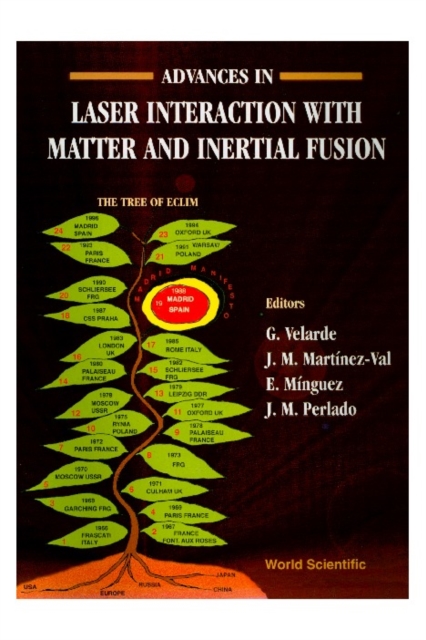
This book collects together theoretical and experimental contributions on laser-plasma interaction and dynamics, together with the physics of laser fusion, coronal, hydrodynamics (instabilities), radiation hydrodynamics and atomic physics.
This proceedings volume is a collection of papers dealing with the applications of spallation neutron sources to pure science, applied science and defense programs.
The International Conference on Nuclear Dynamics at Long and Short Distances was the first meeting to be jointly organised by nuclear physicists from Brazil and Argentina.
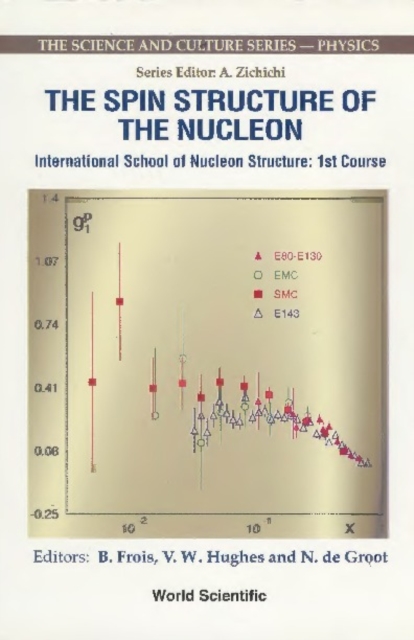
From its early beginnings at SLAC in the 1970's, the study of nucleon spin structure using polarized lepton beams and polarized nucleon targets has become increasingly important in nuclear and particle physics, with current experiments at several of the world's high energy and nuclear physics laboratories (CERN, DESY, SLAC and Jefferson Lab) and with enormous related theoretical studies.
This inaugural volume in a new series on quantum many-body theory contains the papers presented at the Ninth International Conference on Recent Progress in Many-Body Theories.
These conference proceedings will be of interest to all accelerator scientists and engineers, as well as those concerned with the application of cyclotrons in various fields.
This book focuses on the latest theoretical and experimental results and future perspectives regarding electromagnetic and hadronic physics at intermediate energies.
The Wigner symposia gather forefront researchers in the many branches of mathematical physics initiated or influenced by the work of Eugene P Wigner, who died this year.
In the diversified and changing scenarios of the current frontiers of nuclear physics research, the topic 'Nuclear Equation of State' occupies the pivotal position.
The following are the topics covered: Relativistic Heavy Ion Collisions; Hadronic Interaction and Particle Production Processes; Transport Theory for Hadrons and Quark-Gluon Plasma; Hadronization Process; Disordered Chiral Condensate; Strangeness Production; Lepton Pair Production; Particle Interferometry, Electromagnetic Signals of QGP; Structure of Hadrons; Nuclear Astrophysics and Solar Neutrino Problem.
The 14th RCNP OSAKA International Symposium on Nuclear Reaction Dynamics of Nucleon-Hadron Many Body System was held in Osaka from December 6 to 9, 1995.
The International Conference on Nuclear Physics at the Turn of the Millennium: Structure of Vacuum and Elementary Matter, held on March 10th to March 16th, 1996 at Wilderness/George, South Africa, is in honor of the 60th birthday of Prof Walter Greiner.