This handbook--a sequel to the widely used Handbook of Optical Constants of Solids--contains critical reviews and tabulated values of indexes of refraction (n) and extinction coefficients (k) for almost 50 materials that were not covered in the original handbook.
This thesis presents the application of non-perturbative, or functional, renormalization group to study the physics of critical stationary states in systems out-of-equilibrium.
Light scattering-based methods are used to characterize small particles suspended in water in a wide range of disciplines ranging from oceanography, through medicine, to industry.
While bits and pieces of the index of refraction n and extinction coefficient k for a given material can be found in several handbooks, the Handbook of Optical Constants of Solids gives for the first time a single set of n and k values over the broadest spectral range (ideally from x-ray to mm-wave region).
Anna Consortini, The President of the International Commission for Optics (ICO), has accommodated a broad spectrum of optical science topics in Trends in Optics.
Optical Sources, Detectors, and Systems presents a unified approach, from the applied engineering point of view, to radiometry, optical devices, sources, and receivers.
This volume describes the increasing role of in situ optical diagnostics in thin film processing for applications ranging from fundamental science studies to process development to control during manufacturing.
It has been recognised recently that the strange features of the quantum world could be used for new information transmission or processing functions such as quantum cryptography or, more ambitiously, quantum computing.
This book serves two purposes: first to introduce readers to the concepts of geometrical optics, physical optics and techniques of optical imaging and image processing, and secondly to provide them with experience in modeling the theory and applications using the commonly used software tool MATLAB(R).
Colour, Colour Measurement and Colour Change, the first new book in the expanded Science for Conservators series, explains the science of colour, colour measurement and colour change for conservators in a clear and comprehensible way, elucidating the topic for those with no scientific background.
Since 1965, Advances in Magnetic and Optical Resonance has provided researchers with timely expositions of fundamental new developments in the theory of, experimentation with, and application of magnetic and optical resonance.
Physiological optical imaging is a group of emerging technologies that aim to provide healthcare practitioners and biomedical researchers with information about tissue physiology or pathophysiology using approaches different from traditional medical imaging (PET, ultrasound, MRI, X-ray, or CT scan).
The advances of photorefractive optics have demonstrated many useful and practical applications, which include the development of photorefractive optic devices for computer communication needs.
A large part of this book is devoted to a study of possible design procedures for various types of lens or mirror systems, with fully worked examples of each.
Optical fibers have revolutionized telecommunication, becoming the most widely used and the most efficient device for relaying information over long distances.
The use of lasers which emit infra-red radiation and sophisticated detectors of IR radiation is increasing dramatically: they are being used for long-distance fibre-optic communications and remote environmental monitoring and sensing.
This book provides a unified treatment of the characteristics of telescopes of all types, both those whose performance is set by geometrical aberrations and the effect of the atmosphere, and those diffraction-limited telescopes designed for observations from above the atmosphere.
Practical Optics bridges the gap between what students learn in optical engineering curricula and the problems they realistically will face as optical engineering practitioners, in a variety of high-tech industries.
DescriptionThis book provides a detailed overview of the evolution of undersea communications systems, with emphasis on the most recent breakthroughs of optical submarine cable technologies based upon Wavelength Division Multiplexing, optical amplification, new-generation optical fibers, and high-speed digital electronics.
The fifth volume in Jenny Stanford Series on Intelligent Nanosystems, entitled Outlooking Beyond Nanoelectronics and Nanosystems: Ultra Scaling, Pervasiveness, Sustainable Integration, and Biotic Cross-Inspiration, collects global reviews on (1) the historical cross-inspiration of technologies with nature, their evolution towards nanoelectronic and nanosystem components and their sustainability; (2) new materials, techniques, and pervasive applications out of mainstream; and (3) memristor foundation and new bioengineering developments.
Since its inception in 1966, the series of numbered volumes known as Semiconductors and Semimetals has distinguished itself through the careful selection of well-known authors, editors, and contributors.
This book helps to solve the problems and challenges of satellite sensing in the current environment of increasing communications bandwidths and multiplicity of electromagnetic signals.
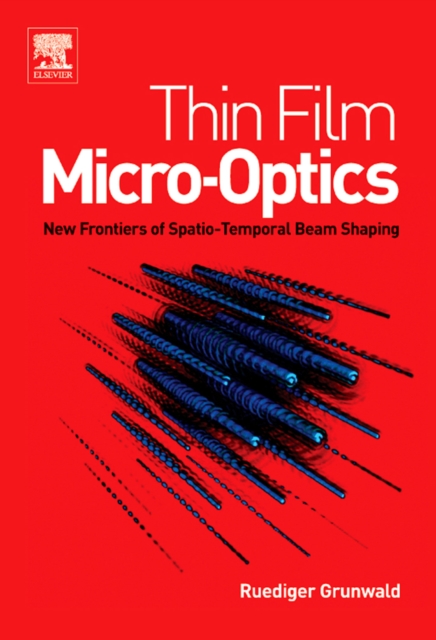
"e;Thin-film microoptics"e; stands for novel types of microoptical components and systems which combine the well-known features of miniaturized optical elements with the specific advantages of thin optical layers.
Current developments in optical technologies are being directed toward nanoscale devices with subwavelength dimensions, in which photons are manipulated on the nanoscale.
This book discusses the recent advances in the area of near-field Raman scattering, mainly focusing on tip-enhanced and surface-enhanced Raman scattering.
This book provides guidelines and design rules for developing high-performance, low-cost, and energy-efficient quantum-dot (QD) lasers for silicon photonic integrated circuits (PIC), optical frequency comb generation, and quantum information systems.
This two-volume book provides an enriching insight into the laser, covering different types of lasers, the basic science behind the technology, their role at the cutting-edge of current scientific research, and their wide-ranging applications.
In the thirty-seven years that have gone by since the first volume of Progress in Optics was published, optics has become one of the most dynamic fields of science.
This second volume in the Handai Nanophotonics book series covers the area of Nanoplasmonics, a recent hot topic in the field of nanophotonics, impacting a diverse range of research disciplines from information technology and nanotechnology to the bio- and medical sciences.