This invaluable volume is a collection of conference talks by James D Bjorken, who has made a huge impact on particle physics and the development of the Standard Model.
In view of the rapid growth in both experimental and theoretical studies of multiphoton processes and multiphoton spectroscopy of atoms, ions and molecules in chemistry, physics, biology, materials science, etc.
Since the 1980s the cross-disciplinary, multidimensional field of links between cosmology and particle physics has been widely recognised by theorists, studying cosmology, particle and nuclear physics, gravity, as well as by astrophysicists, astronomers, space physicists, experimental particle and nuclear physicists, mathematicians and engineers.
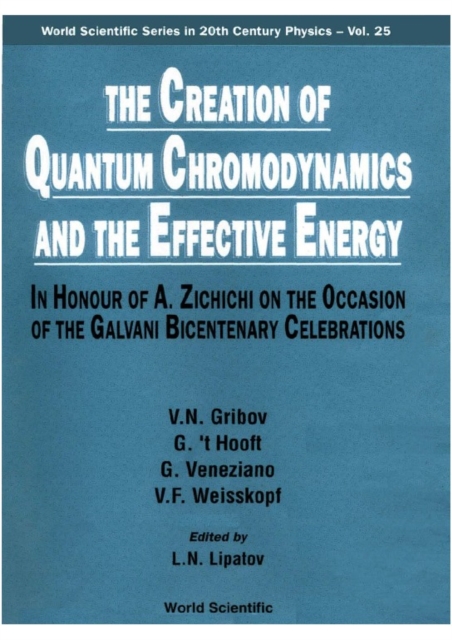
In 1967 a group of physicists from the University of Bologna, led by A Zichichi, published a proposal to search for a heavy lepton using the Frascati (e+e-) collider.
This book contains various experimental and theoretical reports on the status and prospects of one of the most interesting and difficult areas of modern high energy physics - elastic and diffractive scattering.
For the Galvani Bicentenary Celebrations, the University of Bologna and its Academy of Sciences singled out subnuclear physics as the field of scientific research to be associated with this important event, as it would best illustrate, for the new generation of students, the challenge inherent in fundamental sciences.
UNDER THE SPELL OF THE GAUGE PRINCIPLE - by G 't HooftThe University of Bologna and its Academy of Sciences, in collaboration with the Italian National Institute for Nuclear Physics and the Italian Physical Society, celebrated in 1998 the bicentenary of a great pioneer in the field of electric phenomena - Luigi Galvani, the father of macroelectricity.
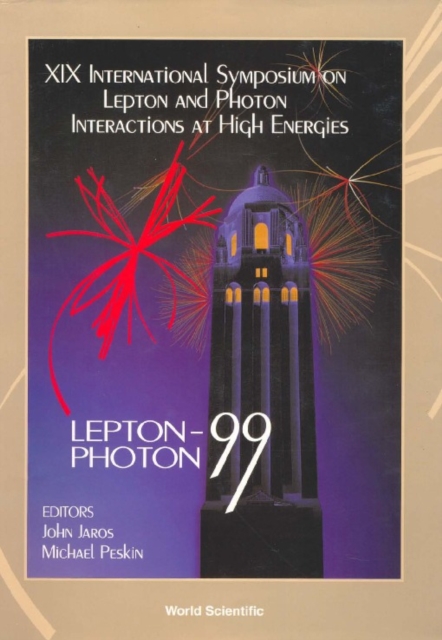
Stanford University hosted the XIX International Symposium on Lepton and Photon Interactions at High Energies on August 9 - 14, 1999, at the Law School on the Stanford University Campus, the site of the previous Symposia.
The Conference "e;Bologna 2000: Structure of the Nucleus at the Dawn of the Century"e; was devoted to a discipline which has seen a strong revival of research activities in the last decade.
Recently there has been much interest in studying events with tagged forward protons at the existing and forthcoming hadronic colliders, the Tevatron and the LHC.
This volume is devoted to different facets of QCD, stressing non-perturbative, analytic and lattice formulations, scattering solutions and approximations, and the understanding of recent RHIC experiments.
This volume is centered on recent developments in the exploration of hadronic structure through lepton scattering, in the description of hadron physics directly from lattice QCD and non-perturbative QCD models, and in efforts to strengthen the links between these activities.
This book presents reviews and new findings in the field of the very early universe, where the interests of particle theorists and astrophysicists meet.
In August/September 2000, a group of 80 physicists from 53 laboratories in 15 countries met in Erice, Italy, to participate in the 38th Course of the International School of Subnuclear Physics.
This book addresses the theoretical, phenomenological and experimental aspects of supersymmetry in particle physics as well as its implications in cosmology.
It is generally felt in the cosmology and particle astrophysics community that we have just entered an era which later can only be looked back upon as a golden age.
In this volume, the following topics are discussed: study of intermediate and low energy heavy ion collisions, nuclear structure at high spin, nuclei far from stability, radioactive ion beam physics and development of experimental facilities.
Superstring theory and its successor, M-theory, hold promises of a deeper understanding of the Standard Model of particle physics, the unification of the four fundamental forces, the quantum theory of gravity, the mysteries of quantum black holes, Big Bang cosmology and, ultimately, their complete synthesis in a final theory of physics.
In this volume, topics such as the AdS/CFT correspondence, non-BPS states, noncommutative gauge theories and the Randall-Sundrum scenario are discussed.
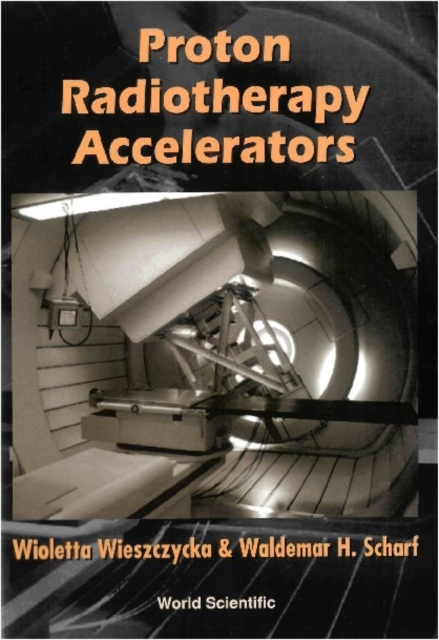
Hadronic radiotherapy uses particle beams to treat tumors located near critical body structures and tumors that respond poorly to conventional photon and electron beam radiotherapy.
In August/September 1999, a group of 68 physicists from 48 laboratories in 17 countries met in Erice, Italy, to participate in the 37th Course of the International School of Subnuclear Physics.
This book is devoted to the broad subject of flavor physics, embracing the question of what distinguishes one type of elementary particles from another.
This volume in contemporary physics records the blossoming physical activities that have occurred at the turn of the millennium, including the most up-to-date and exciting scientific and technological discoveries of recent years.
The second edition of Non-Perturbative Methods in Two-Dimensional Quantum Field Theory is an extensively revised version, involving major changes and additions.
The objective of the workshop series "e;The Identification of Dark Matter"e; is to assess critically the status of work attempting to identify what constitutes dark matter; in particular, to consider what techniques are currently being used, how successful they are, and what new techniques are likely to improve the prospects for identifying dark matter candidates in the future.