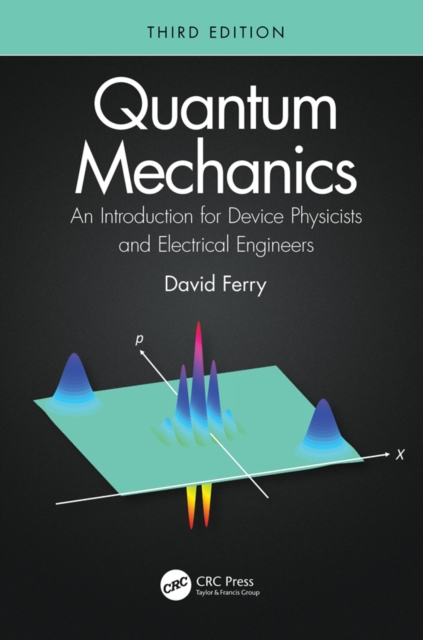
Quantum Mechanics: An Introduction for Device Physicists and Electrical Engineers, Third Edition provides a complete course in quantum mechanics for students of semiconductor device physics and electrical engineering.
This book offers a complete revision for its introduction to the quantum theory of light, including notable developments as well as improvements in presentation of basic theory and concepts, with continued emphasis on experimental aspects.
This book offers a complete revision for its introduction to the quantum theory of light, including notable developments as well as improvements in presentation of basic theory and concepts, with continued emphasis on experimental aspects.
This book provides a brief and pedagogic introduction to a variety of topics, with a common motif that they all occur, in some way or other, in "e;the sky"e;, and involve some sort of "e;rhythm"e;.
This book provides a new mathematical theory for the treatment of an ample series of spatial problems of electrodynamics, particle physics, quantum mechanics and elasticity theory.
Based on a special ONR seminar, Photons and Quantum Fluctuations draws together discoveries in nonclassical or "e;silent"e; light for research workers and postgraduates in quantum optics.
Unique in scope and treatment, Theory of Atomic Nuclei, Quasi-particle and Phonons gives a microscopic description of the structure of complex nuclei at low and intermediate excitation energies in terms of quasi-particle and phonon operators.
The present level of experimental sophistication in quantum physics allows physicists to explore domains unimaginable just a decade ago and to test the most fundamental laws of quantum mechanics.
"e;This useful volume, based on the Taniguchi International Workshop held recently in Sanda, Hyogo, Japan, discusses current problems and offers the mostup-to-date methods for research in spectral and scattering theory.
"e;This useful volume, based on the Taniguchi International Workshop held recently in Sanda, Hyogo, Japan, discusses current problems and offers the mostup-to-date methods for research in spectral and scattering theory.
This book provides a new mathematical theory for the treatment of an ample series of spatial problems of electrodynamics, particle physics, quantum mechanics and elasticity theory.
Unique in scope and treatment, Theory of Atomic Nuclei, Quasi-particle and Phonons gives a microscopic description of the structure of complex nuclei at low and intermediate excitation energies in terms of quasi-particle and phonon operators.
The present level of experimental sophistication in quantum physics allows physicists to explore domains unimaginable just a decade ago and to test the most fundamental laws of quantum mechanics.
Continuing miniaturization of electronic devices, together with the quickly growing number of nanotechnological applications, demands a profound understanding of the underlying physics.
Continuing miniaturization of electronic devices, together with the quickly growing number of nanotechnological applications, demands a profound understanding of the underlying physics.
This book presents a quantum framework for understanding inelastic light scattering which is consistent with the classical descriptions of Raman phenomena and Rayleigh scattering, thus creating a unified theoretical picture of light scattering.
Semiconductor gas sensors have a wide range of applications in safety, process control, environmental monitoring, indoor or cabin air quality and medical diagnosis.
Sowohl im Studium als auch in der täglichen Arbeit benötigt der Physiker eine Vielzahl mathematischer Methoden, die über die Methoden aus den Grundvorlesungen der Analysis und linearen Algebra hinausgehen.
This contributed volume overviews recently presented approaches for carrying out QSPR/QSAR analysis by using a simplifying molecular input-line entry system (SMILES) to represent the molecular structure.
This text takes advantage of recent developments in the theory of path integration to provide an improved treatment of quantization of systems that either have no constraints or instead involve constraints with demonstratively improved procedures.