Science today makes progress through the imaginative harvesting of knowledge g- erated by the many, rather than as the result of the isolated endeavours of the lone researcher.
Although there are numerous technical-scientific books on breast cancer in the global bibliography, such books deal exclusively with the nature of the disease in majority populations of the Western societies, with little or no reference to the nature of the disease in the minority populations in such societies.
At present where protein identification and characterisation using mass spectrometry is a method of choice, this book is presenting a review of basic proteomic techniques.
Novel drugs are being developed which interact with the programmed cell death (apoptotic) machinery in cancer cells, thereby causing these cells to commit suicide and to be removed from the body.
This volume represents the first collection of articles contributed by research leaders working on the Myb family of transcriptional regulatory proteins.
PREFACE The Joint FAO/IAEA Division of Nuclear Techniques in Food and Agriculture is involved in agricultural research and development and assists Member States of FAO and IAEA in improving strategies to ensure food security through the use of nuclear techniques and related biotechnologies, where such techniques have a valuable and often unique role.
The present multi-volume Book Series, CANCER GROWTH AND PROGRESSION, encompasses the widest possible framework of cutting edge research in the field of neoplastic pathology and other integrated fields.
Human biology has now entered into a phase of post-genomics and it might not be an exaggeration to say that the major outcome of the human genome sequencing has finally been to open the way to the exploration of the proteome-proteomics.
During the last five years, clinical research and development costs have risen exponentially without a proportionate increase in the number of new medications.
During the last five years, clinical research and development costs have risen exponentially without a proportionate increase in the number of new medications.
The Data Protection and Medical Research in Europe: PRIVIREAL series focuses on the 'Privacy in Research Ethics and Law' EC-funded project examining the implementation of Directive 95/46/EC on data protection in relation to medical research and the role of ethics committees in European countries.
The Data Protection and Medical Research in Europe: PRIVIREAL series focuses on the 'Privacy in Research Ethics and Law' EC-funded project examining the implementation of Directive 95/46/EC on data protection in relation to medical research and the role of ethics committees in European countries.
Health systems have long been considered key determinants of well-being within modern societies, a valuable resource which have faced a series of reform initiatives throughout the past decades.
Health systems have long been considered key determinants of well-being within modern societies, a valuable resource which have faced a series of reform initiatives throughout the past decades.
International Perspectives on Primary Care Research examines how the evidence base from primary care research can strengthen health care services and delivery, tackle the growing burden of disease, improve quality and safety, and increase a person-centred focus to health care.
International Perspectives on Primary Care Research examines how the evidence base from primary care research can strengthen health care services and delivery, tackle the growing burden of disease, improve quality and safety, and increase a person-centred focus to health care.
Includes a series of fact-filled articles aimed at replacing blind faith in the effectiveness of health services with objective standards for health care delivery.
Includes a series of fact-filled articles aimed at replacing blind faith in the effectiveness of health services with objective standards for health care delivery.
This valuable new book, Handbook of Research on Medicinal Chemistry: Innovations and Methodologies, presents some of the latest advancements in the various fields of combinatorial chemistry, drug discovery, biochemical aspects, pharmacology of medicinal agents, current practical problems, and nutraceuticals.
This title was first published in 2003: As new medical technologies and treatments develop with increasing momentum, the legal and ethical implications of research involving human participants are being called into question as never before.
This title was first published in 2003: As new medical technologies and treatments develop with increasing momentum, the legal and ethical implications of research involving human participants are being called into question as never before.
Analyzing Longitudinal Clinical Trial Data: A Practical Guide provides practical and easy to implement approaches for bringing the latest theory on analysis of longitudinal clinical trial data into routine practice.
Praise for the first edition:"e;Given the author's years of experience as a statistician and as a founder of the first DMC in pharmaceutical industry trials, I highly recommend this book-not only for experts because of its cogent and organized presentation, but more importantly for young investigators who are seeking information about the logistical and philosophical aspects of a DMC.
Since the early 2000s, there has been increasing interest within the pharmaceutical industry in the application of Bayesian methods at various stages of the research, development, manufacturing, and health economic evaluation of new health care interventions.
Since the early 2000s, there has been increasing interest within the pharmaceutical industry in the application of Bayesian methods at various stages of the research, development, manufacturing, and health economic evaluation of new health care interventions.
Comparative effectiveness research (CER) is the generation and synthesis of evidence that compares the benefits and harms of alternative methods to prevent, diagnose, treat, and monitor a clinical condition or to improve the delivery of care (IOM 2009).
Review of the First Edition"e;The goal of this book, as stated by the authors, is to fill the knowledge gap that exists between developed statistical methods and the applications of these methods.
Statistical Approaches in Oncology Clinical Development : Current Paradigm and Methodological Advancement presents an overview of statistical considerations in oncology clinical trials, both early and late phase of development.
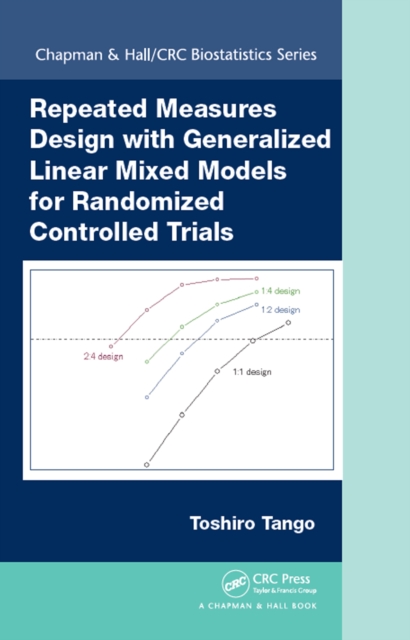
Repeated Measures Design with Generalized Linear Mixed Models for Randomized Controlled Trials is the first book focused on the application of generalized linear mixed models and its related models in the statistical design and analysis of repeated measures from randomized controlled trials.
Handbook of Methods for Designing, Monitoring, and Analyzing Dose-Finding Trials gives a thorough presentation of state-of-the-art methods for early phase clinical trials.