Christopher Gill provides a new translation and commentary on the first half of Marcus Aurelius' Meditations, and a full introduction to the Meditations as a whole.
The Demonic in the Political Thought of Eusebius of Caesarea explores how Eusebius of Caesarea's ideas about demons interacted with and helped to shape his thought on other topics, particularly political topics Hazel Johannessen builds on and complements recent work on early Christian and early modern demonology.
The Demonic in the Political Thought of Eusebius of Caesarea explores how Eusebius of Caesarea's ideas about demons interacted with and helped to shape his thought on other topics, particularly political topics Hazel Johannessen builds on and complements recent work on early Christian and early modern demonology.
Over the centuries leading up to their composition many genres and authors have emerged as influences on Horace's Satires, which in turn has led to a wide variety of scholarly interpretations.
Over the centuries leading up to their composition many genres and authors have emerged as influences on Horace's Satires, which in turn has led to a wide variety of scholarly interpretations.
Self-knowledge - a person's knowledge of their own thoughts, character, and psychological states - has long been a central focus of philosophical enquiry.
Selfhood and the Soul is a collection of new and original essays in honour of Christopher Gill, Emeritus Professor of Ancient Thought at the University of Exeter.
Selfhood and the Soul is a collection of new and original essays in honour of Christopher Gill, Emeritus Professor of Ancient Thought at the University of Exeter.
Early Greek Ethics is devoted to Greek philosophical ethics in its formative period, from the last decades of the sixth century BCE to the beginning of the fourth century BCE.
Discerning the Good in the Letters and Sermons of Augustine turns to the vast collection of moral advice found in Augustine's letters and sermons, mining these neglected and highly illuminating texts for examples of Augustine's application of his own moral concepts.
Discerning the Good in the Letters and Sermons of Augustine turns to the vast collection of moral advice found in Augustine's letters and sermons, mining these neglected and highly illuminating texts for examples of Augustine's application of his own moral concepts.
Julia Annas presents a study of Plato's account of the relation of virtue to law: how it developed from the Republic to the Laws, and how his ideas were taken up by Cicero and by Philo of Alexandria.
Julia Annas presents a study of Plato's account of the relation of virtue to law: how it developed from the Republic to the Laws, and how his ideas were taken up by Cicero and by Philo of Alexandria.
Lucretius' Epicurean poem De Rerum Natura ('On the Nature of Things'), written in the middle of the first century BC, made a fundamental and lasting contribution to the language of Latin philosophy.
Lucretius' Epicurean poem De Rerum Natura ('On the Nature of Things'), written in the middle of the first century BC, made a fundamental and lasting contribution to the language of Latin philosophy.
Focusing primarily on Plato, Aristotle, and the Pyrrhonian skeptics, Fine discusses the following questions, among others: does Socrates, in the Apology, claim to know that he knows nothing?
The Seventh Platonic Letter describes Plato's attempts to turn the ruler of Sicily, Dionysius II, into a philosopher ruler along the lines of the Republic.
This book is a response to the literary pleasures and scholarly problems of reading the texts of Apuleius, most famous for his novel Metamorphoses or Golden Ass.
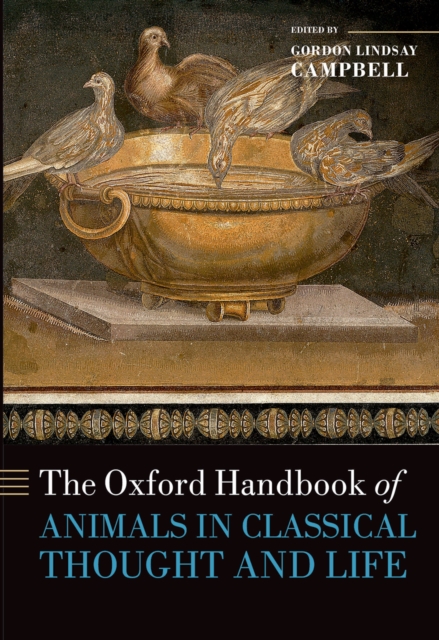
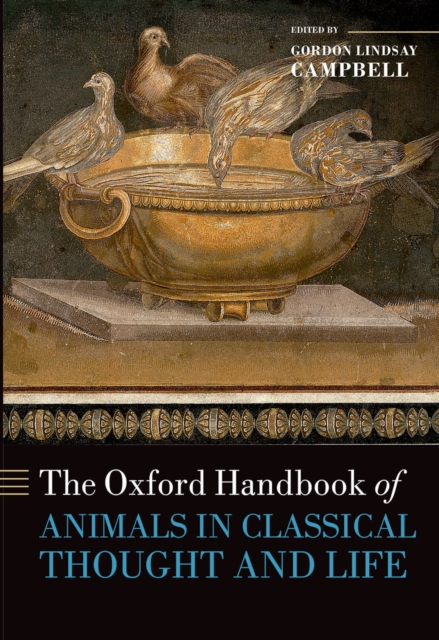
The Oxford Handbook of Animals in Classical Thought and Life is the first comprehensive guide to animals in the ancient world, encompassing all aspects of the topic by featuring authoritative chapters on 33 topics by leading scholars in their fields.
The Oxford Handbook of Animals in Classical Thought and Life is the first comprehensive guide to animals in the ancient world, encompassing all aspects of the topic by featuring authoritative chapters on 33 topics by leading scholars in their fields.
Plutarch's focus on the great leaders of the classical world, his anecdotal style, and his self-presentation as a good-natured friend and wise counsellor have appealed over the centuries to a wide audience, persons as diverse as Beethoven and Benjamin Franklin, Shakespeare and Harry Truman.