Themistius' treatment of Books 5-8 of Aristotle's Physics shows this commentator's capacity to identify, isolate and discuss the core ideas in Aristotle's account of change, his theory of the continuum, and his doctrine of the unmoved mover.
Commenting on the end of Aristotle's On the Heavens Book 3, Simplicius examines Aristotle's criticisms of Plato's theory of elemental chemistry in the Timaeus.
Themistius' treatment of Books 1-3 of Aristotle's Physics presents central features of Aristotle's thought about principles, causation, change and infinity.
Philoponus' commentary on the last part of Aristotle's Physics Book 4 does not offer major alternatives to Aristotle's science, as did his commentary on the earlier parts, concerning place, vacuum and motion in a vacuum.
Around 200 AD, the greatest defender and interpreter of Aristotle within his school, Alexander of Aphrodisias, composed his own book On the Soul, partly following the pattern of Aristotle's.
Philoponus has been identified as the founder in dynamics of the theory of impetus, an inner force impressed from without, which, in its later recurrence, has been hailed as a scientific revolution.
Aristotle's account of place, in which he defined a thing's place as the inner surface of its nearest immobile container, was supported by the Latin Middle Ages, even 1600 years after his death, though it had not convinced many ancient Greek philosophers.
'[Simplicius'] moral interpretation of Epictetus is preserved in the library of nations, as a classic book, most excellently adapted to direct the will, to purify the heart, and to confirm the understanding, by a just confidence in the nature both of God and man.
Aristotle described the scientific explanation of universal or general facts as deducing them through scientific demonstrations, that is, through syllogisms that met requirements of logical validity and explanatoriness which he first formulated.
50 years before Philoponus, two Christians from Gaza, seeking to influence Alexandrian Christians, defended the Christian belief in resurrection and the finite duration of the world, and attacked rival Neoplatonist views.
In this part of the Posterior Analytics, Aristotle elaborates his assessment of how universal truths of science can be scientifically explained as inevitable in demonstrative proofs.
Aristotle's Nicomachean Ethics is a foundational inquiry into the nature of human flourishing, or eudaimonia, and the disciplined cultivation of virtue.
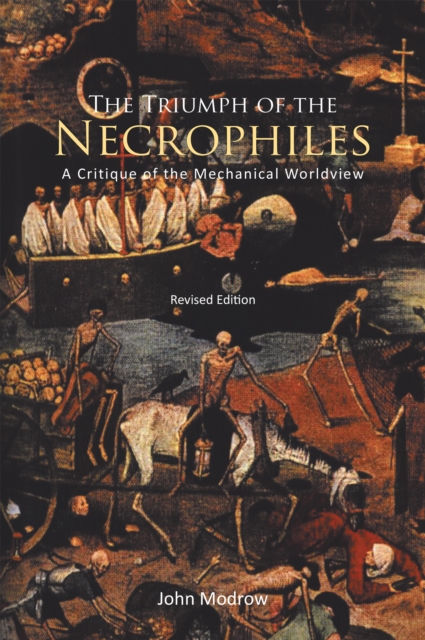
The Triumph of the Necrophiles is the product of over forty years of research and is the most thorough, comprehensive, and penetrating critique of the mechanical worldview ever written.
Plato's Euthyrphro, Apology, and Crito portray Socrates' words and deeds during his trial for disbelieving in the Gods of Athens and corrupting the Athenian youth, and constitute a defense of the man Socrates and of his way of life, the philosophic life.
The Essential Greek and Roman Anthology:The Aeneid- Virgil Meditations- Marcus Aurelius Of The Nature of Things- Lucretius Platos Republic Alcestis- Euripides The Electra of Euripides Hippolytus/The Bacchae- Euripides The Iphigenia in Tauris- Euripedes The Trojan women of Euripides Agamemnon- Aeschylus The Choephori- Aeschylus Eumenides- Aeschylus The Persians- Aeschylus Prometheus Bound- Aeschylus The Seven Against Thebes- Aeschylus The Suppliants- Aeschylus The Oedipus Trilogy- Sophocles The Bucolics and Eclogues- Virgil The Satyricon, Complete- Petronius Arbiter The Georgics- Virgil The Metamorphoses of Ovid The Odyssey- Homer The Religion of Numa- Jesse Benedict Carter Hesiod, The Homeric Hymns, and Homerica- Homer and Hesiod Outlines of Greek and Roman Medicine- James Sands Elliott A Short History of Greek Philosophy- John Marshall The Common People of Ancient Rome- Frank Frost Abbott19 BC
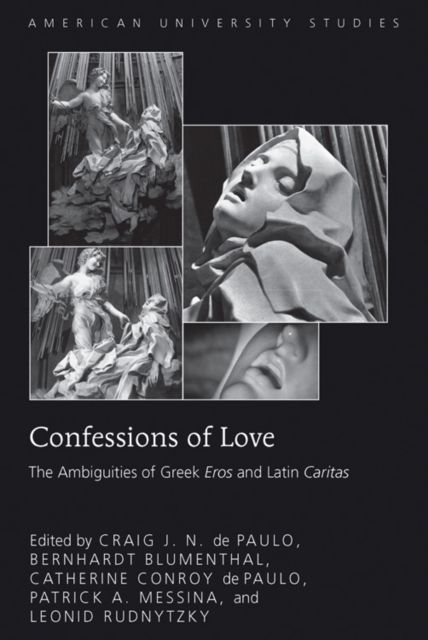
Confessions of Love: The Ambiguities of Greek 'Eros' and Latin 'Caritas' includes a collection of essays by internationally renowned scholars such as Phillip Cary, Roland Teske, and Leonid Rudnytzky, tackling some historic, controversial confessions of love.