This book, combining integratively-revised previously-published papers with entirely new chapters, challenges and treats some major problems in Kant's philosophy not by means of new interpretations but by suggesting some variations on Kantian themes.
For courses in 20th-century Philosophy, recent Continental Philosophy, Anglo-American Philosophy; as part of courses in Contemporary Philosophy; or courses on Epistemology or Metaphysics that take a historical approach.
Medieval debates over "e;divine creation"e; are systematically obscured in our age by the conflict between "e;Intelligent Design"e; Creationists and Evolutionists.
Medieval debates over "e;divine creation"e; are systematically obscured in our age by the conflict between "e;Intelligent Design"e; Creationists and Evolutionists.
'what can be said at all can be said clearly; and of what one cannot talk, about that one must be silent' Wittgenstein's Tractatus Logico-Philosophicus, first published in German in 1921 and in English translation in 1922, is one of the most influential philosophical texts of the twentieth century.
El libro parte de la hipótesis de que la metafísica occidental nace con una sobredosis, identificada por Platón con la idea del Bien en República 509b, a la que sin embargo intenta conjurar por todos los medios.
The seventeenth and eighteenth centuries are arguably the most important period in philosophy's history, given that they set a new and broad foundation for subsequent philosophical thought.
This is the first of a pair of volumes by Jonathan Hodge, collecting all his most innovative, revisionist and influential papers on Charles Darwin and on the longer run of theories about origins and species from ancient times to the present.
This book provides a survey of a number of the major issues in the philosophy of mathematics, such as ontological questions regarding the nature of mathematical objects, epistemic questions about the acquisition of mathematical knowledge, and the intriguing riddle of the applicability of mathematics to the physical world.
This is the first of a pair of volumes by Jonathan Hodge, collecting all his most innovative, revisionist and influential papers on Charles Darwin and on the longer run of theories about origins and species from ancient times to the present.
This book provides a survey of a number of the major issues in the philosophy of mathematics, such as ontological questions regarding the nature of mathematical objects, epistemic questions about the acquisition of mathematical knowledge, and the intriguing riddle of the applicability of mathematics to the physical world.
"e;More than any other living scholar of medieval philosophy, Gyula Klima has influenced the way we read and understand philosophical texts by showing how the questions they ask can be placed in a modern context without loss or distortion.
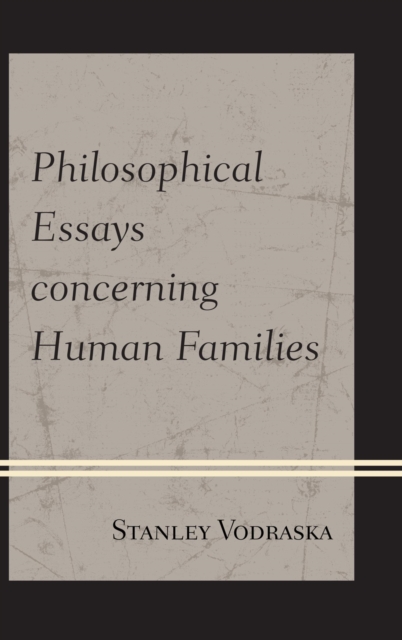
In Philosophical Essays concerning Human Families, Stanley Vodraska describes a principle of moral practice that he calls "e;the principle of familial preference.
Tool-Being offers a new assessment of Martin Heidegger's famous tool-analysis, and with it, an audacious reappraisal of Heidegger's legacy to twenty-first-century philosophy.
This new edition of one of Heidegger's most important works features a revised and expanded translators' introduction and an updated translation, as well as the first English versions of Heidegger's draft of a portion of the text and of his later critique of his own lectures.
Now in a new, affordable edition with updated notes, a superbly readable translation of Kant’s classic work This work, one of the most important texts in the history of ethics, presents Immanuel Kant’s conception of moral self-government based on pure reason.