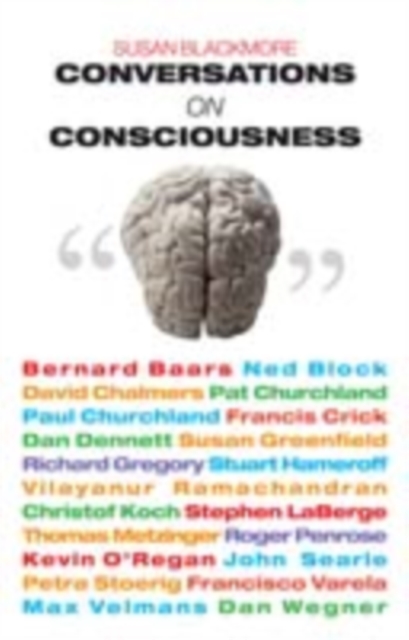
Conversations on Consciousness is just that - a series of twenty lively and challenging conversations between Sue Blackmore and some of the world's leading philosophers and scientists.
One of the most important philosophers of recent times, Elizabeth Anscombe wrote books and articles on a wide range of topics, including the ground-breaking monograph Intention.
In the last few years there has been an explosion of philosophical interest in perception; after decades of neglect, it is now one of the most fertile areas for new work.
The Nature of Normativity presents a complete theory about the nature of normative thought -- that is, the sort of thought that is concerned with what ought to be the case, or what we ought to do or think.
Paradox and Platitude in Wittgenstein's Philosophy is a concise and readable study of five intertwined themes at the heart of Wittgenstein's thought, written by one of his most eminent interpreters.
In Truly Understood, Christopher Peacocke argues that truth and reference have a much deeper role in the explanation of meaning and understanding than has hitherto been appreciated.
Disjunctivism has attracted considerable philosophical attention in recent years: it has been the source of a lively and extended debate spanning the philosophy of perception, epistemology, and the philosophy of action.
When we interact with animals, we intuitively read thoughts and feelings into their expressions and actions - it is easy to suppose that they have minds like ours.
Vision dominates philosophical thinking about perception, and theorizing about experience in cognitive science has traditionally focused on a visual model.
Philosophers on Music: Experience, Meaning, and Work presents significant new contributions to central issues in the philosophy of music, written by leading philosophers working in the analytic tradition.
If humans are purely physical, and if it is the brain that does the work formerly assigned to the mind or soul, then how can it fail to be the case that all of our thoughts and actions are determined by the laws of neurobiology?
A collection of essays by experts in the field, exploring how nature works at every level to produce more complex and highly organized objects, systems, and organisms from much simpler components, and how our increasing understanding of this universal phenomenon of emergence can lead us to a deeper and richer appreciation of who we are as human beings and of our relationship to God.
Gabriele Taylor presents a philosophical investigation of the 'ordinary' vices traditionally seen as 'death to the soul': sloth, envy, avarice, pride, anger, lust, and gluttony.
David Papineau presents a controversial view of human reason, portraying it as a normal part of the natural world, and drawing on the empirical sciences to illuminate its workings.
The Cambridge philosopher Frank Ramsey (1903-1930) died tragically young, but had already established himself as one of the most brilliant minds of the twentieth century.
William James and the Transatlantic Conversation focuses on the American philosopher and psychologist William James (1842-1910) and his engagements with European thought, together with the multidisciplinary reception of his work on both sides of the Atlantic since his death.
This handbook presents an overview of the phenomenon of reference - the ability to refer to and pick out entities - which is an essential part of human language and cognition.
This handbook presents an overview of the phenomenon of reference - the ability to refer to and pick out entities - which is an essential part of human language and cognition.
Perceptual organization comprises a wide range of processes such as perceptual grouping, figure-ground organization, filling-in, completion, perceptual switching, etc.
This book provides a significant contribution to scholarship on the psychology of science and the psychology of technology by showcasing a range of theory and research distinguished as psychological studies of science and technology.
This collection brings together a set of new papers that advance the debate concerning the nature of explanation in mind and brain science, and help to clarify the prospects for bonafide integration across these fields.
This book explores the themes within, and limits of, a dialogue between Martin Heidegger's philosophy of being and Jacques Lacan's post-Freudian metapsychology.
Richard Cross provides the first complete and detailed account of Duns Scotus's theory of cognition, tracing the processes involved in cognition from sensation, through intuition and abstraction, to conceptual thought.