The volume will consist of about 40 articles written by some very influential mathematicians of our time and will expose the latest achievements in the broad area of nonlinear analysis and its various interdisciplinary applications.
Control of Linear Parameter Varying Systems compiles state-of-the-art contributions on novel analytical and computational methods for addressing system identification, model reduction, performance analysis and feedback control design and addresses address theoretical developments, novel computational approaches and illustrative applications to various fields.
Parametric Resonance in Dynamical Systems discusses the phenomenon of parametric resonance and its occurrence in mechanical systems, vehicles, motorcycles, aircraft and marine craft, along micro-electro-mechanical systems.
Regularity and Complexity in Dynamical Systems describes periodic and chaotic behaviors in dynamical systems, including continuous, discrete, impulsive, discontinuous, and switching systems.
Nonlinear Dynamics of Complex Systems describes chaos, fractal and stochasticities within celestial mechanics, financial systems and biochemical systems.
Cooperative Control Design: A Systematic, Passivity-Based Approach discusses multi-agent coordination problems, including formation control, attitude coordination, and synchronization.
Fractional Dynamics and Control provides a comprehensive overview of recent advances in the areas of nonlinear dynamics, vibration and control with analytical, numerical, and experimental results.
This book presents the recently introduced and already widely referred semi-discretization method for the stability analysis of delayed dynamical systems.
This IMA Volume in Mathematics and its Applications DISCRETE EVENT SYSTEMS, MANUFACTURING SYSTEMS AND COMMUNICATION NETWORKS is based on the proceedings of a workshop that was an integral part of the 1992-93 IMA program on "e;Control Theory.
During the last decade there has been a renewed interest in research on supramolecular assemblies in solutions, such as micelles and microemulsions, not only because of their extensive applications in industries dealing with catalysts, detergency, biotechnology, and enhanced oil recovery, but also due to the development of new and more powerful experimental and theoretical tools for probing the microscopic behavior of these systems.
The present volume contains the papers which were accepted for presentation at the 3rd International Symposium for Systems Analysis and Simulation held in Berlin (GDR), September 12-:-16, 1988.
The Second Law of Thermodynamics has been called the most important law of nature: It is the law that gives a direction to processes that is not inherent in the laws of motion, that says the state of the universe is driven to thermal equilibrium.
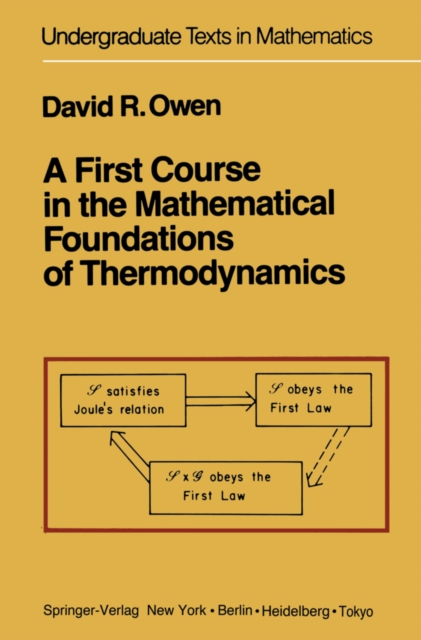
Research in the past thirty years on the foundations of thermodynamics has led not only to a better understanding of the early developments of the subject but also to formulations of the First and Second Laws that permit both a rigorous analysis of the consequences of these laws and a substantial broadening of the class of systems to which the laws can fruitfully be applied.
This IMA Volume in Mathematics and its Applications STOCHASTIC DIFFERENTIAL SYSTEMS, STOCHASTIC CONTROL THEORY AND APPLICATIONS is the proceedings of a workshop which was an integral part of the 1986-87 IMA program on STOCHASTIC DIFFERENTIAL EQUATIONS AND THEIR APPLICATIONS.
This IMA Volume in ~athematics and its Applications PERCOLATION THEORY AND ERGODIC THEORY OF INFINITE PARTICLE SYSTEMS represents the proceedings of a workshop which was an integral part of the 19R4-85 IMA program on STOCHASTIC DIFFERENTIAL EQUATIONS AND THEIR APPLICATIONS We are grateful to the Scientific Committee: naniel Stroock (Chairman) Wendell Fleming Theodore Harris Pierre-Louis Lions Steven Orey George Papanicolaoo for planning and implementing an exciting and stimulating year-long program.
The articles in this volume focus on control theory of systems governed by nonlinear linear partial differential equations, identification and optimal design of such systems, and modelling of advanced materials.
This IMA Volume in Mathematics and its Applications VARIATIONAL AND FREE BOUNDARY PROBLEMS is based on the proceedings of a workshop which was an integral part of the 1990- 91 IMA program on "e;Phase Transitions and Free Boundaries.
This book has grown out of lectures and courses in calculus of variations and optimization taught for many years at the University of Michigan to graduate students at various stages of their careers, and always to a mixed audience of students in mathematics and engineering.
This book presents a selection of papers presented to the Second Inter- national Symposium on Semi-Markov Models: Theory and Applications held in Compiegne (France) in December 1998.
The absence of a book dealing with rubber processing has been apparent for some time and it is surprising that a straightforward text has not been produced.
The four-week period fran May 20 to June 16, 1984 was an intensive period of advanced study on the foundations and frontiers of nonequili- brium statistical physics (NSP).