As understanding of the engineering design and configuration processes grows, the recognition that these processes intrinsically involve imprecise information is also growing.
Human-System interaction has been and will continue to be of interest to many researchers of various disciplines: engineers, computer scientists, psychologists, and social scientists.
Fuzzy Logic Foundations and Industrial Applications is an organized edited collection of contributed chapters covering basic fuzzy logic theory, fuzzy linear programming, and applications.
Fuzzy Modelling: Paradigms and Practice provides an up-to-date and authoritative compendium of fuzzy models, identification algorithms and applications.
Twenty five years ago, in 1964, The Operational Research Society's first International Conference (held at Gonville and Caius College, Cambridge) took as its theme "e;Operational Research and the Social Sciences"e;.
Subspace Identification for Linear Systems focuses on the theory, implementation and applications of subspace identification algorithms for linear time-invariant finite- dimensional dynamical systems.
Over the past several years, cooperative control and optimization has un- questionably been established as one of the most important areas of research in the military sciences.
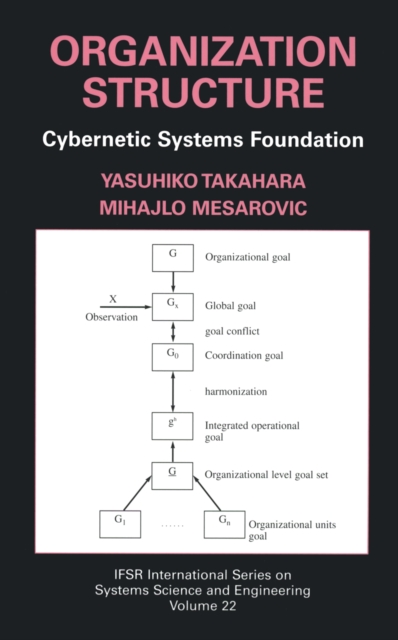
Organization Structure: Cybernetic Systems Foundation utilizes a cybernetic systems framework for the study of organizations using GST (General Systems Theory) and presents a comprehensive formal view of organizations assessing regulation, coordination and adaptation managements.
This book is intended to be an easy, concise, but rather complete, introduc- the ISO/ANSI C++ programming language with special empha- tion to sis on object-oriented numeric computation for students and professionals in science and engineering.
Statisticians of the Centuries aims to demonstrate the achievements of statistics to a broad audience, and to commemorate the work of celebrated statisticians.
This text was developed over a three year period of time (1971- 1973) from a variety of notes and references used in the presentation of a senior/first year graduate level course in the Division of En- gineering at Brown University titled Linear System Theory.
The basis for this book is a number of lectures given frequently by the author to third year students of the Department of Economics at Leningrad State University who specialize in economical cybernetics.
The purpose of this four volume series is to make available for college teachers and students samples of important and realistic applications of mathematics which can be covered in undergraduate programs.
In the first edition of this book I tried to survey in brief compass the main ideas, methods, and discoveries of rational thermodynamics as it then stood, only five years after Messrs.
Vallombrosa Center was host during the week September 7-12, 1985 to about 40 mathematicians, physical scientists, and engineers, who share a common interest in free surface phenomena.
The book deals with several closely related topics concerning approxima- tions and perturbations of random processes and their applications to some important and fascinating classes of problems in the analysis and design of stochastic control systems and nonlinear filters.
The subject of differential and difference equations is an old and much-honored chapter in science, one which germinated in applied fields such as celestial mechanics, nonlinear oscillations, and fluid dynamics.
The aim of this book is to provide an introduction to the mathematical theory of infinite dimensional dynamical systems by focusing on a relatively simple, yet rich, class of examples, that is, those described by delay differential equations.
Building on Wilson's renormalization group, the authors have developed a unified approach that not only reproduces known results but also yields new results.
Unlike the conventional research for the general theory of stability, this mono- graph deals with problems on stability and stabilization of dynamic systems with respect not to all but just to a given part of the variables characterizing these systems.
The mathematical theory of networks and systems has a long, and rich history, with antecedents in circuit synthesis and the analysis, design and synthesis of actuators, sensors and active elements in both electrical and mechanical systems.
One of the basic tenets of science is that deterministic systems are completely predictable-given the initial condition and the equations describing a system, the behavior of the system can be predicted 1 for all time.
The volume that you have before you is the result of a growing realization that fluctuations in nonequilibrium systems playa much more important role than was 1 first believed.
It is difficult for me to forget the mild sense of betrayal I felt some ten years ago when I discovered, with considerable dismay, that my two favorite books on linear system theory - Desoer's Notes for a Second Course on Linear Systems and Brockett's Finite Dimensional Linear Systems - were both out of print.
The problem of developing a systematic approach to the design of feed- back strategies capable of shaping the response of complicated dynamical control systems illustrates the integration of a wide variety of mathemat- ical disciplines typical of the modern theory of systems and control.