This cutting edge collection focuses on the nature of civil society and its role in facilitating governance in Central Asia, considering local implications related to the concept of social capital and civil society in the Uzbek context.
By delving into the history of geopolitics and bringing us up to date with cutting-edge case studies looking at infrastructure, terrain, and maps, this book will dispel simplistic and misleading notions about the nature of how humans interact with the environment.
Offering a comprehensive, up-to-date examination of the complex web of wars and proxy wars, revolutions and counter-revolutions that are ripping the Middle East apart, this book puts these events in their historical context and leads readers through the labyrinth that is the new Middle East.
Macro-regional strategies seek to improve the interplay of the EU with existing regimes and institutions, and foster coherence of transnational policies.
This volume is the result of a 2013 conference held by the Asan Institute for Policy Studies (South Korea) on the 'middle power' countries of Mexico, Indonesia, the Republic of Korea, Turkey and Australia (MIKTA).
This book investigates relations between Israel, the Palestinian territories and the European Union by considering them as interlinked entities, with relations between any two of the three parties affecting the other side.
This book explains the increasingly turbulent Sino-Japanese relations since the 2000s by innovatively investigating the formation mechanism of mutual misperception deeply rooted in China-Japan-U.
Japan's Foreign Aid Policy in Africa seeks to evaluate TICAD's intellectual contribution to and its development practices regarding Africa over the past 20 years.
The book presents a model of interaction effects between policymakers and the media which can shed light on the former's ability to enhance democratic legitimacy in foreign policy decision-making.
This book studies the reactions of India, Brazil, and South Africa the three main non-proliferation actors of the Global South to Iran's nuclear program.
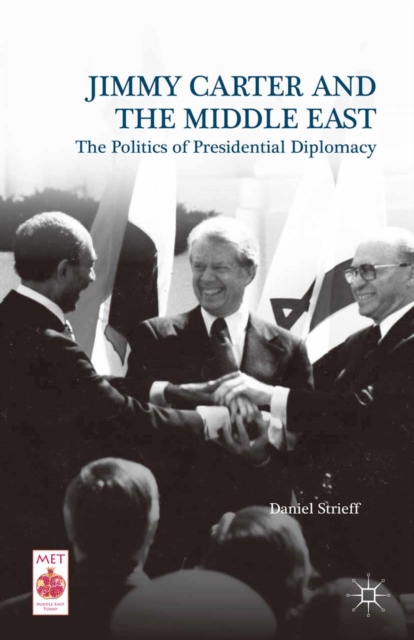
Based on newly declassified documents, this book offers a provocative new analysis of President Jimmy Carter's political role in Arab-Israeli diplomacy.
The book analyzes Brazil's Africa engagement as a rising power's strategy to gain global recognition, linking it to Brazil's broader foreign policy objectives and shedding light on the mechanisms of Brazilian status-seeking in Africa.
Russia's place in the world as a powerful regional actor can no longer be denied; the question that remains concerns what this means in terms of foreign policy and domestic stability for the actors involved in the situation, as Russia comes to grips with its newfound sources of might.
The book provides the first comprehensive comparative analysis of the development of EU enlargement conditionality across four different enlargement waves - the first (2004) and the second (2007) phase of the Eastern enlargement, the EU enlargement to Croatia (2013), and the ongoing enlargement round involving Turkey and the Western Balkans.
This book examines the emergent conviction that UN robust peacekeeping works better than UN traditional peacekeeping in reducing civilian killings within contemporary post-cold war violent civil wars.
At a time of change in the international system, this book examines how non-traditional leading nations from the Global South have fared to date and what the chances are of their rise to continue.
This book examines how North Korea has managed to weather an uncertain political future and catastrophic economic system since the end of the Cold War.
This study examines the history and politics of Turkey-EU relations since 1959, exploring the complex interaction of geostrategic and normative concerns which have resulted in the current lack of accession progress and Turkey's slide to authoritarianism.
This book analyzes the failure of the EU's peace-through-trade policy in Iraq and Iran between 1979 and 2009 from a theoretical and empirical perspective.
An analysis of the new physical presence of Chinese companies operating in Latin America and the Caribbean, the associated challenges that they face, and how they are impacting the region and its relationship with the PRC.
The first English-language monograph on the Slovak-Polish border in 1918-47 explores the interplay of politics, diplomacy, moral principles and self-determination.
This book examines Israel's relationship and political decision-making process towards the Occupied Territories from the aftermath of the Six Day War to the Labour Party's electoral defeat in 1977.
This book offers a concise account of US "e;dual containment"e; policy towards Iran and Iraq during the 1990s, an overlooked era between the tumult of the liberation of Kuwait and the terrorist attacks of September 11, 2001.
Fully revised and updated, this comprehensive guide to diplomacy explores the art of negotiating international agreements and the channels through which such activities occur when states are in diplomatic relations, and when they are not.
This book presents the first-ever close and up-to-date look at how American diplomats working at our embassies abroad communicate with foreign audiences to explain US foreign policy and American culture and society.
In this collection of refreshing and provocative essays, the contributors to Theorizing Foreign Policy in a Globalized World reflect on the game-changing political impact of globalization, outlining the situation as it currently stands and suggesting strategies for analyzing foreign policy and global governance.
This timely study analyses the ways in which competing ideologies and cultural narratives have influenced the Obama administration's decision-making on Iraq, Afghanistan, Libya and Syria, situating these decisions within the broader history of American foreign policy.
"e;In his account of the relationship between France, the UK and the US Andrew Williams successfully intertwines diplomatic history with international thought.