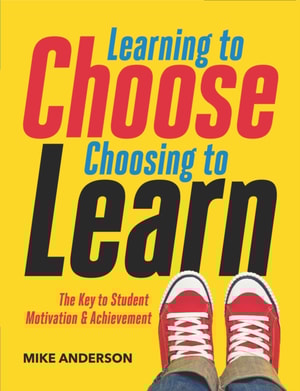
Offering students choices about their learning, says author Mike Anderson, is one of the most powerful ways teachers can boost student learning, motivation, and achievement.
Offering students choices about their learning, says author Mike Anderson, is one of the most powerful ways teachers can boost student learning, motivation, and achievement.
Until now, the conversation around mobile devices in schools has been divided into two camps: those favoring 1:1 plans, in which each student is assigned a school-provided laptop or tablet, and supporters of Bring Your Own Device (BYOD) initiatives that shift the responsibility for providing and maintaining classroom mobile technology to students and their parents.
Until now, the conversation around mobile devices in schools has been divided into two camps: those favoring 1:1 plans, in which each student is assigned a school-provided laptop or tablet, and supporters of Bring Your Own Device (BYOD) initiatives that shift the responsibility for providing and maintaining classroom mobile technology to students and their parents.
In this essential guide, Starr Sackstein-a National Board Certified Teacher-explains how teachers can use reflection to help students decipher their own learning needs and engage in deep, thought-provoking discourse about progress.
In this essential guide, Starr Sackstein-a National Board Certified Teacher-explains how teachers can use reflection to help students decipher their own learning needs and engage in deep, thought-provoking discourse about progress.
More than a decade into the 21st century, teachers continue to struggle with designing digital assignments as a viable tool for learning and with assessing the demonstration of that learning through student-created products.
More than a decade into the 21st century, teachers continue to struggle with designing digital assignments as a viable tool for learning and with assessing the demonstration of that learning through student-created products.
The Six-Step Button Therapy Method briefly describes a practical six-step psychological self-help method and a holistic cognitive counseling tool for mental health professionals designed to:Help you identify, modify, and eliminate your Buttons that trigger stress and distress in your life.
The Button Therapy Book is a practical cognitivecounseling manual for mental health professionalsand a psychological self-help book designed to: Help you identify, modify, and eliminate your Buttons that triggerstress and distress in your life.
This book describes, for the first time in pedagogical form, an approach to computer-based work in complex sociotechnical systems developed over the last 30 years by Jens Rasmussen and his colleagues at Riso National Laboratory in Roskilde, Denmark.
A Short Introduction to Geospatial Intelligence explains the newest form of intelligence used by governments, commercial organizations, and individuals.
A comprehensive account of the origins, evolution, and behavior of South and Central American primatesNew World Monkeys brings to life the beauty of evolution and biodiversity in action among South and Central American primates, who are now at risk.
Involuntary memory was identified by the pioneering memory researcher Hermann Ebbinghaus more than a century ago, but it was not until very recently that cognitive psychologists began to study this memory phenomenon.
Connectionism is a "e;hands on"e; introduction to connectionist modeling through practical exercises in different types of connectionist architectures.
As part of the study of emotions and politics, this book explores connections between affect and cognition and their implications for political evaluation, decision and action.
What insights can we gain from the social sciences about the role memory plays in creating or re-creating the many conflicts threatening global peace in the twenty-first century?
Medical texts provide a powerful means of accessing contemporary perceptions of illness and through them assumptions about the nature of the body and identity.
Marja-Leena Stenstrom * and Pai * vi Tynjal * a * Changing Working Life as a Challenge to Education Recentmacro-leveltrends,suchaseconomicglobalisation,thedevelopmentofthe- formationsociety,changesinmethodsofproductionandtheorganisationofwork,and the growing signi?
Increased attention is being paid to the need for statistically educated citizens: statistics is now included in the K-12 mathematics curriculum, increasing numbers of students are taking courses in high school, and introductory statistics courses are required in college.
Beliefs about nature of knowledge and learning, or epistemological beliefs have been an interest of educational researchers and psychologists for the past several years.
The idea of the present volume emerged in 2002 from a series of talks by Frank Stephan in 2002, and John Case in 2003, on developments of algorithmic learning theory.
A unique feature of this book is that chapters favor that line of cognitive linguistics which makes a clear distinction between real world and projected world.
Beyond their remarkable technical accomplishments, the new directions taken by the sciences in recent decades call for renewal of their epistemological basis.
This is the second volume of the new conference series Design Computing and Cognition (DCC) that takes over from and subsumes the successful series Artificial Intelligence in Design (AID) published by Kluwer since 1992.
"e;Clashes of Knowledge"e; is the first volume in a book series called "e;Knowledge and Space"e; dealing with spatial disparities of knowledge and the impact of the spatial context on the production and application of knowledge.
Self-Organizing Natural Intelligence brings new scientific methods to intelligence research that is currently under the influence of largely classical 19th century single causal theory and method.