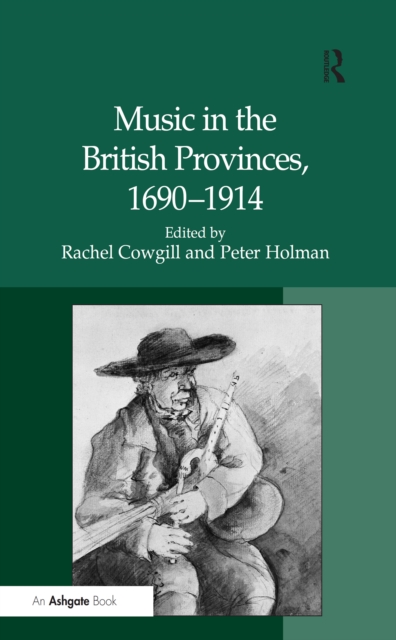
Selected from papers given at the third biennial conference on Music in Nineteenth-Century Britain, this volume, in common with its two predecessors, reflects the interdisciplinary character of the topic.
This selection of essays represents a wide cross-section of the papers given at the Tenth International Conference on Nineteenth-Century Music held at the University of Bristol in 1998.
This selection of essays represents a wide cross-section of the papers given at the Tenth International Conference on Nineteenth-Century Music held at the University of Bristol in 1998.
When Olivier Messiaen died in 1992, the prevailing image was of a man apart; a deeply religious man whose only sources of inspiration were God and Nature and a composer whose music progressed along an entirely individual path, artistically impervious to contemporaneous events and the whims both of his contemporaries and the critics.
When Olivier Messiaen died in 1992, the prevailing image was of a man apart; a deeply religious man whose only sources of inspiration were God and Nature and a composer whose music progressed along an entirely individual path, artistically impervious to contemporaneous events and the whims both of his contemporaries and the critics.
The articles reprinted in this volume treat operas as opera and from some sort of critical angle; none of the articles uses methodology appropriate for another kind of musical work.
The articles reprinted in this volume treat operas as opera and from some sort of critical angle; none of the articles uses methodology appropriate for another kind of musical work.
This volume takes an interdisciplinary approach to studying a wide range of subjects associated with the creation, performance and reception of 'opera' in varying social and historical contexts from the eighteenth to the twentieth centuries.
This volume takes an interdisciplinary approach to studying a wide range of subjects associated with the creation, performance and reception of 'opera' in varying social and historical contexts from the eighteenth to the twentieth centuries.
Matthew Head explores the cultural meanings of Mozart's Turkish music in the composer's 18th-century context, in subsequent discourses of Mozart's significance for 'Western' culture, and in today's (not entirely) post-colonial world.
Matthew Head explores the cultural meanings of Mozart's Turkish music in the composer's 18th-century context, in subsequent discourses of Mozart's significance for 'Western' culture, and in today's (not entirely) post-colonial world.
Since the emergence of rock'n'roll in the early 1950s, there have been a number of live musical performances that were not only memorable in themselves, but became hugely influential in the way they shaped the subsequent trajectory and development of popular music.
Since the emergence of rock'n'roll in the early 1950s, there have been a number of live musical performances that were not only memorable in themselves, but became hugely influential in the way they shaped the subsequent trajectory and development of popular music.
Listeners, performers, students and teachers will find here the analytical tools they need to understand and interpret musical evidence from the baroque era.
Listeners, performers, students and teachers will find here the analytical tools they need to understand and interpret musical evidence from the baroque era.
Hailed as a child prodigy and later acclaimed as England's finest extempore organist, Samuel Wesley - son of Charles Wesley and nephew of John Wesley, the founders of Methodism - is best known today for his musical compositions and for his promotion of the music of J.
Hailed as a child prodigy and later acclaimed as England's finest extempore organist, Samuel Wesley - son of Charles Wesley and nephew of John Wesley, the founders of Methodism - is best known today for his musical compositions and for his promotion of the music of J.
The traditional approach to the study of Goethe and Schubert is to place them in opposition to one another, both in terms of their life experiences and in relation to the nineteenth-century Lied.
The traditional approach to the study of Goethe and Schubert is to place them in opposition to one another, both in terms of their life experiences and in relation to the nineteenth-century Lied.
The most important figure of seventeenth-century Neapolitan music, Francesco Provenzale (1624-1704) spent his long life in the service of a number of Neapolitan conservatories and churches, culminating in his appointment as maestro of the Tesoro di S.
The most important figure of seventeenth-century Neapolitan music, Francesco Provenzale (1624-1704) spent his long life in the service of a number of Neapolitan conservatories and churches, culminating in his appointment as maestro of the Tesoro di S.