George Schuyler, a renowned and controversial black journalist of the Harlem Renaissance, and Josephine Cogdell, a blond, blue-eyed Texas heiress and granddaughter of slave owners, believed that intermarriage would "e;invigorate"e; the races, thereby producing extraordinary offspring.
The groundbreaking analytical techniques of Heinrich Schenker have had a powerful impact on the English-speaking musical world, and their importance, a century after he embarked on his major projects, is greater than ever.
Designed for both the practicing choral director and the choral methods student, this is a compact and comprehensive overview of the many teaching methods, strategies, materials, and assessments available for choral sight-singing instruction.
The motet was unquestionably one of the most important vocal genres from its inception in late twelfth-century Paris through the Counter-Reformation and beyond.
An accessible exploration of an important and understudied music theory topic, Swain's book examines the dimensional technique of analyzing harmonic rhythm.
The vocal repertoire of the twentieth century--including works by Schoenberg, Boulez, Berio, Larsen, and Vercoe--presents exciting opportunities for singers to stretch their talents and demonstrate their vocal flexibility.
Building on the foundation of Lerdahl and Jackendoff's influential A Generative Theory of Tonal Music, this volume presents a multidimensional model of diatonic and chromatic spaces that quantifies listeners' intuitions of the relative distances of pitches, chords, and keys from a given tonic.
The past ten years have seen a rapidly growing interest in performing and recording Classical and Romantic music with period instruments; yet the relationship of composers' notation to performing practices during that period has received only sporadic attention from scholars, and many aspects of composers' intentions have remained uncertain.
More than twenty years ago James Tyler wrote a modest introduction to the history, repertory, and playing techniques of the four- and five-course guitar.
Musical Excellence offers performers, teachers, and researchers, new perspectives and practical guidance for enhancing performance and managing the stress that typically accompanies performance situations.
Overturning the inherited belief that popular music is unrefined, Form as Harmony in Rock Music brings the process-based approach of classical theorists to popular music scholarship.
Overturning the inherited belief that popular music is unrefined, Form as Harmony in Rock Music brings the process-based approach of classical theorists to popular music scholarship.
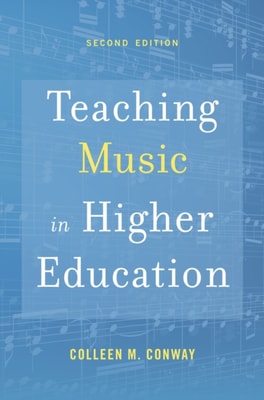
With five newly written chapters and sizable additions to nine original chapters, this second edition of Teaching Music in Higher Education provides a welcome update to author Colleen M.
With five newly written chapters and sizable additions to nine original chapters, this second edition of Teaching Music in Higher Education provides a welcome update to author Colleen M.
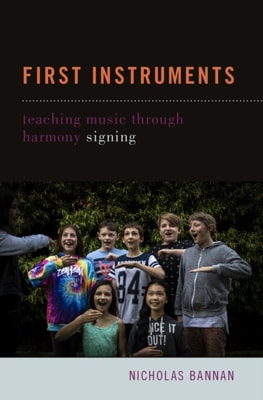
Written for music educators from K - 5 onwards, First Instruments is a practical guide to teaching musical ideas through the first instruments we develop in early childhood, laying the foundation for how the collective creativity the book presents can sustain a lifelong commitment to music-making: voice and hand gestures.
Written for music educators from K - 5 onwards, First Instruments is a practical guide to teaching musical ideas through the first instruments we develop in early childhood, laying the foundation for how the collective creativity the book presents can sustain a lifelong commitment to music-making: voice and hand gestures.
Shimmering in maximal minimalism, joyful bleakness, and bodiless intimacy, Laurie Anderson's Big Science diagnosed crises of meaning, scale, and identity in 1982.
Shimmering in maximal minimalism, joyful bleakness, and bodiless intimacy, Laurie Anderson's Big Science diagnosed crises of meaning, scale, and identity in 1982.