This study takes a look at a controversial question: what do the acts and shows of grief performed in early modern drama tell us about the religious culture of the world in which they were historically staged?
Leading scholars in the field analyze Shakespeare's plays to show how their dramatic content shapes issues debated in conflicts arising from the creation and application of law.
Through an examination of plays, actors, reviews, and audience response of the period, this study traces the development of Broadway as a source of 'mature' American drama, and the simultaneous development of Professional-Managerial Class consciousness and habitus.
Theatre and Religion on Krishna s Stage examines the history and form of India's ras lila folk theatre, and discusses how this theatre functions as a mechanism of worship and spirituality among Krishna devotees in India.
Mendel's Theatre offers a new way of thinking about early twentieth-century American drama by uncovering the rich convergence of heredity theory, the American eugenics movement, and innovative modern drama from the 1890s to 1930.
Performing Magic on the Western Stage examines magic as a performing art and as a meaningful social practice, linking magic to cultural arenas such as religion, finance, gender, and nationality and profiling magicians from Robert-Houdin to Pen& Teller.
The book reveals how the fantastic is used in modern theatre as a manipulative device to encode the unspeakable and control audience response, challenging conventional readings of all authors who use the fantastic.
This book is the first in-depth cultural history of cinema's polyvalent and often contradictory appropriations of Shakespearean drama and performance traditions.
Beyond the Golden Door is the first book devoted to showing how Jewish playwrights of the twentieth century have dramatized the Jewish encounter with America.
Revenge Drama in European Renaissance and Japanese Theatre is a collection of essays that both explores the tradition of revenge drama in Japan and compares that tradition with that in European Renaissance drama.
This book examines over 125 American, English, Irish and Anglo-Indian plays by 70 dramatists which were published in 14 American general interest periodicals aimed at the middle-class reader and consumer.
This study argues that late medieval English 'mystery plays' were about masculinity as much as Christian theology, modes of devotion, or civic self-consciousness.
Shakespeare Among the Animals examines the role of animal-metaphor in the Shakespeare stage, particularly as such metaphor serves to underwrite various forms of social difference.
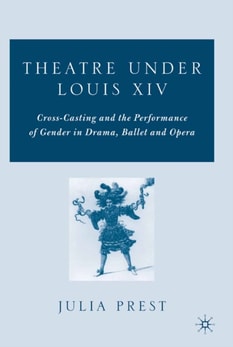
This book explores the fascinating phenomenon of cross-casting and related gender issues in different theatrical genres and different performance contexts during the heyday of French theatre.
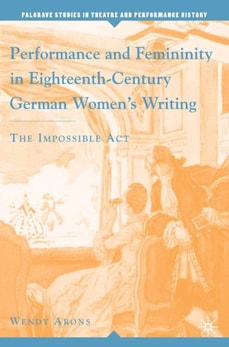
In this book, Wendy Arons examines how women writers used theater and performance to investigate the problem of female subjectivity and to intervene in the dominant discourse about ideal femininity.
Written by both practitioners and scholars, this significant and timely collection explores the sites of contemporary performance, and the notion of place.
In this beautifully illustrated book, one of the foremost Shakespeareans of our time explores the ways in which Shakespeare has been imagined from his time to ours.
This is the first book to explore the broad political significance of Genet's performance practice by focusing on his radical experiments, polemical subjects and formal innovations in theatre, film and dance.
This book investigates how the Children of Paul's (1599-1606) and the Children of the Queen's Revels (1600-13) defined their players as children and, via an analysis of their plays and theatrical practices, it examines early modern theatre as a site in which children have the opportunity to articulate their emerging selfhoods.
The Theatre of War surveys more than two hundred plays about the First World War written, published and/or performed in Britain and Ireland between 1909 and 1998.
Hegemony and Fantasy in Irish Drama, 1899-1949 offers a theoretically innovative reconsideration of drama produced in the Irish Renaissance, as well as an engagement with non-canonical drama in the under-researched period 1926-1949.
This book presents an exploration of the under-explored terrain of visuality, demonstrating the use of new theoretical insights into vision for the analysis of theatre and performance and simultaneously shows theatre and performance to be an excellent 'theoretical object' for exploring the cultural, historical and embodied character of visuality.
Examining the ways in which national theatres have formed and evolved over time, this new collection highlights the difficulties these institutions encounter today, in an environment where nationalism and national identity are increasingly contested by global, transnational and local agendas, and where economic forces create conflicting demands.
The 'in-yer-face' plays of the mid-1990s announced a new generation shaped by Thatcherism and defined by antipathy to social ideals and political involvement.
This title examines the representation of the body in Irish theatre alongside the specific circumstances within which Irish theatre is performed, incorporating issues of gender and embodiment, and the performance of Irishness and tradition.