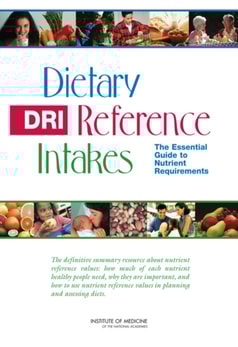
Widely regarded as the classic reference work for the nutrition, dietetic, and allied health professions since its introduction in 1943, Recommended Dietary Allowances has been the accepted source in nutrient allowances for healthy people.
In December 2004, at a press conference called to announce his departure as Secretary of the Department of Health and Human Services (HHS), Tommy Thompson raised both concern and controversy when he remarked that he could not understand why the terrorists had not yet attacked our food supply "e;because it is so easy to do.
Several changes in the United States over the past two decades have implications for diet, nutrition, and food safety, including patterns of food consumption that have produced an increase in overweight and obese Americans and threats to food safety from pathogens and bioterrorism.
This volume is the newest release in the authoritative series of quantitative estimates of nutrient intakes to be used for planning and assessing diets for healthy people.
The Institute of Medicine's (IOM's) Food Forum was established in 1993 to allow science and technology leaders in the food industry, top administrators in the federal government, representatives from consumer interest groups, and academicians to discuss and debate food and food safety issues openly and in a neutral setting.
The environment is increasingly recognized as having a powerful effect on human and ecological health, as well as on specific types of human morbidity, mortality, and disability.
This book evaluates recently published data related to the risk associated with human exposure to radon and radon progeny and assesses whether sufficient and appropriate new information is available to deem necessary a reassessment of health risks due to exposure to radon.
Like many other agencies of the federal government, the Food and Drug Administration (FDA) relies extensively on external advisory committees for independent scientific and technical advice.
The Nutrition Labeling and Education Act of 1990 (NLEA) changed the existing regulatory framework for food labeling requirements that was shared among federal, state, and local levels of government.
This book considers two important international nutrition issues, provides a scientific evaluation, and proposes strategies for intervention at the community level.
In this volume, the National Research Council examines problems arising throughout government-owned, contractor-operated facilities in the United States engaged in activities to build nuclear weapons.
There has been intense interest recently among the public and the media in the possibility that increased intakes of "e;dietary antioxidants"e; may protect against chronic disease.
The physiological or psychological stresses that employees bring to their workplace affect not only their own performance but that of their co-workers and others.
The current situation regarding labeling and defining dietary fiber in the United States and many other countries is arbitrary due to its reliance on analytical methods as opposed to an accurate definition that includes its role in health.
The Food and Nutrition Board of the Institute of Medicine (IOM), part of the National Academies, was asked to evaluate the use of various dietary assessment tools and to make recommendations for the assessment of inadequate or inappropriate dietary patterns.
The Institute of Medicine's (IOM's) Food Forum was established in 1993 to allow science and technology leaders in the food industry, top administrators in several federal government agencies from the United States and Canada, representatives from consumer interest groups, and academicians to openly communicate in a neutral setting.
Results from the National Research Council's (NRC) landmark study Diet and health are readily accessible to nonscientists in this friendly, easy-to-read guide.
Eating enough food to meet nutritional needs and maintain good health and good performance in all aspects of lifeboth at home and on the jobis important for all of us throughout our lives.
Nutrition Labeling offers a thorough examination of current nutrition labeling practices and recommends ways to make food labeling information consistent with recent dietary recommendations from the U.
Houston is struggling with many of the environmental problems that most of the nation's major metropolitan areas are struggling with - transportation, water and air pollution, flooding, and major demographic changes.
The Special Supplemental Nutrition Program for Women, Infants, and Children(the WIC program) has promoted the health of low-income families for more than30 years by providing nutrition education, supplemental food, and other valuableservices.
This series of individually authored chapters examines the nature and extent of scientific advances in the nutrition sciences and describes both future opportunities in the field and barriers to progress.
This lively book examines recent trends in animal product consumption and diet; reviews industry efforts, policies, and programs aimed at improving the nutritional attributes of animal products; and offers suggestions for further research.