This is an expanded second edition of Nicholas Mercuro and Steven Medema's influential book Economics and the Law, whose publication in 1998 marked the most comprehensive overview of the various schools of thought in the burgeoning field of Law and Economics.
Revolutionary ideas on how to use markets to achieve fairness and prosperity for allMany blame today's economic inequality, stagnation, and political instability on the free market.
A new, evolutionary explanation of markets and investor behaviorHalf of all Americans have money in the stock market, yet economists can't agree on whether investors and markets are rational and efficient, as modern financial theory assumes, or irrational and inefficient, as behavioral economists believe.
How modern economics abandoned classical liberalism and lost its wayMilton Friedman once predicted that advances in scientific economics would resolve debates about whether raising the minimum wage is good policy.
A masterful introduction to the key ideas behind the successes-and failures-of free-market economicsSince 1946, Henry Hazlitt's bestselling Economics in One Lesson has popularized the belief that economics can be boiled down to one simple lesson: market prices represent the true cost of everything.
How modern economics abandoned classical liberalism and lost its wayMilton Friedman once predicted that advances in scientific economics would resolve debates about whether raising the minimum wage is good policy.
A compelling book that examines Gordon Brown's rise to power, his years as Chancellor, and his dramatic decision to give the Bank of England independence "e;An essential read for anyone who wants to properly understand political and economic policy developments over the past 15 years and enjoy some good insights about the future.
A groundbreaking study that shows how countries can create innovative, production-based economies for the twenty-first centuryAchieving economic growth is one of today's key challenges.
How the kibbutz movement thrived despite its inherent economic contradictions and why it eventually declinedThe kibbutz is a social experiment in collective living that challenges traditional economic theory.
An in-depth look at how to account for the human complexities at the heart of today's financial systemOur economy may have recovered from the Great Recession-but not our economics.
A groundbreaking new synthesis and theory of social institutionsUnderstanding Institutions proposes a new unified theory of social institutions that combines the best insights of philosophers and social scientists who have written on this topic.
A reevaluation of what money is-and what it might beQuestions about the nature of money have gained a new urgency in the aftermath of the global financial crisis.
From Nobel Prize-winning economist Michael Kremer and fellow leading development economist Rachel Glennerster, an innovative solution for providing vaccines in poor countriesMillions of people in the third world die from diseases that are rare in the first world-diseases like malaria, tuberculosis, and schistosomiasis.
A comprehensive introduction to the statistical and econometric methods for analyzing high-frequency financial dataHigh-frequency trading is an algorithm-based computerized trading practice that allows firms to trade stocks in milliseconds.
How ideas in complexity can be used to develop more effective public policyComplexity science-made possible by modern analytical and computational advances-is changing the way we think about social systems and social theory.
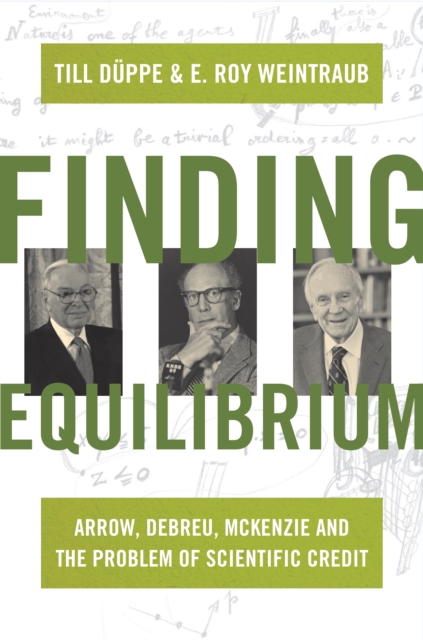
The remarkable story and personalities behind one of the most important theories in modern economicsFinding Equilibrium explores the post-World War II transformation of economics by constructing a history of the proof of its central dogma-that a competitive market economy may possess a set of equilibrium prices.
A Nobel Prizewinning economist makes a new argument about the real roots of prosperityand why they are under threat todayIn this book, Nobel Prize-winning economist Edmund Phelps draws on a lifetime of thinking to make a sweeping new argument about what makes nations prosperand why the sources of that prosperity are under threat today.
A fully expanded edition of the Nobel Prize-winning economist's classic bookThis collection of essays uses the lens of rational expectations theory to examine how governments anticipate and plan for inflation, and provides insight into the pioneering research for which Thomas Sargent was awarded the 2011 Nobel Prize in economics.
Understanding the dynamic evolution of the yield curve is critical to many financial tasks, including pricing financial assets and their derivatives, managing financial risk, allocating portfolios, structuring fiscal debt, conducting monetary policy, and valuing capital goods.
Ariel Rubinstein's well-known lecture notes on microeconomics-now fully revised and expandedThis book presents Ariel Rubinstein's lecture notes for the first part of his well-known graduate course in microeconomics.
Research on the spatial aspects of economic activity has flourished over the past decade due to the emergence of new theory, new data, and an intense interest on the part of policymakers, especially in Europe but increasingly in North America and elsewhere as well.
Optimal tax design attempts to resolve a well-known trade-off: namely, that high taxes are bad insofar as they discourage people from working, but good to the degree that, by redistributing wealth, they help insure people against productivity shocks.
A sweeping look at the evolution of commercial banks over the past two centuriesCommercial banks are among the oldest and most familiar financial institutions.
An authoritative look at the microeconomics of entrepreneurshipEntrepreneurs are widely recognized for the vital contributions they make to economic growth and general welfare, yet until fairly recently entrepreneurship was not considered worthy of serious economic study.