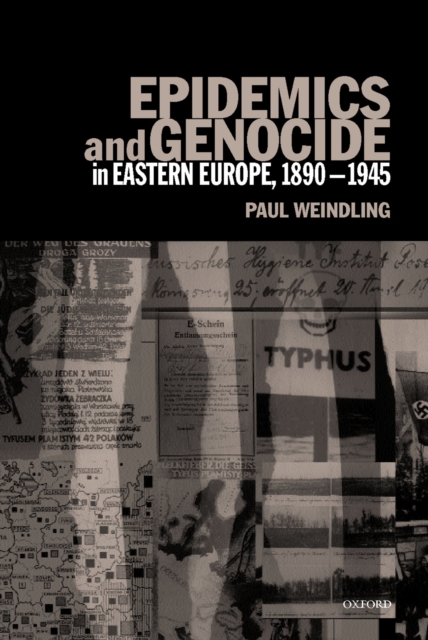
The Silesian town of Bedzin lies a mere twenty-five miles from Auschwitz; through the linked ghettos of Bedzin and its neighbouring town, some 85,000 Jews passed on their way to slave labour or the gas chambers.
The Silesian town of Bedzin lies a mere twenty-five miles from Auschwitz; through the linked ghettos of Bedzin and its neighbouring town, some 85,000 Jews passed on their way to slave labour or the gas chambers.
James Hinton uses diaries kept by nine 'ordinary' people in wartime Britain to re-evaluate the social history of the Second World War, and to reflect on the twentieth-century making of the modern self.
German policy in occupied France during the Second World War was in many ways a story of bitter internal conflict between the various German agencies in charge of the occupation.
The Second World War affected the lives and shaped the experience of millions of individuals in Germany - soldiers at the front, women, children and the elderly sheltering in cellars, slave labourers toiling in factories, and concentration-camp prisoners and POWs clearing rubble in the Reich's devastated cities.
This book provides a cultural history of Spanish politics from the civil war of 1833 to the Spanish adoption of the Euro in 2002, a period dominated for the most part by violent military interventions in the political process, a succession of weak, unstable, but repressive governments, and the ever-present threat of rebellion from below, and culminating in the victory and repressive dictatorship of General Franco.
The US decision to drop an atomic bomb on the Japanese city of Hiroshima on 6 August 1945 remains one of the most controversial events of the twentieth century.
Barbed Wire Diplomacy examines how the United Kingdom government went about protecting the interests, lives and well-being of its prisoners of war (POWs) in Nazi Germany between 1939 and 1945.
James Hinton uses diaries kept by nine 'ordinary' people in wartime Britain to re-evaluate the social history of the Second World War, and to reflect on the twentieth-century making of the modern self.
German policy in occupied France during the Second World War was in many ways a story of bitter internal conflict between the various German agencies in charge of the occupation.
Culture in Camouflage aims to remap the history of British war culture by insisting on the centrality and importance of the literature of the Second World War.
The Second World War affected the lives and shaped the experience of millions of individuals in Germany - soldiers at the front, women, children and the elderly sheltering in cellars, slave labourers toiling in factories, and concentration-camp prisoners and POWs clearing rubble in the Reich's devastated cities.
Between 1939 and 1945, the British public was spellbound by the martial endeavours and dashing style of the young men of the RAF, especially those with silvery fabric wings sewn above the breast pocket of their glamorous slate-blue uniform.
The history of National Socialism as movement and regime remains one of the most compelling and intensively studied aspects of twentieth-century history, and one whose significance extends far beyond Germany or even Europe alone.
The trial of major Nazi war criminals in Nuremberg was a landmark event in the development of modern international law, and continues to be highly influential in our understanding of international criminal law and post-conflict justice.
When the Allies decided to try German war criminals at the end of World War II they were attempting not only to punish the guilty but also to create a record of what had happened in Europe.
A concise introduction to European history between 1914 and 1945, this series of succinct interpretations written by leading scholars offers a new introduction to the period.
Based on extensive archival research this book situates the Irish civil war in the general process of decolonization in the twentieth century, and explains why divisions over the Anglo-Irish Treaty of 1921 proved so formative in the development of the Irish state.
Six decades after the defeat of National Socialism, commemoration and mourning are ongoing, open-ended projects in Germany and Austria, and continue to generate a steady stream of literature and film about the Nazi past that, while comparatively modest in volume, is often disproportionately influential in public debates.