This book explores the story of the Israelites' worship of the Golden Calf in its Jewish, Christian, and Muslim contexts, from ancient Israel to the emergence of Islam.
This book explores the story of the Israelites' worship of the Golden Calf in its Jewish, Christian, and Muslim contexts, from ancient Israel to the emergence of Islam.
This book develops a theory of enriched meanings for natural language interpretation that uses the concept of monads and related ideas from category theory, a branch of mathematics that has been influential in theoretical computer science and elsewhere.
This volume brings together the latest research from leading scholars on the mental lexicon - the representation of language in the mind/brain at the level of individual words and meaningful sub-word units.
This volume brings together the latest research from leading scholars on the mental lexicon - the representation of language in the mind/brain at the level of individual words and meaningful sub-word units.
This volume explores the question of why languages - even those spoken in the same geographical area by people who share similar social structures, occupations, and religious beliefs - differ in the meanings expressed by their grammatical systems.
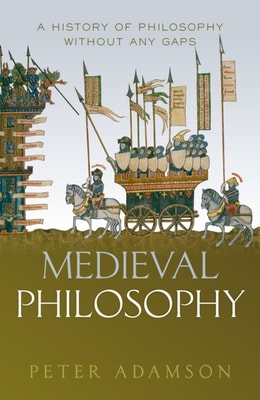
Peter Adamson presents a lively introduction to six hundred years of European philosophy, from the beginning of the ninth century to the end of the fourteenth century.
Peter Adamson presents a lively introduction to six hundred years of European philosophy, from the beginning of the ninth century to the end of the fourteenth century.
Superficially, Wittgenstein and Heidegger seem worlds apart: they worked in different philosophical traditions, seemed mostly ignorant of one another's work, and Wittgenstein's terse aphorisms in plain language could not be farther stylistically from Heidegger's difficult prose.
Superficially, Wittgenstein and Heidegger seem worlds apart: they worked in different philosophical traditions, seemed mostly ignorant of one another's work, and Wittgenstein's terse aphorisms in plain language could not be farther stylistically from Heidegger's difficult prose.
In this volume, international experts in negation provide a comprehensive overview of cross-linguistic and philosophical research in the field, as well as accounts of more recent results from experimental linguistics, psycholinguistics, and neuroscience.
In this volume, international experts in negation provide a comprehensive overview of cross-linguistic and philosophical research in the field, as well as accounts of more recent results from experimental linguistics, psycholinguistics, and neuroscience.
In Wittgenstein on Logic as the Method of Philosophy, Oskari Kuusela examines Wittgenstein's early and late philosophies of logic, situating their philosophical significance in early and middle analytic philosophy with particular reference to Frege, Russell, Carnap, and Strawson.
In Wittgenstein on Logic as the Method of Philosophy, Oskari Kuusela examines Wittgenstein's early and late philosophies of logic, situating their philosophical significance in early and middle analytic philosophy with particular reference to Frege, Russell, Carnap, and Strawson.
By taking a distinctively institutional approach, Catharine Abell provides a unified solution to a wide range of philosophical problems raised by fiction.