Mark Wilson presents a highly original and broad-ranging investigation of the way we get to grips with the world conceptually, and the way that philosophical problems commonly arise from this.
A collection of the best work by philosophers, cognitive scientists, and linguists on grammatical gradience and linguistic uncertainty - such as when warm becomes hot, how many grains make a heap, and when a puddle becomes a pond - introduced, explained, contextualized, and indexed.
The Nature of Normativity presents a complete theory about the nature of normative thought -- that is, the sort of thought that is concerned with what ought to be the case, or what we ought to do or think.
Knowledge by Agreement defends the ideas that knowledge is a social status (like money, or marriage), and that knowledge is primarily the possession of groups rather than individuals.
Brad Inwood presents a selection of his most influential essays on the philosophy of Seneca, the Roman Stoic thinker, statesman, and tragedian of the first century AD.
Paradox and Platitude in Wittgenstein's Philosophy is a concise and readable study of five intertwined themes at the heart of Wittgenstein's thought, written by one of his most eminent interpreters.
Discussion of Wittgenstein's Tractatus is currently dominated by two opposing interpretations of the work: a metaphysical or realist reading and the 'resolute' reading of Diamond and Conant.
In Truly Understood, Christopher Peacocke argues that truth and reference have a much deeper role in the explanation of meaning and understanding than has hitherto been appreciated.
Saving Truth from Paradox is an ambitious investigation into paradoxes of truth and related issues, with occasional forays into notions such as vagueness, the nature of validity, and the Godel incompleteness theorems.
Artworld Metaphysics turns a critical eye upon aspects of the artworld, and articulates some of the problems, principles, and norms implicit in the actual practices of artistic creation, interpretation, evaluation, and commodification.
Philosophers on Music: Experience, Meaning, and Work presents significant new contributions to central issues in the philosophy of music, written by leading philosophers working in the analytic tradition.
This book examines the hypothesis of "e;direct compositionality"e;, which requires that semantic interpretation proceed in tandem with syntactic combination.
This book gives a clear and readable overview of the philosophical work of Jurgen Habermas, the most influential German philosopher alive today, who has commented widely on subjects such as Marxism, the importance and effectiveness of communication, the reunification of Germany, and the European Union.
This is a self-contained introduction to the Minimalist Program for linguistic theory, the boldest and most radical version of Noam Chomsky's naturalistic approach to language.
Between the beginnings of European lexicography and 1700, many glossaries and dictionaries were arranged not according to the alphabet, but in a topical order which followed the influential paradigms of theology, philosophy, and natural history at that time.
The Cambridge philosopher Frank Ramsey (1903-1930) died tragically young, but had already established himself as one of the most brilliant minds of the twentieth century.
Constructions of Intersubjectivity shows that the meaning of grammatical constructions often has more to do with the human cognitive capacity for taking other peoples' points of view than with describing the world.
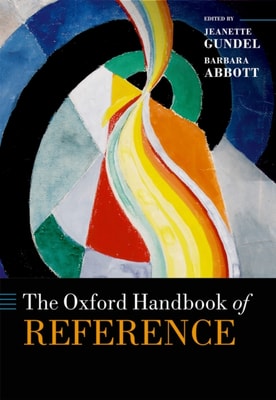
This handbook presents an overview of the phenomenon of reference - the ability to refer to and pick out entities - which is an essential part of human language and cognition.
This handbook presents an overview of the phenomenon of reference - the ability to refer to and pick out entities - which is an essential part of human language and cognition.
Knowledge and Presuppositions develops a novel account of epistemic contextualism based on the idea that pragmatic presuppositions play a central role in the semantics of knowledge attributions.
This book examines the question of whether languages can differ in grammatical complexity and, if so, how relative complexity differences might be measured.