Intended for advanced students of physics, chemistry, and related disciplines, this text treats the quantum theory of atoms and ions within the framework of self-consistent fields.
Introduction to Superconductivity differs from the first edition chiefly in Chapter 11, which has been almost completely rewritten to give a more physically-based picture of the effects arising from the long-range coherence of the electron-waves in superconductors and the operation of quantum interference devices.
The Beta Equilibrium, Stability, and Transport Codes: Application to the Design of Stellarators covers the application of the BETA computer codes to the Heliotron E plasma confinement experiment.
The Method of Second Quantization deals with the method of second quantization and its use to solve problems of quantum mechanics involving an indefinite number of particles, mainly in field theory and quantum statistics.
Ultraviolet and Visible Absorption Spectra, Index for 1930-1954 is a reference volume listing of ultraviolet and visible absorption spectra in the literature.
Optics of Charged Particles describes how charged particles move in the main and fringing fields of magnetic or electrostatic dipoles, quadrupoles, and hexapoles using the same type of formulation and consistent nomenclature throughout.
Physical Acoustics: Principles and Methods, Volume IX includes four chapters that are device-oriented and devoted to understanding electron drag stresses on dislocations and difference in flow stress between the normal and superconducting states of Type I and Type II superconductors.
Muon Physics, Volume III: Chemistry and Solids explores muon chemistry and muons in matter, with emphasis on positive muons and muonium in matter; mesomolecular processes induced by muons; and depolarization of negative muons.
Lectures on Field Theory and the Many-Body Problem is a 23-chapter lecture series on the developments in the understanding of the structure and axiomatics of Field Theory, which has proved to be a most useful tool in the study of many-body problems.
Optical Radiation Measurements, Volume 1: Radiometry is an introduction to the measurement of optical radiant energy, with emphasis on the principles and generally applicable methods of radiometry.
Inelastic Ion-Surface Collisions is a collection of papers presented at the 1976 International Workshop on Inelastic-Ion-Surface Collisions, held at Bell Laboratories, Murray Hill, New Jersey.
Applications of Liquid Scintillation Counting deals with liquid scintillation counting and its applications in fields such as the biosciences, medicine, environmental and space sciences, chemistry, and physics.
Physical Acoustics: Principles and Methods, Volume IV, Part A: Applications to Quantum and Solid State Physics provides an introduction for the various applications of quantum mechanics to acoustics by describing several processes for which such considerations are essential.
Ion Implantation: Science and Technology serves as both an introduction to and tutorial on the science, techniques, and machines involved in ion implantation.
Hadrons and Their Interactions: Current and Field Algebra, Soft Pions, Supermultiplets, and Related Topics focuses on formulas, principles, and interactions involved in the study of physics.
Theory of Orbits: The Restricted Problem of Three Bodies is a 10-chapter text that covers the significance of the restricted problem of three bodies in analytical dynamics, celestial mechanics, and space dynamics.
Neutron Cross Sections, Volume 1: Neutron Resonance Parameters and Thermal Cross Sections, Part A represents the fourth edition of what was previously known as BNL-325, Neutron Cross Sections, Volume 1.
The Foundations of Quantum Theory discusses the correspondence between the classical and quantum theories through the Poisson bracket-commutator analogy.
In a clearly written and systematic presentation, Path Integrals and Quantum Processes covers all concepts necessary to understand the path integral approach to calculating transition elements, partition functions, and source functionals.
The Proceedings of First International Conference on Opto-Electronics and Applied Optics 2014, IEM OPTRONIX 2014 presents the research contributions presented in the conference by researchers from both India and abroad.
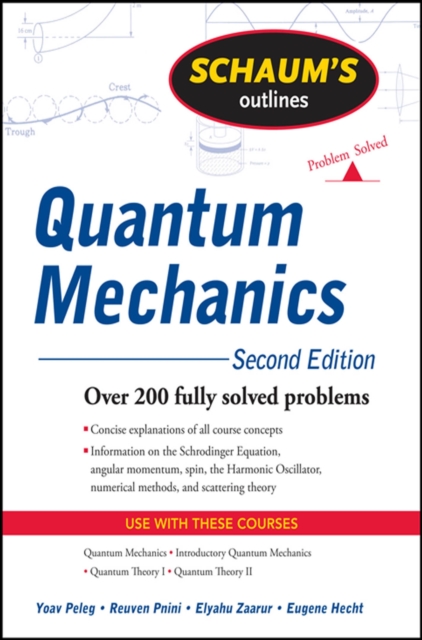
For a quick nuts-and-bolts overview of quantum mechanics, there's no book that does it betterPared-down, simplified, and tightly focused, Schaum s Easy Outline of Quantum Mechanics is perfect for anyone turned off by dense text.
Provides evidence that human consciousness can never be reproduced and exposes the perils of artificial intelligence Explains how consciousness transcends the brain and body through quantum theory and accounts of consciousness in the clinically dead Shares scientific evidence of how the image on the Shroud of Turin was produced and connects these findings to evidence concerning near-death experiences Reveals how consciousness cannot be reproduced by a machine and how attempts to do so threaten what makes us human Stephen Hawking once said that the unanticipated consequences of artificial intelligence will be the greatest threat to humanitys survival.
A study of the new scientific understanding of consciousness and the mind as a fifth dimension of reality • Introduces the existence of a fifth dimension--one of mind--an inner- or hyperspace where time is transcended • Shows how the barrier of the speed of light is actually a gateway demarking the fifth dimension Since the introduction of Descartes’ dualism in the seventeenth century, the mind and the physical world have been viewed as disconnected entities.
How ancient Egyptians understood quantum theory Investigates the history of how modern religion and the Age of Science were inspired by the sacred science of the ancients Examines how quantum theory explains that the cosmos arises from consciousness Reveals the unanimity between Schwaller de Lubiczs sacred science and the science of a cosmos governed by quantum mechanics Since the dawn of the Age of Science humankind has been engaged in a methodical quest to understand the cosmos.
On July 4, 2012, physicists at the Large Hadron Collider in Geneva madehistory when they discovered an entirely new type of subatomic particle that many scientists believe is the Higgs boson.
Statistical Thermodynamics of Semiconductor Alloys is the consideration of thermodynamic properties and characteristics of crystalline semiconductor alloys by the methods of statistical thermodynamics.
Fundamental does for physics what Tim's first book, Elemental, does for chemistry: it demystifies the topic in his trademark humorous, engaging style, including the most recent developments in the field.