This book analyzes the tension between the host state's commitment to provide regulatory stability for foreign investors - which is a tool for attracting FDI and generating economic growth - and its evolving non-economic commitments towards its citizens with regard to environmental protection and social welfare.
This book highlights the growing number of 'post-bureaucratic' firms that are abandoning hierarchical organizational forms in favor of self-managing teams.
This book compares the unique features of workplace mediation to other contexts of mediation, as well as the specific competences each situation requires of the mediator.
This book comprises the latest achievements in research and development in educational robotics presented at the 12th International Conference on Robotics in Education (RiE), which was carried out as a purely virtual conference from April 28 to 30, 2021.
Extensive previous research has investigated environmental conflict management issues in networked settings and the design of policy networks, but the emergence and evolution of self-organizing policy networks are still not fully understood.
This book brings together the expertise of two authors involved in initiating the development of Online Family Dispute Resolution (OFDR), while also examining the unique Australian system.
The second volume of the Balkan Yearbook of European and International Law (BYEIL) focuses on the United Nations Convention on Contracts for the International Sale of Goods (CISG), which was signed 40 years ago.
This volume focuses on new ways of working, and explores implications of these new practices with a particular emphasis on the place occupied by technology, materiality and bodies within contemporary working configurations.
This book provides senior managers, project- and program managers, team coaches and team leaders with thought and management tools for potentiating self-organization and creating collaborative intelligence in teams.
Shedding new light on the human side of big data through the lenses of emotional and social intelligence competencies, this book advances the understanding of the requirements of the different professions that deal with big data.
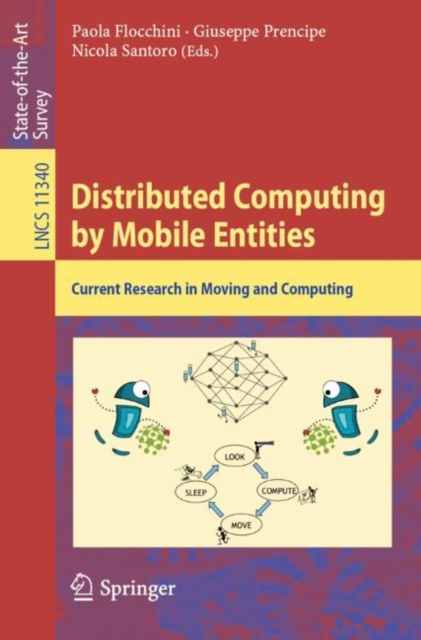
Distributed Computing by Mobile Entities is concerned with the study of the computational and complexity issues arising in systems of decentralized computational entities operating in a spatial universe Encompassing and modeling a large variety of application environments and systems, from robotic swarms to networks of mobile sensors, from software mobile agents in communication networks to crawlers and viruses on the web, the theoretical research in this area intersects distributed computing with the fields of computational geometry (especially for continuous spaces), control theory, graph theory and combinatorics (especially for discrete spaces).
The must-read summary of Dave Anderson's book: "e;If You Don't Make Waves You'll Drown: 10 Hard-Charging Strategies for Leading in Politically Correct Times"e;.
The must-read summary of David Magee's book: "e;How Toyota Became #1: Leadership Lessons from the World's Greatest Car Company"e; This complete summary of the ideas from David Magee's book "e;How Toyota Became #1"e; shows that the criteria and qualities leading to Toyota's rise to the top had little to do with sales results or profit margins.
The must-read summary of Jack Stack and Bo Burlingham's book: "e;A Stake in the Outcome: Building a Culture of Ownership for the Long-Term Success of Your Business"e;.
The must-read summary of Adrian Gostick and Chester Elton's book: "e;The Carrot Principle: How the Best Managers Use Recognition to Engage Their People, Retain Talent, and Accelerate Performance"e;.