The potential consequences of a predator-prey predators tend to do that increase or maximize prey interaction are probably more serious, especially capture and that prey tend to do to avoid being for the prey, than are the consequences of most captured?
The The following following set set of of papers papers is is mainly mainly a a representa- representa- have have been been overdue overdue since since the the pioneering pioneering work work of of tive tive sample sample from from 19 19 presentations presentations at at a a special special sym- sym- Howard Howard Winn Winn in in the the late late 1950's.
The "e;International Symposium on Scleroderris Canker of Conifers"e; held June 21-24, 1983 in Syracuse, New York was the result of mutual interest expressed by the USDA Forest Service, the Canadian Forestry Service, and the State Uni- versity of New York College of Environmental Science and Forestry (SUNY ESF).
The opportunity to explore a developing new technology in a single biological system, chitin, from the molecular basis and with the inter- relationship of the utilization of benzoylphenyl ureas in effective pest agroecosystem management strategies, represents a new evolution for integration of knowledge in this highly complex area.
This book is dedicated to the scientists whose professional devotion and accomplish- ments in research on scale insects of the area made the compilation of this book possible.
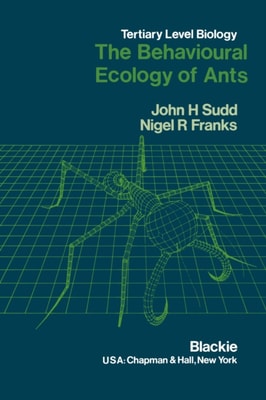
This book is concerned with two problems: how eusociality, in which one individual forgoes reproduction to enhance the reproduction of a nestmate, could evolve under natural selection, and why it is found only in some insects-termites, ants and some bees and wasps.
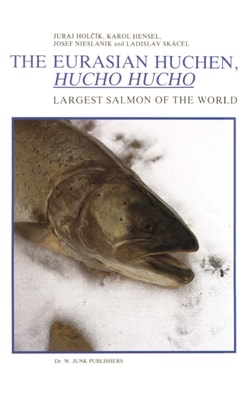
The need to gather available data on the Eurasien huchen - an important salmonid species - has been forced by a plain and, unfortunately, common fact of our times: the numbers and distribution of this biggest of salmonids have begun to decline and its range has begun to shrink.
The papers included in this volume were amongst day running of the conference, and Ms Julia those presented at the 5th International Epheme- Reed, Ms Kim James, Ms Anne Devereaux, roptera Conference and the 9th International Mr Peter Green, Ms Catriona Smith who assist- Plecoptera Conference at the Marysville Hotel, ed them, Mr David Ginn and all the staff at the Marysville Australia from the 18th to the 24th of Marysville Hotel also deserve special thanks for February 1987.
The preparation of a volume of worldwide research contributions can be a time- consuming task which is frequently more difficult than many other types of book.
Recent years have seen a growing interest in and activity at the interface between physics and biology, with the realization that both subjects have a great deal to learn from and to teach to one another.
The 9th International Symposium on Insect-Plant Relationships (SIP-9) was once more, following the tradition established in 1958, a forum for investigators in both basic and applied entomology interested in the important and fascinating field of interactions between plants and insects.
Leading researchers in the area of the origin and evolution of life in the universe contributed to Chemical Evolution: Physics of the Origin and Evolution of Life.
This volume provides a selection of the most significant papers presented at the 15th International Seaweed Symposium in Valdivia, Chile, in January 1995.
The recent development of ideas on biodiversity conservation was already being considered almost three-quarters of a century ago for crop plants and the wild species related to them, by the Russian geneticist N.
The seashore has long been the subject of fascination and study - the Ancient Greek scholar Aristotle made observations and wrote about Mediterranean sea urchins.
Entomological research benefits from a great diversity of technical approaches - from the molecular to the descriptive - and these are applied to an even greater diversity of insect species.
Over the past 30 years or so, research effort in behaviour and ecology has progressed from simple documentation of the habits or habitats of differ- ent species to asking more searching questions about the adaptiveness of the patterns of behaviour observed; moved from documenting simply what occurs, to trying to understand why.
The four-day international Conference on Pest Management in Rice, which is the subject of this volume, was the third in an ongoing series of meetings on tropical crops organised by the Pesticides Group of the Society of Chemical Industry, London.
Biogeography may be defined simply as the study of the geographical distribution of organisms, but this simple defmition hides the great complexity of the subject.
The rise of the neutral theory of molecular evolution seems to have aroused a renewed interest in mathematical population genetics among biologists, who are primarily experimenters rather than theoreticians.
The effects of isolation, area size, and habitat quality on the survival of animal and plant populations in the cultural landscape are central aspects of a research project started in Germany in 1993 (,Forschungsverbund, Isolation, FHichengroBe und BiotopquaIiHit', abbreviated to 'FIFB').
Mark Chase There are many literature resources available to molecular biologists wishing to assess genetic variation, but the myriad of techniques and approaches potentially available to the plant breeder and the evolutionary biologist is truly bewildering, and most have never been evaluated side-by-side on the same sets of samples.
Researchers in the field of ecological genomics aim to determine how a genome or a population of genomes interacts with its environment across ecological and evolutionary timescales.
Three major aspects that distinguish this book are that (1) it contains the most detailed analysis of the sexual reproduction (oogenesis, fertilization and embryonic incubation) in a particular phylum of the aquatic invertebrates (Bryozoa) ever made; this analysis is based on an exhaustive review of the literature on that topic published over the last 260 years, as well as extensive original histological, anatomical and morphological data obtained during studies of both extant and extinct species; (2) this broad analysis has made it possible to reconstruct the major patterns, stages and trends in the evolution of sexual reproduction in various bryozoan clades, showing numerous examples of parallelisms during transitions from broadcasting to embryonic incubation, from planktotrophic to non-feeding larvae and from lecithotrophy to placentation; corresponding shifts in oogenesis, fertilization and embryonic development are discussed in detail; and (3) the key evolutionary novelties acquired by Bryozoa are compared with similar innovations that have evolved in other groups of marine invertebrates, showing the general trends in the evolution of their sexual reproduction.