It is surprising, and even disappointing, that there have been very few meetings and published volumes resulting from these meetings that focus attention upon all of the groups of DNA tumor viruses.
Most often when the subject of antimicrobial resistance is discussed, the organizational emphasis is on individual antimicrobial agents or groups of agents.
Many bacteria, such as certain Neisseria and Haemophilus or Escherichia coli, are able to withstand the bactericidal activity of complement and phagocytes.
When comparing the number of contributions for the proceedings of the third symposium on The Influence of Antibiotics on the Host-Parasite Relationship with those of its two predecessors, one becomes aware of the progress that has been made in this field.
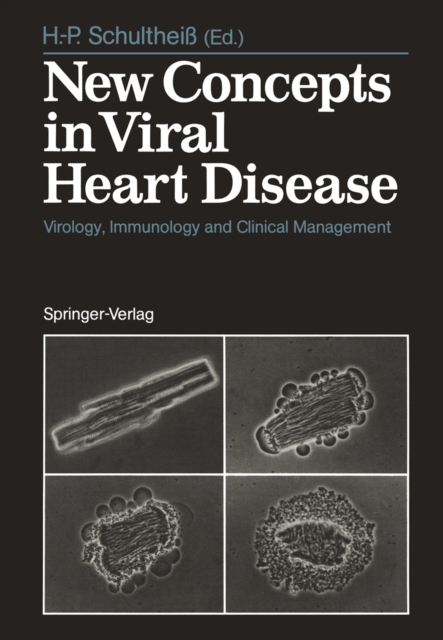
The recent rapid advances in our knowledge of immunological and virological mechanisms involved in the pathogenesis of viral heart disease makes it difficult for everybody working in this field to keep up with the latest developments.
Elucidation of the mechanisms of pathogenesis underlying the diseases caused by viruses and bacteria has fascinated scientists for many years in two ways.
The fact that none of the known DNA polymerases is able to initiate DNA chains but only to elongate from a free 3' -OH group raises the problem of how replication is initiated, both at the replication origin and on Okazaki frag- ments.
Medical Parasitology is primarily intended to be an illustrated textbook which provides a review ofthe most important species ofparasite which occur in man; their areas ofdistribution, morphology and development, the typical disease symptoms resulting from infection, epidemiology and also methods of detection and indications for therapy.
In diesem Buch werden die verschiedenen Viren (Hepatitis-B-Virus, Hepatitis-Non-A-Non-B-Viren, Cytomegalievirus, Epstein-Barr-Virus, Papovaviren, HIV), die Blut, Plasma und Plasmapräparate kontaminieren können, besprochen.
This volume deals specifically with those antituberculosis drugs which passed the preclinical phase and have been or are used in the treatment of tuberculosis and other mycobacterial diseases (except leprosy) in at least some parts of the world.
Die durch das menschliche Immundefektvirus HIV verursachte erworbene Immunschwäche AIDS gewinnt aufgrund steigender Erkrankungszahlen zunehmend an praktisch-ärztlicher Bedeutung.
Crystalline surface layers (S-layers) represent an almost universal feature of archaebacterial cell envelopes and can be found in gram-positive and gram-negative eubacterial species from nearly all phylogenetic branches.
Dieses Buch gibt dem Labor- und Verwaltungsleiter im Bereich der Labororganisation für die Personalbedarfsberechnung, die Kostenstellenrechnung und Kosten-Nutzen-Beurteilung und die Führung einer Laborstatistik wertvolle Hilfestellung und Anregung.
The present volume of "e;Current Topics in Microbiology and Immunology"e; is a series of papers on subjects that are relevant to the growing use of 'wild mice' in immunological, microbiological and genetical research.
The last decade has witnessed rapid progress in our under- standing of the mechanisms of protein export and secretion in both prokaryotic and eukaryotic cells.
On the occasion of a research visit to Thailand in my capacity as a member of the governing board of the South Asia Institute of the University of Heidelberg, I saw for the first time the severe clinical picture of dengue with haemorrhagic symptoms among Thai children.
The contributions to this book derived from the Seventh Munich Symposium on Microbiology on June 3 and 4, 1981, which was organized by the WHO Centre for Collection and Evaluation of Data on Comparative Virology at the Institute of Medical Microbiology, Infectious and Epidemic Diseases, University of Munich, Federal Repub- lic of Germany.
When discussing the drug, the bug, and the host in the past, emphasis was laid mainly upon the interaction between antibiotics and bacteria or the reaction of the host to the invading organism.
All but one* of the following articles represent comprehensive reports on a workshop held between 7 and 9 May 1981 at the Institute of Virology and Immunobiology, University of Wfuzburg, Federal Republic of Germany.