Debates about methods of supporting language development and academic skills of deaf or hard-of-hearing children have waxed and waned for more than 100 years: Will using sign language interfere with learning to use spoken language or does it offer optimal access to communication for deaf children?
Teaching Deaf Learners: Psychological and Developmental Foundations explores how deaf students (children and adolescents) learn and the conditions that support their reaching their full cognitive potential -- or not.
Written by an expert in the field who is both a teacher and a teacher-educator, this book is an in-depth and practical resource for educators and parents who wish to introduce music to children with hearing loss.
In Bilingualism and Bilingual Deaf Education, volume editors Marc Marschark, Gladys Tang, and Harry Knoors bring together diverse issues and evidence in two related domains: bilingualism among deaf learners - in sign language and the written/spoken vernacular - and bilingual deaf education.
In Bilingualism and Bilingual Deaf Education, volume editors Marc Marschark, Gladys Tang, and Harry Knoors bring together diverse issues and evidence in two related domains: bilingualism among deaf learners - in sign language and the written/spoken vernacular - and bilingual deaf education.
Most students who are deaf or hard of hearing (DHH) struggle with acquiring literacy skills, some as a direct result of their hearing loss, some because they are receiving insufficient modifications to access the general education curriculum, and some because they have additional learning challenges necessitating significant program modifications.
Throughout history there have been efforts to help deaf children develop spoken language through which they could have full access to the hearing world.
Over the past decade there has been a significant increase in interest from educators and the general public about deafness, special education, and the development of children with special needs.
This volume is the long-awaited revision of the only textbook on primary language instruction written with classroom teachers of deaf and hard-of-hearing children (TODs) in mind.
This volume is the long-awaited revision of the only textbook on primary language instruction written with classroom teachers of deaf and hard-of-hearing children (TODs) in mind.
The relationship of language to cognition, especially in development, is an issue that has occupied philosophers, psychologists, and linguists for centuries.
Mi Reina es un sueño que se fue gestando mientras criaba a un angel màs que especial, llamada Verònica, que padece Parálisis Cerebral desde su nacimiento y hoy tiene ya 33 años de edad.
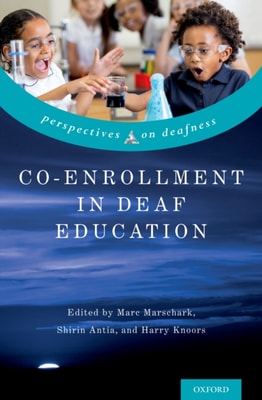
Co-enrollment programming in deaf education refers to classrooms in which a critical mass of deaf and hard-of-hearing (DHH) students is included in a classroom containing mainly hearing students and which is taught by both a mainstream teacher and a teacher of the deaf.
Co-enrollment programming in deaf education refers to classrooms in which a critical mass of deaf and hard-of-hearing (DHH) students is included in a classroom containing mainly hearing students and which is taught by both a mainstream teacher and a teacher of the deaf.
This volume presents the latest research from internationally recognized researchers and practitioners on language, literacy and numeracy, cognition, and social and emotional development of deaf learners.
This volume presents the latest research from internationally recognized researchers and practitioners on language, literacy and numeracy, cognition, and social and emotional development of deaf learners.
If teachers want to educate deaf learners effectively, they have to apply evidence-informed methods and didactics with the needs of individual deaf students in mind.
If teachers want to educate deaf learners effectively, they have to apply evidence-informed methods and didactics with the needs of individual deaf students in mind.
Debates about methods of supporting language development and academic skills of deaf or hard-of-hearing children have waxed and waned for more than 100 years: Will using sign language interfere with learning to use spoken language or does it offer optimal access to communication for deaf children?
Languages and Languaging in Deaf Education offers a profound vision for deaf education and studies, as author Ruth Swanwick offers bold contributions towards a new pedagogical framework.
Languages and Languaging in Deaf Education offers a profound vision for deaf education and studies, as author Ruth Swanwick offers bold contributions towards a new pedagogical framework.
Throughout history there have been efforts to help deaf children develop spoken language through which they could have full access to the hearing world.
Over the past decade there has been a significant increase in interest from educators and the general public about deafness, special education, and the development of children with special needs.
Language development, and the challenges it can present for individuals who are deaf or hard-of-hearing, have long been a focus of research, theory, and practice in D/deaf studies and deaf education.
Language development, and the challenges it can present for individuals who are deaf or hard-of-hearing, have long been a focus of research, theory, and practice in D/deaf studies and deaf education.
Teaching Deaf Learners: Psychological and Developmental Foundations explores how deaf students (children and adolescents) learn and the conditions that support their reaching their full cognitive potential -- or not.
In recent years, the intersection of cognitive psychology, developmental psychology, and neuroscience with regard to deaf individuals has received increasing attention from a variety of academic and educational audiences.
In recent years, the intersection of cognitive psychology, developmental psychology, and neuroscience with regard to deaf individuals has received increasing attention from a variety of academic and educational audiences.
Beginnend in den frühen 2000er Jahren ist Inklusion in den letzten Jahrzehnten immer stärker in den Fokus (praktischer, theoretischer wie empirischer) Bildungsbemühungen gerückt.
International Review of Research in Developmental Disabilities is an ongoing scholarly look at research into the causes, effects, classification systems, and syndromes of developmental disabilities.
Based on the analysis of eighteen authentic and inspiring personal stories, this book illustrates how people with severe childhood disabilities achieved extraordinary career success.
This book offers opportunities for better understanding teachers' unique challenges when planning teaching sessions for learners with special needs, based on the transdisciplinary approach.
Special education across education programs nationwide is an incredibly high-need teacher shortage area, and mentoring can make a profound difference in teacher retention and effectiveness.